
How to Make ChatGPT Recommend Your Business in 2026
Want to grow your leads from AI search? Master Generative Engine Optimization (GEO) and discover the top ways to make ChatGPT recommend your business.
Generative Engine Optimization (GEO) — also called AI search optimization, LLM SEO, or Answer Engine Optimization (AEO) — is the practice of structuring your website and online presence so that AI tools like ChatGPT, Perplexity, Gemini, and Google AI Overviews understand your business well enough to mention or recommend it in their answers.
This matters because consumer behavior has already shifted dramatically. ChatGPT passed roughly 900 million weekly active users by February 2026, more than double the year before, and drives about 87% of all AI referral traffic to websites. Around 77% of consumers say they used AI to help with a purchase decision in the past six months, and one in four say ChatGPT’s product recommendations beat Google’s. AI-sourced website traffic grew over 500% year-on-year in 2025, and industry forecasts project AI search visitors will overtake traditional organic visitors by 2028.
Here’s what that looks like in practice: a lead comes through a company’s contact form and answers “how did you find us” with four words that would have been unthinkable three years ago — “ChatGPT recommended you.” No Google search, no ad click, no referral. A language model, inside a private conversation the business owner will never see, compared the available options in their category and named their company by name. The lead arrives pre-sold, skips the usual objections, and books a meeting in minutes.
If your business isn’t structured to be understood and cited by AI, you’re becoming invisible in a rapidly growing share of buying decisions — even if you rank well on Google. That’s the gap GEO is designed to close.
How Is GEO Different from Traditional SEO?
Traditional SEO gets your webpage ranked on a results page that a human then has to click through. GEO gets your business name mentioned directly inside an AI-generated answer — no click required, and often no competing links shown at all.
GEO overlaps with SEO but isn’t identical: search engines rank pages, while AI assistants synthesize answers from sources they trust and cite. GEO is about becoming one of those trusted sources rather than one of many ranked results.
Importantly, Google’s own 2026 guidance treats optimizing for generative AI features as “still SEO,” and Search Engine Journal has summarized Google’s position as blunt: because AI Overviews and AI Mode are rooted in core Search ranking systems, optimizing for generative AI search is still SEO, with AEO and GEO functioning as an additive layer rather than a separate discipline.
In practical terms, this means you shouldn’t throw out your existing SEO work. You should build on top of it — the technical foundation, quality content, and authority signals that already help you rank are the same signals that help AI models trust and cite you.
What Do AEO, GEO, and AIO Actually Mean?
These three terms get used almost interchangeably, but they describe slightly different layers of the same shift:
- AEO (Answer Engine Optimization) makes your content easy to extract as a direct answer in tools like ChatGPT, featured snippets, and voice search.
- GEO (Generative Engine Optimization) focuses specifically on being cited or mentioned inside AI-generated summaries and conversational answers, like ChatGPT responses and Google AI Overviews.
- AIO (Artificial Intelligence Optimization) is the broader, ongoing work of making AI systems consistently understand, trust, and recommend your brand across every touchpoint — not just a single answer.
You don’t need to pick one. In practice, the tactics below serve all three at once: a well-structured FAQ page with schema markup is simultaneously an AEO play, a GEO play, and part of your long-term AIO strategy.
How Does ChatGPT Decide Which Businesses to Recommend?
AI assistants build answers by retrieving and scoring passages and mentions from across the open web, then choosing the most trustworthy, specific, and consistent sources to cite. ChatGPT, Perplexity, Gemini, and Google’s AI build an answer by retrieving passages from across the web, scoring them, and choosing which few to quote and link.
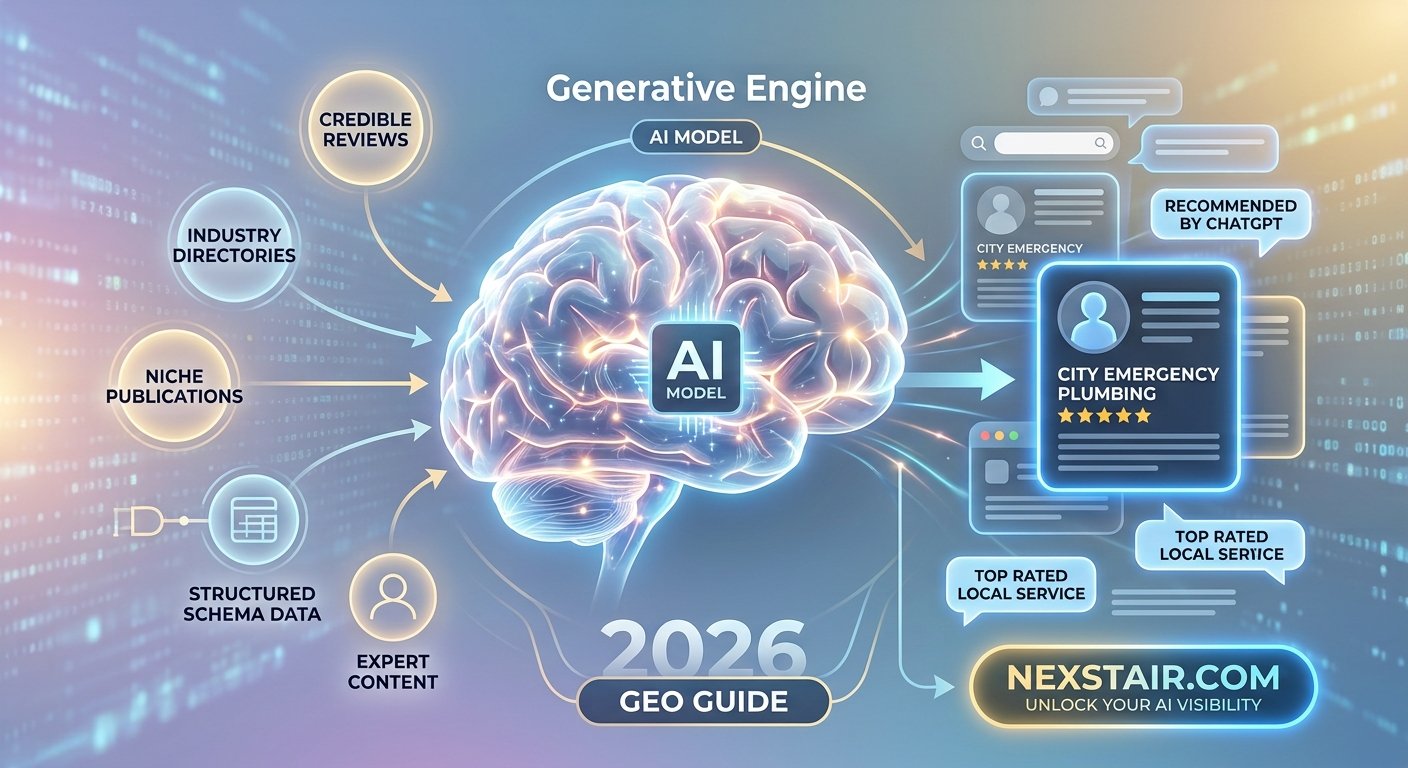
The strongest signal isn’t your homepage copy — it’s your footprint across the internet. The single biggest factor in whether ChatGPT recommends your business is how often, and where, your name shows up across the open web: industry directories, niche publications, Reddit discussions, local news features, and podcast appearances all contribute to this footprint.
In short, ChatGPT tends to recommend businesses that are:
- Frequently mentioned across credible, independent third-party sources
- Clearly described in structured, easily-extractable content
- Consistent in name, category, and positioning everywhere they appear online
- Backed by real reviews and reputation signals across multiple platforms
- Specific rather than generic — naming exact services, locations, and use cases instead of vague marketing language
That last point deserves emphasis. AI models are pattern-matching against millions of pages of content. Vague statements like “we provide the best solutions for your needs” give a model nothing to extract. Specific statements like “we specialize in emergency plumbing repairs for homes built before 1980 in [city]” give it something concrete to cite.
What Are the Core Strategies to Get Recommended by ChatGPT?
1. Lead With a Direct Answer on Every Key Page
Put a 1–2 sentence direct answer under the relevant header so AI answer engines can easily extract it. Structure your “About,” service, and FAQ pages so the first sentence under each heading directly answers the question the heading poses — no throat-clearing, no marketing fluff, no three paragraphs of scene-setting before you get to the point.
For example, instead of opening a section titled “What services do you offer?” with a paragraph about your company’s history, open it with: “We offer three core services: X, Y, and Z, each designed for [specific use case].” That sentence alone is now citable.
2. Add Structured Data (Schema Markup)
Add FAQ and Service schema so AI tools know exactly what you do, without needing to guess from unstructured prose. Implementing LocalBusiness Schema, Product Schema, Review Schema, and FAQPage Schema helps AI understand your brand more precisely and increases the odds your structured facts (hours, location, pricing tier, services) get pulled accurately into an answer.
Schema markup doesn’t guarantee a citation, but it removes ambiguity. When an AI system has to choose between a page with clear, machine-readable facts and a page where it has to infer those facts from marketing copy, the structured page wins more often.
3. Build a Real Mention Footprint
Get cited in industry directories, niche publications, local news, review platforms, and relevant online discussions. A real reputation built across the web, backed by first-hand, story-driven expertise content, is what AI is built to surface — not polished ad copy.
One home services company in metro Atlanta saw their inbound calls shift from “I found you on Google” to “ChatGPT recommended you” over roughly six months, driven by building their mention footprint, earning citations on credible sources, and publishing specific, first-hand expertise content rather than generic marketing pages. That’s the GEO bar in 2026: specific, story-driven content backed by a real reputation across the web, not a stuffed keyword list.
4. Write for Natural-Language Questions, Not Keyword Density
Optimize for natural language queries and entity-attribute keywords rather than repeating exact-match keywords. This means writing content that answers full questions the way a real customer would ask ChatGPT — for example, “who is the best [service] for [use case] in [location]?” — rather than cramming a page with the same three keywords over and over.
AI models read for context and meaning, not keyword frequency. A page that naturally answers ten realistic customer questions will outperform a page that repeats one keyword phrase fifty times.
5. Manage Reviews and Local Reputation Actively
Actively manage your Google Business Profile, seek local media coverage, and encourage user-generated content and genuine customer reviews. Review volume and sentiment are strong trust signals that AI models weigh heavily when deciding what to cite, especially for local and service-based businesses.
Don’t neglect review platforms outside Google, either — industry-specific directories and forums often carry as much or more weight for AI models trying to establish whether a business is trustworthy in a specific niche.
6. Localize for Culture, Not Just Language
If you serve multiple regions or languages, go beyond simple translation into cultural transcreation — understanding local pain points, preferences, and language habits rather than producing a direct word-for-word translation of your existing site. AI models trained on region-specific content are more likely to surface businesses that clearly speak to a local audience’s actual concerns, not just their language.
7. Use AI Tools to Support (Not Replace) the Work
Using AI tools for market research, content drafting, and identifying gaps in your current content can speed up the process considerably — but the underlying work (real citations, real reviews, specific content) still has to happen through genuine effort and outreach, not shortcuts.
What Tactics Should You Avoid?
Not all “GEO advice” circulating in 2026 is accurate, and some of it wastes time or actively hurts trust signals. Skip these:
- Stuffing your homepage with AI-friendly keywords. ChatGPT doesn’t index keyword density — it reads context, so repetition without substance doesn’t help.
- Adding an llms.txt file to your site. Google has publicly confirmed it does not use this file for its AI features, and there’s no solid evidence ChatGPT uses it either. It’s a low-priority tactic at best.
- Buying mentions on low-quality PBN (private blog network) blogs. Low-trust sources don’t make it into AI answers, and associating your brand with spammy link networks can actively hurt your broader reputation signals.
The businesses that win the next few years won’t be the ones with the most keywords — they’ll be the ones AI trusts enough to recommend, because their information is consistent, specific, and backed by real third-party validation.
How Do You Test Whether ChatGPT Already Recommends You?
Open ChatGPT, Perplexity, or Google’s AI Overview and type something like “best [your industry] in [your city]” and see whether your business appears in the response. Ask the AI engines directly the same 3–5 questions a real customer would realistically ask before hiring or buying from a business like yours.
Run this test monthly, and track which competitors get named instead of you. That gap — the businesses AI mentions that you don’t see mentioned for yourself — is effectively your content and citation roadmap. If a competitor consistently appears and you don’t, look at where they’re mentioned online that you aren’t, and start closing those gaps one by one.
You can also track results indirectly:
- AI referral traffic in GA4 — sessions arriving from chatgpt.com, perplexity.ai, and gemini.google.com are now trackable as a distinct channel.
- Branded search growth in Search Console — people who first see your business mentioned in an AI answer often go on to Google your name directly afterward, which shows up as a lift in branded search impressions.
How Long Does It Take to See Results?
A realistic timeline is 2–3 months for on-site changes (schema, direct-answer formatting, FAQ content) to start showing up in AI answers, and 3–6 months for broader mention-footprint and reputation work — earning citations, building reviews, appearing in directories — to fully take effect.
This is a compounding effort, not a one-time fix. The businesses that stay consistent build long-term AI visibility that’s genuinely hard for latecomers to catch up to, because AI models tend to reinforce sources they’ve already learned to trust.
Does GEO Also Improve Regular Google Rankings?
Yes. GEO work improves your Google rankings too, since the underlying signals — clear structure, real reviews, authoritative mentions, and answer-shaped content — are the same signals traditional search ranking systems reward. Because AI Overviews and AI Mode are rooted in core Search ranking systems, optimizing for generative AI search is still SEO in the ways that matter most.
This is good news for anyone worried about splitting their attention: there’s no real tradeoff between optimizing for AI answers and optimizing for traditional search results. The two reinforce each other.
Quick GEO Checklist for Your Business
- Add a direct 1–2 sentence answer under every major heading on your site
- Implement FAQ, LocalBusiness, Service, and Review schema across key pages
- Publish first-hand, specific, story-driven content instead of generic marketing copy
- Get cited in directories, local press, niche publications, and relevant forums
- Actively collect and respond to reviews across Google and industry-specific platforms
- Write content around real customer questions, not just repeated keywords
- Test your target prompts monthly in ChatGPT, Perplexity, and Google AI Overviews
- Keep your business name, category, and description consistent everywhere online
- Track AI referral traffic in GA4 and branded search growth in Search Console
- Skip low-value tactics like llms.txt files and PBN link buying
Ready to Get Your Business Recommended by AI?
Getting ChatGPT and other AI assistants to recommend your business takes structured content, technical schema, and a real authority footprint — built consistently over months, not overnight. It’s a genuine investment, but for most businesses today, staying invisible to AI search costs far more than the effort to fix it.
Need this done for you? Nexstair helps businesses build AI-ready websites, structured content, and GEO/AEO strategies that get found and recommended by ChatGPT, Perplexity, and Google AI Overviews.
👉 Visit Nexstair.com to get your free AI visibility audit
👉 Talk to Nexstair about optimizing your website for AI search
Frequently Asked Questions | ChatGPT Recommend Your Business
Q: What does GEO stand for?
A: Generative Engine Optimization — the practice of structuring content so AI tools like ChatGPT cite and recommend it in their answers.
Q: Is GEO the same as SEO?
A: No, but it overlaps heavily. SEO ranks pages for human clicks; GEO gets your brand mentioned directly inside AI-generated answers. Most experts treat GEO as an extension of SEO, not a separate discipline.
Q: What’s the difference between AEO and GEO?
A: AEO focuses on getting your content extracted as a direct answer (featured snippets, voice search, quick-answer boxes). GEO focuses specifically on getting your brand mentioned inside conversational AI answers like ChatGPT responses.
Q: Does adding an llms.txt file help ChatGPT recommend my site?
A: No. Google has confirmed it doesn’t use this file, and there’s no solid evidence any major AI engine does either.
Q: How do I know if ChatGPT already recommends my business?
A: Ask ChatGPT the exact questions a customer would ask, such as “best [service] in [city],” and see if your business appears in the response.
Q: How long does GEO take to work?
A: Typically 2–3 months for on-site changes to start appearing in AI answers, and 3–6 months for full mention-footprint and reputation gains to take effect.
Q: Does GEO hurt my traditional SEO if I focus on it?
A: No — the two reinforce each other, since AI search features are built on the same core ranking systems as traditional search.
Recent Posts
Related Posts
Scale Your PPC Campaign Without Losing Budget
Scale your PPC campaign presents one of the most persistent dilemmas in digital marketing. When budgets increase, ad spend can...

Social Media Strategy for Small Business in 2026: Platforms, Budgets and AI Search Visibility
A social media strategy is a written plan that ties one business goal to a defined audience, two or three...
Technical SEO Services: How to Find the Right Company for Your Business
Technical SEO services (also called technical search engine optimization) are the fixes and checks that let search engines crawl, render,...
AI SEO for Small Business: What Changed in 2026 and What to Do About It
AI SEO for small business is no longer a future trend to watch. It is the environment every local shop,...
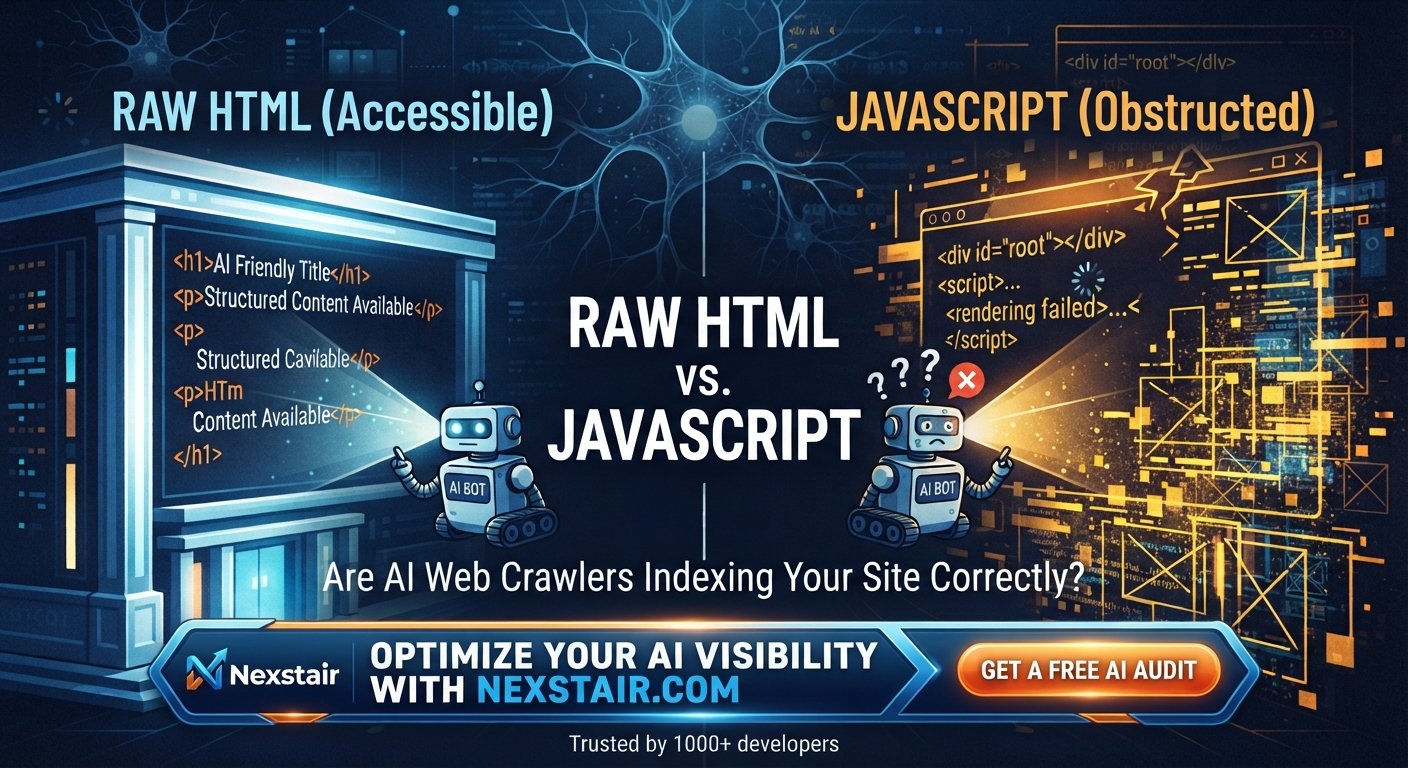
Are AI Web Crawlers Indexing Your Site Correctly?
For years, web developers have relied on JavaScript to power the modern internet, operating under the assumption that search engines...