
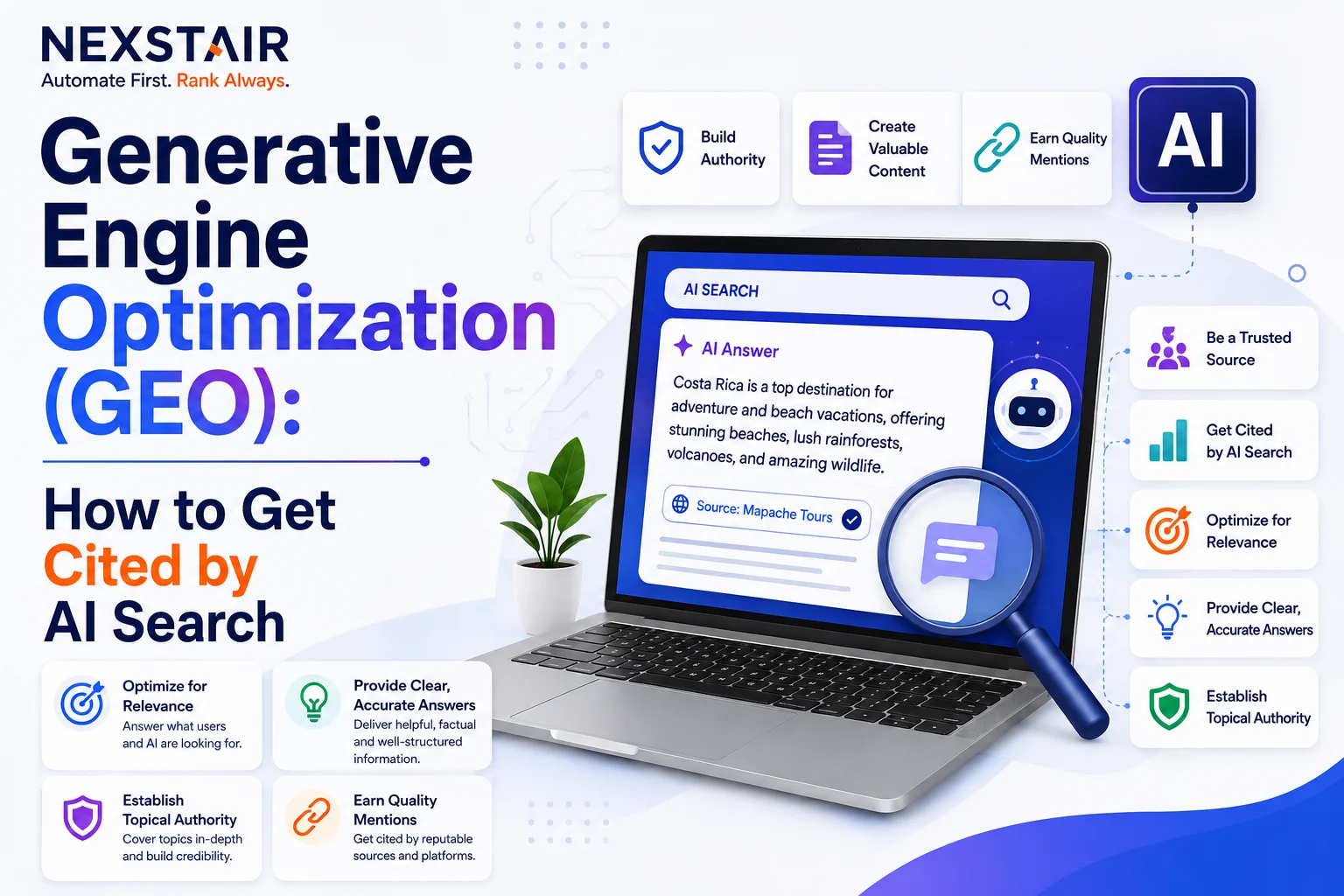
Generative Engine Optimization (GEO): How to Get Cited by AI Search
Generative Engine Optimization, GEO, is the practice of structuring content so AI systems like ChatGPT, Perplexity, Gemini, and Google AI Overviews cite it directly in the answers they generate. Traditional SEO earns a ranking position on a results page. GEO earns a mention inside the answer itself, often with no click required.
The shift matters because search behavior has already changed. A growing share of queries now get answered inside an AI Overview or a chatbot response before a user ever reaches a list of blue links. Businesses that only optimize for the old model of ranking are optimizing for a shrinking share of how people actually find information.
This guide covers what GEO actually requires: how it differs from traditional SEO, the technical foundation both disciplines share, how to structure content so language models can parse and cite it, and the trust signals that determine whether an AI system treats a page as a source worth quoting. Nexstair’s AI automation Services team works with businesses building this kind of AI-facing visibility into their broader digital strategy.
What Generative Engine Optimization Actually Means
GEO is the discipline of optimizing digital content so generative AI systems retrieve, summarize, and cite it when answering user queries. The term comes out of research on how large language models select sources, and it’s related to answer engine optimization (AEO) and AI optimization (AIO), though GEO has become the term most businesses use.
The core difference from SEO is what the content is being optimized for. SEO optimizes for a ranking algorithm sorting links. GEO optimizes for a language model synthesizing an answer from multiple sources at once and deciding which ones deserve a citation. A page can rank on page one and still never get quoted in an AI Overview, because ranking and getting cited are governed by different mechanics.
How GEO Differs From Traditional SEO
Traditional SEO rewards keyword density, backlink volume, and page authority accumulated over time. GEO rewards clarity, structure, and how directly a passage answers a specific question. A page written for GEO reads less like a page optimized to rank and more like a page written to be quoted.
This doesn’t mean SEO becomes irrelevant. Site speed, crawlability, mobile responsiveness, and clean code remain the technical foundation that both disciplines depend on. An AI system still has to crawl and process a page before it can decide whether to cite it. What changes is the layer built on top of that foundation: content written for extraction and citation, not just ranking.
The Technical Foundation GEO Still Requires
Before a page can be cited, it has to be readable by the systems doing the citing. This overlaps heavily with technical SEO.
Crawlability comes first. AI crawlers still need to access a page the same way search engine crawlers do. A misconfigured robots.txt file or JavaScript-heavy content that never renders for a crawler blocks GEO the same way it blocks SEO.
Schema markup gives structure a machine can parse. Article, FAQPage, and Author schema tell an AI system what type of content it’s looking at and who wrote it, which matters for both extraction and trust evaluation.
Site speed and accessibility remain baseline requirements. A slow, broken, or insecure site signals low quality to both search engines and the models increasingly built on top of them.
Writing Content Structured for AI Extraction
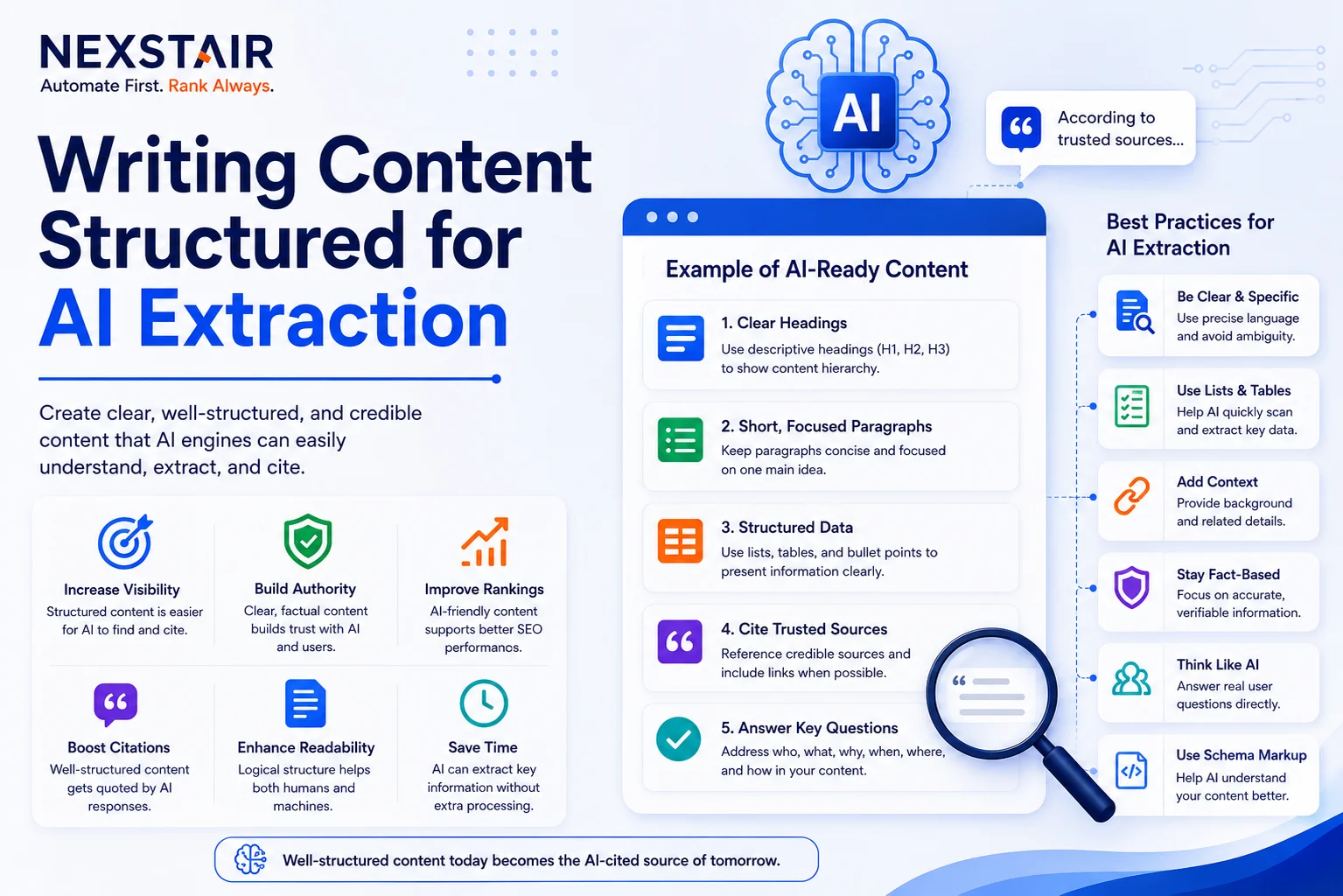
Once the technical layer is solid, content structure determines whether a language model can actually pull a clean, quotable answer out of a page.
Start from prompts, not keywords. Think about the actual question someone would type or speak to an AI assistant, not the fragment they’d type into a search box. “Best CRM for a small business” targets a search engine. “What’s the best CRM for a small business with under 10 employees” targets a generative one.
Answer first, elaborate after. If a heading asks a question, the first sentence under it should answer that question directly. Generative engines extract the most direct, self-contained answer they can find, so burying the answer under three sentences of preamble reduces the odds it gets pulled.
Use a hierarchy the model can follow. A clean H1 to H2 to H3 structure, with each H2 mapping to a distinct sub-question, gives an AI system clear boundaries around each answer. Flat, unstructured walls of text force the model to guess where one idea ends and another begins.
Lean on lists, tables, and summaries. Bullet points, comparison tables, and short “key takeaway” boxes are easier for a model to extract cleanly than a long descriptive paragraph carrying the same information.
Distribute FAQs throughout, not just at the end. Each question-and-answer pair functions as a direct match for a possible user prompt. A dedicated FAQ section captures some of this, but embedding short Q&A pairs within relevant sections captures more.
Trust Signals That Influence Citation
Generative engines weigh authority and credibility heavily when deciding which source to cite, arguably more than traditional search ranking does, because a citation carries the AI system’s own reputation with it.
Clear authorship matters. A named author with visible credentials signals a real source behind the content, not an anonymous or automated one.
Cited sources build a chain of trust. Linking to credible external data and studies shows the content is grounded in something beyond opinion, and gives the AI system a paper trail it can verify.
Freshness signals relevance. A visible “last updated” date tells both search engines and AI systems that a page reflects current information rather than something stale being resurfaced.
Consistency across the web reinforces authority. An entity, a business, an author, a brand, that shows up consistently and accurately across multiple credible sources is easier for a model to trust than one with a thin or inconsistent footprint.
Applying GEO Across Different Query Types
Not every query calls for the same content shape. Informational queries (“what is X”) reward clear definitions early in the content, ideally a single self-contained sentence that answers the question before any elaboration begins. Comparative queries (“X vs Y”) reward structured comparison tables with named criteria down one axis and the compared options across the other, since a model can lift a row directly into a summarized answer. Transactional queries (“best X for Y”) reward content that names specific options with concrete reasons for each, rather than a general discussion of what makes a good option in the abstract.
A single page can address more than one query type if it’s structured deliberately. A GEO-optimized comparison article, for example, might open with a direct informational answer defining the category, follow with a comparison table addressing the comparative query, and close with a recommendation section addressing the transactional one. Building content that anticipates which type of query it’s answering, section by section, makes the structure decisions above much easier to apply correctly and gives a single piece of content multiple chances to get cited.
A Practical GEO Checklist
Before publishing content intended to perform in AI search, check it against this list:
- Title is built around a real question or prompt, not just a keyword phrase
- The introduction answers the core question directly within the first few sentences
- Headings follow a clear H1 to H2 to H3 hierarchy with one sub-question per H2
- The article includes bullet points, tables, or summary boxes, not just long paragraphs
- FAQs are present, either as a dedicated section or distributed through the content
- Authorship is visible, and external sources are cited where relevant
- A visible update date reflects when the content was last reviewed
- Schema markup (Article, FAQPage, Author) is implemented
- The underlying page loads fast, is mobile-responsive, and is fully crawlable
Where GEO Fits Alongside AI Automation and SEO
GEO isn’t a replacement for SEO or a standalone project sitting apart from a business’s broader digital strategy. It’s an extension of the same technical and content foundation that good SEO already requires, aimed at a new set of systems reading that content. A business already investing in AI automation Services to run its internal processes is well positioned to extend that same AI fluency outward, into how its content gets found, read, and cited by the AI systems its own customers are increasingly using to search.
Reach Nexstair Technologies at +1 (307) 221-5230 or info@nexstair.com to talk through where GEO fits into your existing SEO and content strategy.
Frequently Asked Questions
What is Generative Engine Optimization (GEO)?
GEO is the practice of structuring content so AI systems like ChatGPT, Perplexity, and Google AI Overviews cite it directly when generating answers. It focuses on clarity, structure, and direct answers rather than the keyword and backlink signals traditional SEO relies on.
Is GEO the same thing as SEO?
No. SEO optimizes content to rank on a search results page. GEO optimizes content to get cited inside an AI-generated answer. They share the same technical foundation, crawlability, site speed, structured data, but the content-level strategy differs.
Do I need to abandon SEO to focus on GEO?
No. Technical SEO fundamentals, site speed, mobile responsiveness, crawlability, remain required for GEO to work at all. GEO builds on top of that foundation rather than replacing it.
Which AI platforms does GEO apply to?
GEO applies to any generative engine that synthesizes answers from web sources, including ChatGPT, Perplexity, Google Gemini, Microsoft Copilot, and Google AI Overviews. Each platform has slightly different retrieval behavior, but the core structural and trust principles apply across all of them.
What role does schema markup play in GEO?
Schema markup, particularly Article, FAQPage, and Author schema, gives AI systems a structured, machine-readable summary of a page’s content and authorship. This makes it easier for the system to correctly interpret and cite the content.
How is a GEO-optimized article different from a normal blog post?
A GEO-optimized article answers questions directly and early, uses a clear heading hierarchy mapped to sub-questions, and includes lists, tables, and distributed FAQs. A typical blog post often buries the answer in narrative framing before getting to the point, which reduces how easily a model can extract a clean answer from it.
Can a small business realistically compete for AI citations against large brands?
Yes, more easily than in traditional SEO in some cases, since AI citation weighs clarity and direct relevance to a specific question rather than accumulated domain authority alone. A small business with a precise, well-structured answer to a narrow question can get cited over a larger competitor with a vaguer, less-structured page on the same topic.
Recent Posts
Related Posts

Scale Your PPC Campaign Without Losing Budget
Scale your PPC campaign presents one of the most persistent dilemmas in digital marketing. When budgets increase, ad spend can...

Social Media Strategy for Small Business in 2026: Platforms, Budgets and AI Search Visibility
A social media strategy is a written plan that ties one business goal to a defined audience, two or three...

Technical SEO Services: How to Find the Right Company for Your Business
Technical SEO services (also called technical search engine optimization) are the fixes and checks that let search engines crawl, render,...

AI SEO for Small Business: What Changed in 2026 and What to Do About It
AI SEO for small business is no longer a future trend to watch. It is the environment every local shop,...
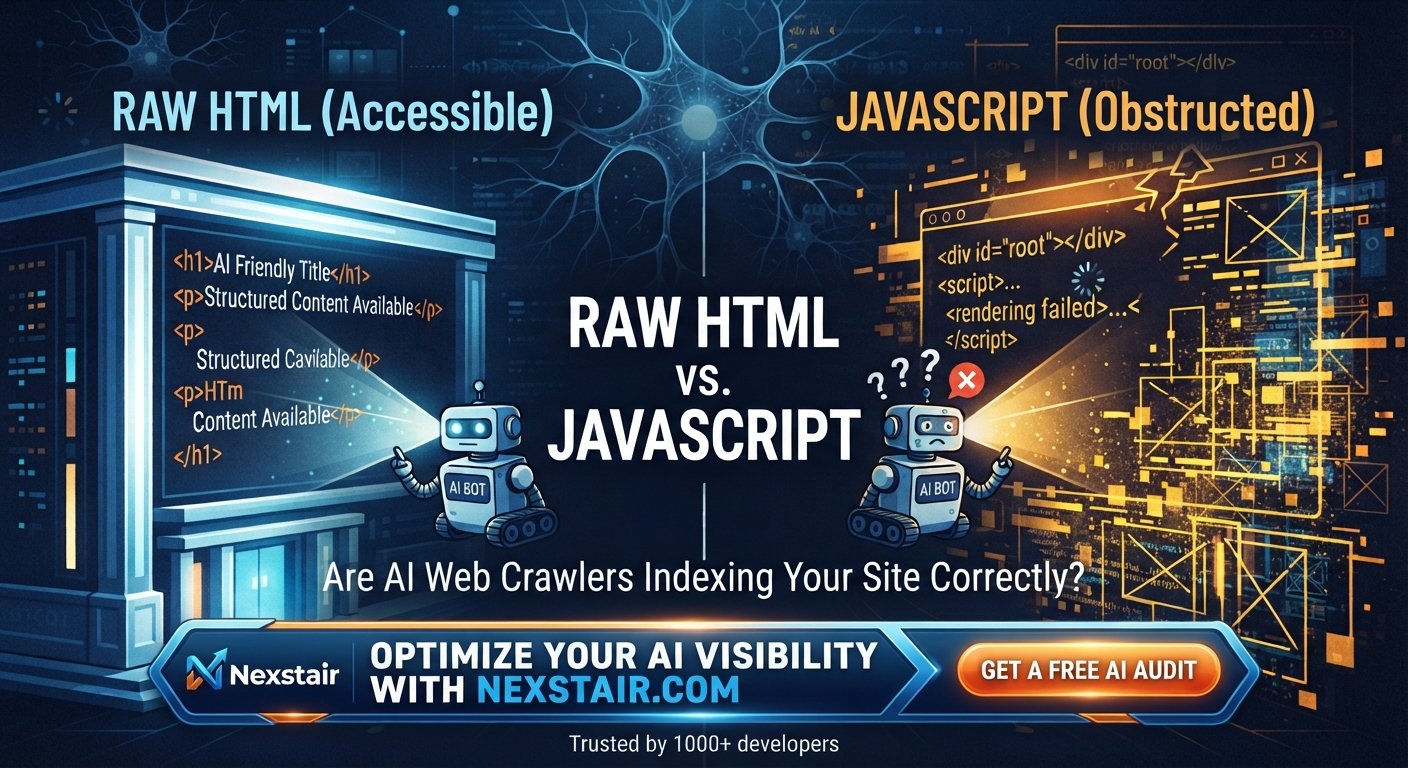
Are AI Web Crawlers Indexing Your Site Correctly?
For years, web developers have relied on JavaScript to power the modern internet, operating under the assumption that search engines...