
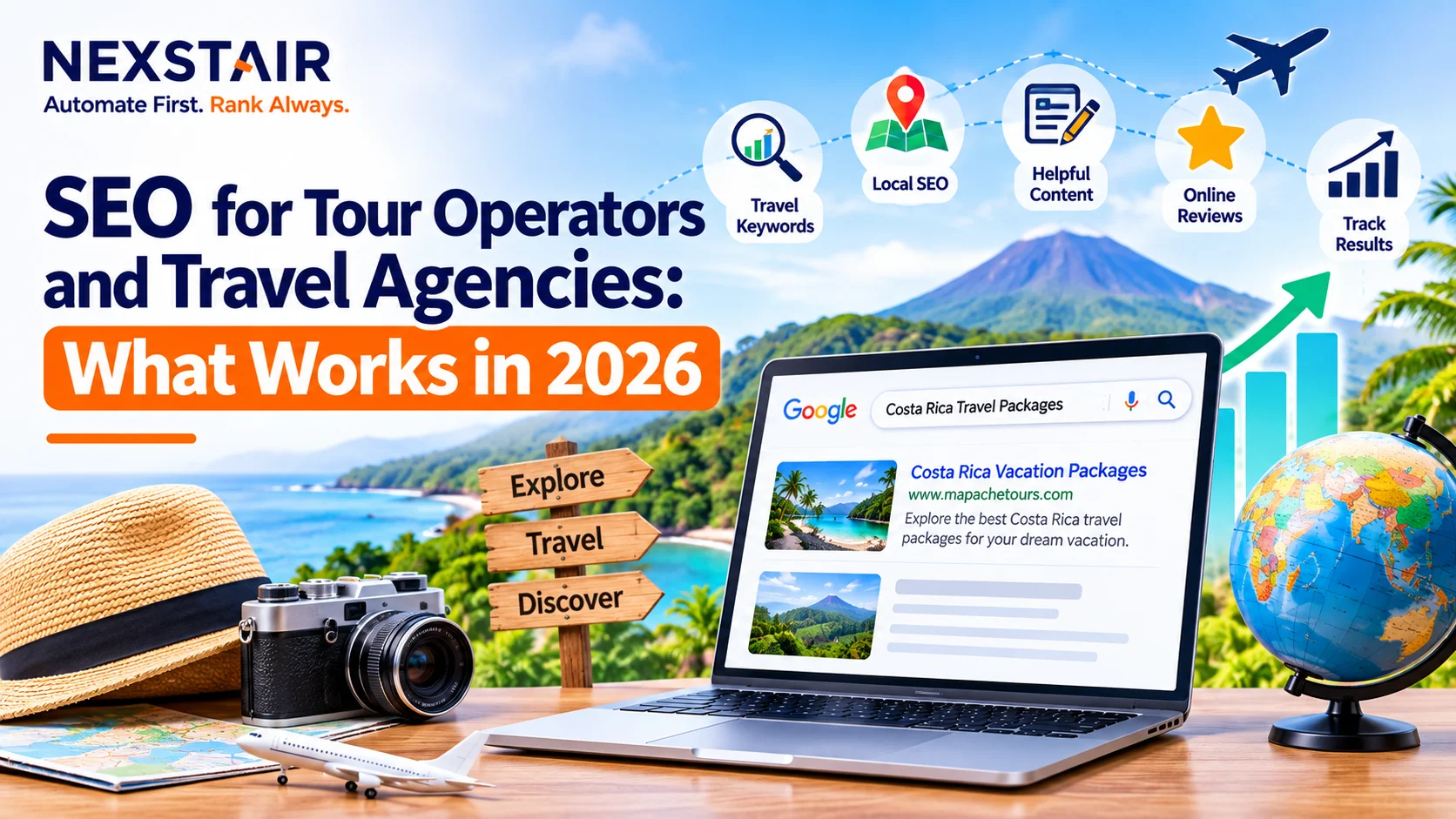
SEO for Tour Operators and Travel Agencies: What Works in 2026
SEO for tour operators and travel agencies (travel SEO) is the practice of earning organic Google traffic from travelers who search for destinations, tours, itineraries, and trip planners. The goal is bookings and inquiries, not rankings alone. A tour operator sells a specific experience, such as a three-day Iceland tour. A travel agency sells planning and advice, such as a family honeymoon itinerary. Both rely on the same engine: pages that match what a traveler types into a search box.
Travelers still start with search, but the path has widened. In its November 2025 research, Phocuswright found that nearly four in ten U.S. travelers had used generative AI for trip research in the past 12 months, an increase of 11 points in one year, while general search still led all other research tools. So a travel business now needs pages that rank in Google and also get quoted by AI answers.
This guide covers what works in 2026: how travelers search, which keywords small travel businesses can win, how to build tour pages, local SEO, schema markup, seasonal content, links, first-hand experience, AI citations, and tracking. It also lists common mistakes. The FAQs at the end answer questions on value, keywords, online travel agencies (OTAs), paid ads, and timing.
How Travelers Search Before They Book
Travelers research in stages, and each stage uses different search terms. Early searches are broad (“best time to visit Peru”). Middle searches compare options (“Machu Picchu tour 4 day vs 7 day”). Late searches name a product or a company (“Inca Trail permit small group”). A site that only targets late searches misses the people still deciding where to go.
Planning starts early, too. In Phocuswright’s 2024 survey of U.S. leisure travelers, 54% of travelers who converted first saw the influential content more than a month before their trip. Content published today can earn a booking next season, which makes SEO a slow channel by design.
AI summaries change the click path. A Pew Research Center study of 900 U.S. adults, with browsing data from March 2025, found that users clicked a traditional result link in 8% of visits when a Google AI summary appeared, against 15% when it didn’t. Only 1% of visits clicked a link inside the summary. Fewer clicks per search means each ranking page has to earn the click with a clear, specific answer. Next comes the question of what each type of travel business should target.
Tour Operators and Travel Agencies Need Different Pages
Tour operators win with product pages. Each tour, departure, or package gets its own page that answers the buyer’s questions: where it goes, what’s included, how long it runs, what it costs, and how to book. A single “Tours” page that lists everything can’t rank for specific searches.
Travel agencies win with expertise pages. An agency’s inventory is often the same hotels and flights every OTA sells, so it competes on knowledge: destination specialists, itinerary examples, planning guides, and advisor profiles. The searches it should chase look like “Italy honeymoon planner” or “Africa safari travel agent,” not “cheap flights to Rome.”
The page types differ, and so do the keywords, which is where the real work begins.
Choose Keywords You Can Win
Small travel businesses lose when they chase head terms like “Paris tours.” OTAs, tourism boards, and review platforms own those results. Smaller sites win by narrowing along four lines:
- Specify the traveler: “family,” “solo female,” “senior,” “honeymoon.”
- Specify the style: “small group,” “private,” “luxury,” “budget,” “cycling.”
- Specify the place: a region, a city, a trailhead, not a country.
- Specify the need: “with kids,” “wheelchair accessible,” “no flights,” “in winter.”
Combine them and a keyword like “private food tour for families in Lisbon” has fewer competitors and clearer intent. Each keyword gets one page, and the page title, heading, and opening paragraph state it plainly.
Google’s autocomplete and “People also ask” boxes show how travelers phrase questions. Pick terms where the top results are small operators or blogs, not national platforms. Once a keyword is chosen, the page has to deliver.
Build Tour and Destination Pages That Answer Everything
A strong tour page replaces the phone call. It answers every question a traveler would ask, in the order they’d ask it. Cover these elements on each page:
- State the route, duration, group size, and season in the first screen.
- List the inclusions and exclusions separately, with no vague phrases.
- Show a day-by-day itinerary with real place names.
- Post the price, or the starting price, with what changes it.
- Add cancellation and refund terms in plain words.
- Embed reviews from real guests, with names and dates where permitted.
- Place one booking or inquiry button above the fold and another at the end.
Original photos and video matter, because stock images tell travelers nothing about your trip. Write alt text that describes each image for screen-reader users, and keep file sizes small so pages load fast on mobile.
Destination guides support the product pages. A guide to “Where to stay in Kyoto” can link to a Kyoto tour, and the tour page can link back. Those internal links pass context between pages, and they carry readers from research to booking. Local visibility adds another route to the same traveler.
Win Local Search With Google Business Profile
Local SEO services matter for any travel business with a physical office, a meeting point, or a service area. A complete Google Business Profile can appear in the map pack for searches such as “travel agency near me” or “walking tours in Savannah.”
Fill in every field: business name, categories, address or service area, hours, phone, website, and photos. Add services or products, and post updates for new departures or seasonal offers. Keep the name, address, and phone number identical across your website, directories, and social profiles, because mismatches weaken trust.
Reviews carry weight here. Google’s local ranking guidance lists relevance, distance, and prominence, and review count and score feed prominence. So ask every guest for a review within a day or two of the trip, when the memory is fresh, and reply to each one. Reply to the bad reviews as well, with facts and a fix.
Search engines also read structured data to confirm those details, which is the next layer.
Add Schema Markup for Travel Pages
Schema markup is code that labels a page’s facts for search engines. Google documents LocalBusiness structured data as a way to tell it about business hours, departments, and reviews, and its examples use JSON-LD, a script block that sits in the page head or body. The required properties are `name` and `address`. Recommended ones include `openingHoursSpecification`, `geo`, `telephone`, `url`, and `priceRange`.
Add LocalBusiness or TravelAgency markup to the homepage and contact page. Keep it accurate, because it must match what’s visible on the page. Test it in Google’s Rich Results Test and watch Search Console for errors. An SEO audit and technical optimization usually covers schema. With the technical layer set, seasonal content comes next.
Plan Content Around Booking Seasons
Travel demand moves in waves, so an SEO content strategy should follow booking windows. Publish destination inspiration months before peak season, planning guides closer to it, and last-minute pages near departure. A safari operator might publish “best time for a Tanzania safari” in the winter before the dry season, then “what to pack” a few weeks before departures.
Keep evergreen pages alive. Update dates, prices, and itineraries each year, and keep the same URL so earned links and history stay put.
Useful formats include destination guides, sample itineraries, cost breakdowns, logistics pages on visas and permits, and comparisons of two routes or seasons. Each piece should link to the product page it supports, and each should show something the OTAs don’t: the guide’s local knowledge. That experience becomes a ranking asset of its own, and social media marketing can carry each guide to travelers who aren’t searching yet.
Show First-Hand Experience
Google’s quality guidelines use E-E-A-T (experience, expertise, authoritativeness, and trustworthiness), and travel content depends on the first letter. A traveler wants to know that the writer has been there. So show it.
Put real names and bios on guides, advisors, and authors. Share original photos, route maps, and trip notes from your own departures. Add short quotes from guests, including mild criticism, because balanced reviews look more honest than perfect ones. State your credentials where they apply, such as licenses, memberships, and years operating. And publish contact details, a physical address where one exists, and clear terms.
First-hand detail also separates your page from generic AI-written guides. A line like “the 6 a.m. departure beats the cruise-ship crowds at the main gate” can only come from experience, and it makes the page worth linking to.
Earn Links and Mentions
Backlinks, links from other websites to yours, remain a strong signal, and travel has natural sources for them. Tourism boards, chambers of commerce, hotel partners, local bloggers, and regional media all link to businesses they know. So the best approach to link building and outreach is partnerships, not spam.
Practical sources include official tourism board listings, hotel and lodge partners, local news features, bloggers who take a tour and write about it, and original data, such as a seasonal price report, that writers can cite.
Avoid paid links and link swaps at scale. Google treats those as spam, and the penalty costs more than the links are worth. A few relevant links from real local sources outweigh dozens from unrelated directories. As links build authority, the next frontier is getting cited by AI tools.
Get Cited in AI Answers
AI tools such as Google’s AI Overviews and ChatGPT pull answers from pages that state facts clearly. You can’t control the output, but you can make your pages easy to quote.
- Lead each section with a direct answer, then add detail.
- Use question-style headings that match how travelers ask.
- Keep facts specific: durations, prices, group sizes, and inclusions.
- Keep business details consistent across your site and profiles.
- Cite your sources and show the date of the last update.
Clear reference-style pages also help human readers, so the work pays twice. Everything above needs measurement to prove it’s working.
Track Bookings, Not Just Traffic
Traffic alone doesn’t pay for a trip. Track the actions that lead to revenue: inquiry forms, booking clicks, phone calls, brochure downloads, and completed bookings. Set these up as key events in Google Analytics 4, and connect Google Search Console to see which searches bring visitors.
Tag campaign links with UTM parameters so you can tell which channel produced each inquiry. Ask every new customer how they found you, and log the answer in your booking system or CRM. Offline bookings, such as a phone call after a Google search, are easy to miss, so a call tracking number helps.
Build SEO reporting and tracking into a monthly review, but judge results over a full season, because travel buying cycles are long. Compare organic inquiries to the same month last year. Even a good plan stumbles on a few predictable mistakes.
Common Travel SEO Mistakes
- Targeting broad terms like “tours in Italy” that OTAs own.
- Putting every tour on one page, so none can rank.
- Using supplier descriptions copied from partners, which duplicates content across the web.
- Letting last year’s prices and dates sit on live pages.
- Ignoring reviews, or replying only to the good ones.
- Skipping mobile testing, even though many travelers browse on phones.
- Reporting rankings instead of inquiries and bookings.
Conclusion
SEO for tour operators and travel agencies works when each page matches a traveler’s stage of planning. Tour operators win with specific tour pages, agencies win with expertise pages, and both win by choosing narrow keywords instead of head terms owned by OTAs. Complete tour pages, an accurate Google Business Profile, reviews, and LocalBusiness schema give search engines the facts. Seasonal content, first-hand experience, partner links, and clear answers that AI tools can quote build authority over time. Tracking inquiries and bookings shows which of those efforts pays. Travelers research months ahead, so the work compounds across seasons.
Frequently Asked Questions
Is SEO worth it for a tour operator?
Yes, SEO is worth it when the operator has specific tours to sell and can wait for results. Organic search brings travelers who are already researching trips, and each ranking page keeps working after it’s published. The cost is time: results usually build over several months, not weeks.
What is travel SEO?
Travel SEO is the practice of optimizing a travel website to earn organic search traffic from people planning trips. It covers keyword research, tour and destination pages, local search, technical fixes, reviews, links, and content built around booking seasons. The aim is inquiries and bookings.
Which keywords should a tour operator target?
Target specific, long-tail keywords that combine a place, a traveler type, and a trip style, such as “private food tour for families in Lisbon.” Add need-based terms like accessibility, season, or group size. Avoid head terms such as “Paris tours,” where OTAs and tourism boards dominate.
Can a small travel agency outrank online travel agencies like Viator or Booking.com?
Not for broad terms, but yes for narrow ones. A small agency can outrank OTAs on specific searches by offering first-hand expertise, original itineraries, and local detail that large platforms don’t publish. Choose specialty keywords and build pages around them.
Is SEO better than paid ads for tour operators?
SEO wins on long-term cost, and paid ads win on speed. Ads produce clicks as soon as the budget runs, while SEO builds visibility that lasts after the spend stops. Most travel businesses use ads for near-term departures and SEO for steady, lower-cost demand.
How long does SEO take to work for a travel business?
Expect three to six months for early ranking movement and closer to a year for clear booking growth, depending on competition and site condition. Travel adds a seasonal delay, so judge results over a full booking season and compare against the same period last year.
Recent Posts
Related Posts
SEO for tour operators and travel agencies (travel SEO) is the practice of earning organic Google traffic from travelers who...
A digital marketing agency is an outside team that plans, runs, and measures a business's online marketing across search engine...
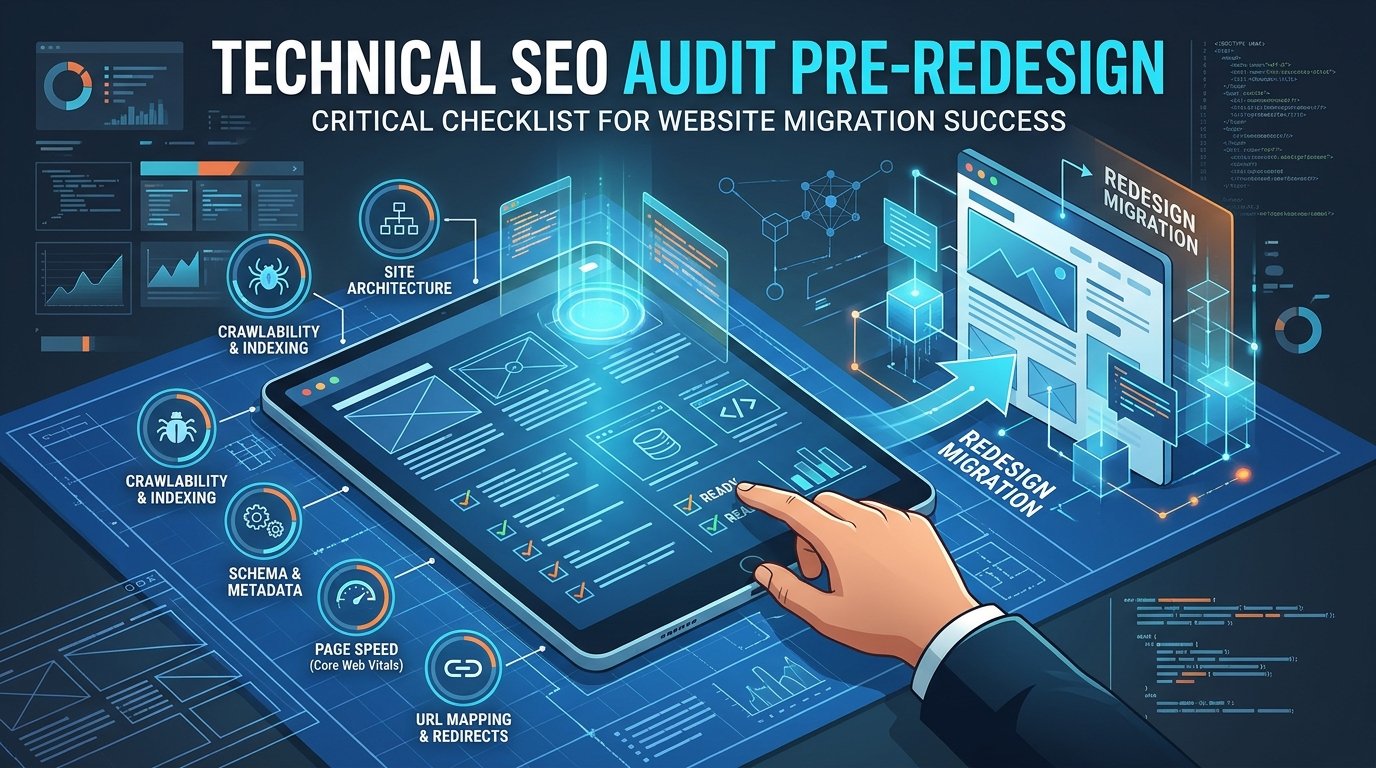
A website redesign is exciting. New layout, fresh branding, better user experience. It is also one of the easiest ways...
Growing a travel brand on Instagram means turning attention on the platform into inquiries and paid bookings, not just a...

AI landing page design services are professional design and build engagements where a team combines AI prototyping and behavior analytics...