
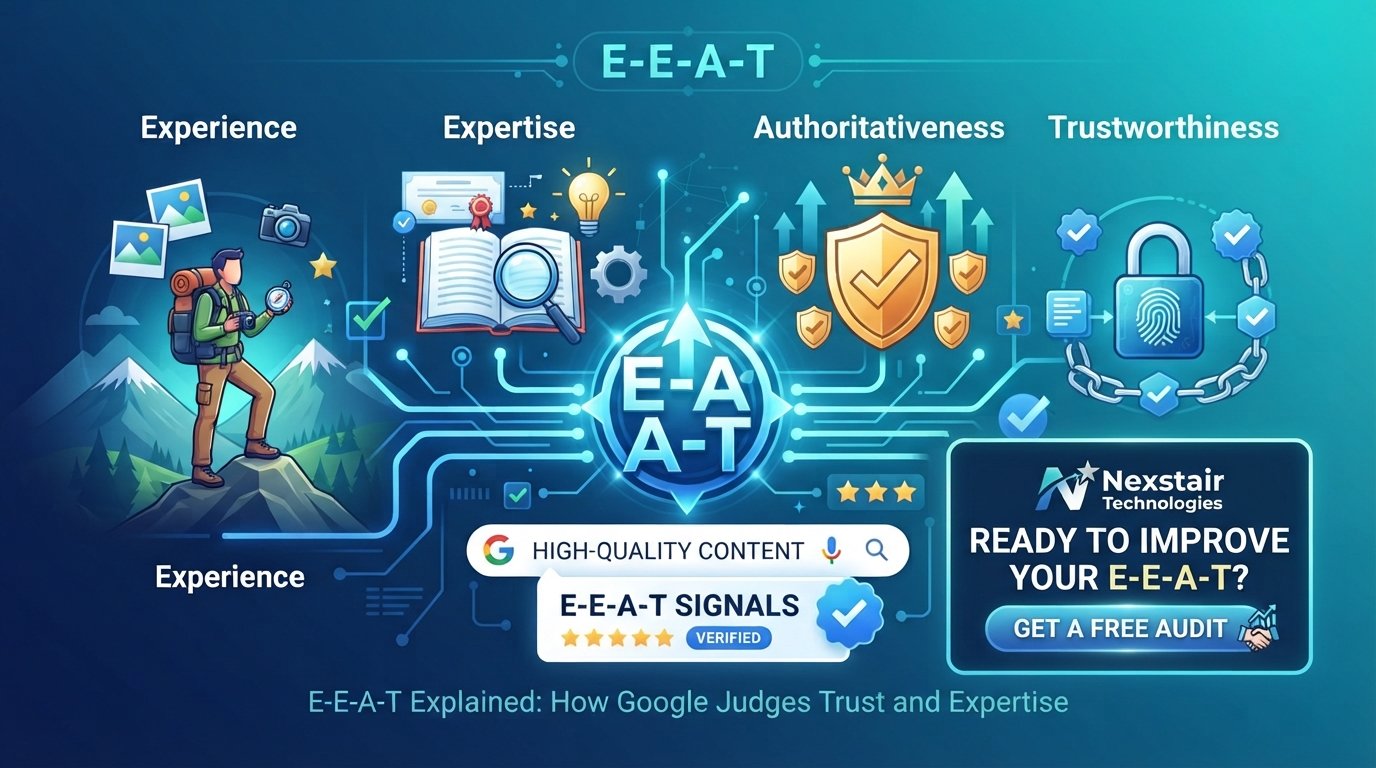
What is E-E-A-T: How Google Judges Trust and Expertise
You have probably seen the acronym everywhere: E-E-A-T. Every SEO article mentions it, every agency pitch leans on it, and yet most explanations stop at defining the four letters without exploring What is E-E-A-T in practice or what Google actually does with these signals. That gap matters, because misunderstanding the framework leads businesses to chase superficial fixes—like adding a generic author box—while ignoring the core signals that genuinely move the needle. This guide breaks down exactly how Google’s quality standards work, why building true trust and expertise matters more than ever, and how you can fortify your digital presence.
Ready to see how your website stacks up? Stop guessing and get a comprehensive content and authority audit from Nexstair Technologies to uncover your exact E-E-A-T gaps today.
What is E-E-A-T?
E-E-A-T stands for Experience, Expertise, Authoritativeness, and Trustworthiness. It comes directly from Google’s Search Quality Rater Guidelines, a lengthy document Google gives to thousands of human quality raters who manually evaluate search results and provide feedback that helps Google’s engineers understand whether their algorithms are working as intended.
The framework started as E-A-T (Expertise, Authoritativeness, Trustworthiness) back in 2014. Google added the second E, Experience, in December 2022, formally recognizing that firsthand, lived involvement with a topic is a distinct quality signal from academic or credentialed expertise. Someone who has personally used a product, performed a repair, or lived through a medical treatment brings something to the content that a well-researched but secondhand article cannot fully replicate.
Is E-E-A-T a Direct Google Ranking Factor?
No, and this is the single most misunderstood part of the entire framework. E-E-A-T is not a ranking factor Google’s algorithm checks off directly. There is no “E-E-A-T score” sitting in the ranking system the way page speed or mobile-friendliness might be measured. Instead, E-E-A-T is a quality framework used by human raters to evaluate search results and report back on how well Google’s algorithms are surfacing genuinely helpful content.
That distinction sounds like a technicality, but it changes how you should think about optimization. You cannot install a plugin or check a box that raises your “E-E-A-T score,” because no such score exists in the ranking pipeline. What you can do is strengthen the underlying signals, things like author credentials, citation quality, and content accuracy, that correlate strongly with what raters have consistently flagged as high or low quality. Google’s algorithms are trained and refined using that rater feedback, which is why sites demonstrating real E-E-A-T tend to perform better over time even though no single line of code is scoring them on it directly.
What Is the Difference Between Experience and Expertise?
These two pillars get confused constantly, and the distinction matters for how you build content.
Experience asks whether the content creator has actual, firsthand involvement with the topic. Did they personally use the product, visit the location, go through the process, or live the situation they are writing about? Experience shows up through specific, concrete details that only someone who was actually there could include, original photos, personal anecdotes, and observations that go beyond what could be gathered from research alone.
Expertise asks whether the creator has demonstrated subject-matter knowledge, which is often validated by formal credentials, a professional background, or a track record of accurate, high-quality work in the field. A board-certified physician writing about a treatment demonstrates expertise. A patient describing what that same treatment actually felt like demonstrates experience. Google’s guidelines increasingly want to see both where the topic calls for it, since a technically accurate article written by someone with no real-world contact with the subject can still fall short of what a rater considers genuinely helpful.
How Does Authoritativeness Work as a Trust Signal?
Authoritativeness measures whether the creator or the website is recognized as a go-to source by others in the field, not just by its own self-description. This is fundamentally a reputation signal, and it is built externally as much as internally.
Quality backlinks from respected sites in your industry, guest contributions on established publications, mentions and citations from other credible sources, and a growing presence in Google’s Knowledge Graph all reinforce authoritativeness. This is why a single well-optimized page rarely outranks a site with a long history of being cited and referenced by others in the same space. Authority accumulates over time through consistent, quality output and genuine recognition, not through any single piece of content, however well it is written.
What Makes Trustworthiness the Foundation of E-E-A-T?
Trustworthiness sits at the center of the E-E-A-T model, and Google’s own guidelines treat it as the most important of the four pillars. The reasoning is straightforward: content can demonstrate real experience, genuine expertise, and strong authority, but if it is inaccurate, deceptive, or unsafe, none of the other three pillars matter. A page can be written by a credentialed expert and still fail on trust if it contains factual errors, hides its commercial intent, or operates on an insecure, unreliable website.
Trust is built through accuracy (are the claims verifiable and correct), transparency (is it clear who created the content and why), and security (does the site protect user data and operate reliably). Practical trust signals include clear “About” and contact pages, transparent disclosure of sponsored content or affiliate relationships, accurate and updated information, and basic technical hygiene like HTTPS and a functioning, secure website.
Why Does E-E-A-T Matter More in 2026 Than in Previous Years?
E-E-A-T’s importance has grown alongside the volume of AI-generated content flooding the web. As it becomes cheaper and faster to produce large amounts of generic content, Google needs stronger ways to separate genuinely helpful, human-verified information from mass-produced, unverified text. Sites built around original data, firsthand expertise, and transparent authorship have shown measurably better resilience through recent core updates, while thin or heavily AI-paraphrased content without genuine expertise behind it has seen sharp traffic declines.
The stakes have also expanded beyond traditional search. AI-powered tools like ChatGPT, Perplexity, and Google AI Overviews are increasingly factoring E-E-A-T-like quality signals into which sources they choose to cite in generated answers. A site with weak trust and authority signals risks losing visibility not just in classic search rankings, but in the AI-generated answers that are steadily capturing more of the search experience.
Not sure how your site’s E-E-A-T signals actually stack up? Get a free content and authority audit from Nexstair Technologies and see exactly where the gaps are.
Which Topics Face the Strictest E-E-A-T Standards?
Your-Money-or-Your-Life (YMYL) topics face the highest bar. These are subjects where inaccurate or misleading information could directly harm a person’s health, financial stability, safety, or legal standing, categories like medical advice, financial guidance, legal information, and government or civic content.
For YMYL content, Google’s quality raters expect both professional expertise and, where relevant, lived experience. A medical article should ideally be reviewed by a licensed clinician, and a financial guide should clearly disclose the author’s credentials along with any potential conflicts of interest. Content in these categories that lacks verifiable expertise or transparent authorship faces a much steeper climb toward ranking well, regardless of how well the page is otherwise written or optimized.
How Do You Actually Demonstrate E-E-A-T on Your Website?
Google evaluates E-E-A-T through a mix of on-page and off-page signals, since raters and algorithms alike are looking for evidence, not claims.
What on-page signals matter most?
- Detailed author bios with real credentials, linking to a full author profile showing relevant experience, qualifications, and other published work.
- Original data, research, and first-hand examples — case studies, proprietary data, screenshots, and documented processes.
- Clear citations to credible sources like primary research, government data, or recognized industry sources.
- Schema markup for authorship and organization (Person and Organization schema) to connect content to a verifiable entity.
- Accurate, regularly updated content with visible publish and last-updated dates.
What off-page signals matter most?
- Backlinks from reputable, relevant sites in your industry.
- Brand mentions and citations across the web, even without a link.
- Reviews and reputation signals on third-party platforms.
- A consistent entity presence — matching business information across your website, Google Business Profile, and directories.
Building author authority and structured data across an entire site is a lot to manage alone. Nexstair Technologies can implement the schema, content, and authority signals that strengthen your E-E-A-T (https://nexstair.com/services/seo/) from the ground up.
How Can You Measure Whether Your E-E-A-T Is Improving?
Because there is no direct E-E-A-T score, measurement relies on tracking the proxies that correlate with it rather than a single dashboard number.
Monitor rankings and traffic stability through core update cycles, since sites with strong E-E-A-T tend to show more resilience during major algorithm shifts than sites relying on thin or unverified content. Track referral traffic and citations from AI search tools, since these platforms increasingly reward the same trust and authority signals Google’s raters look for. Watch your backlink profile for growth in links from reputable, relevant sources rather than raw link volume. Review your content for gaps — pages missing author attribution, outdated information, or unsupported claims — since those are the clearest places E-E-A-T is currently weak, and closing those gaps is where most measurable improvement tends to come from.
FAQs About E-E-A-T and Google Search Quality
What does E-E-A-T stand for?
E-E-A-T stands for Experience, Expertise, Authoritativeness, and Trustworthiness, the framework Google’s Quality Rater Guidelines use to evaluate content quality. It began as E-A-T in 2014 and expanded to include Experience in December 2022.
Is E-E-A-T a Google ranking factor?
No, E-E-A-T is not a direct ranking factor with its own algorithmic score. It is a quality evaluation framework used by human raters to assess search results, and that rater feedback helps Google refine the algorithms that do determine rankings.
How is Experience different from Expertise in E-E-A-T?
Experience refers to firsthand, lived involvement with a topic, while Expertise refers to demonstrated subject-matter knowledge, often validated by credentials or professional background.
Why is Trustworthiness considered the most important E-E-A-T pillar?
Trustworthiness is considered the foundation of E-E-A-T because content can show experience, expertise, and authority and still fail if it is inaccurate, deceptive, or unsafe.
Which types of content face the strictest E-E-A-T requirements?
Your-Money-or-Your-Life (YMYL) topics, including health, finance, legal, and safety content, face the strictest E-E-A-T requirements because inaccurate information in these categories can cause real harm.
Does E-E-A-T affect visibility in AI search tools like ChatGPT and Perplexity?
Yes, AI search tools increasingly factor E-E-A-T-like quality signals into which sources they cite, meaning weak trust and authority signals can hurt visibility in AI-generated answers as well as traditional search rankings.
How can a small business improve its E-E-A-T without a large content team?
A small business can improve E-E-A-T by adding detailed author bios with real credentials, citing original data or firsthand experience, keeping content accurate and updated, and maintaining consistent business information across its website and directories.
Key Takeaways | What is E-E-A-T?
E-E-A-T is not a checklist item or an algorithmic score you can install. It is a quality philosophy built around four connected ideas: has the creator actually done or lived what they are writing about, do they demonstrably know the subject, are they recognized by others as credible, and can everything they publish be trusted as accurate and transparent. Sites that treat E-E-A-T as an ongoing practice, not a one-time fix, are the ones building the kind of resilience that holds up through core updates and earns citations in AI-generated answers alike.
If you want a clear picture of where your site’s E-E-A-T signals stand today, request a free content and authority audit from Nexstair Technologies and get a concrete plan for building the trust and expertise signals Google actually rewards.
Recent Posts
Related Posts
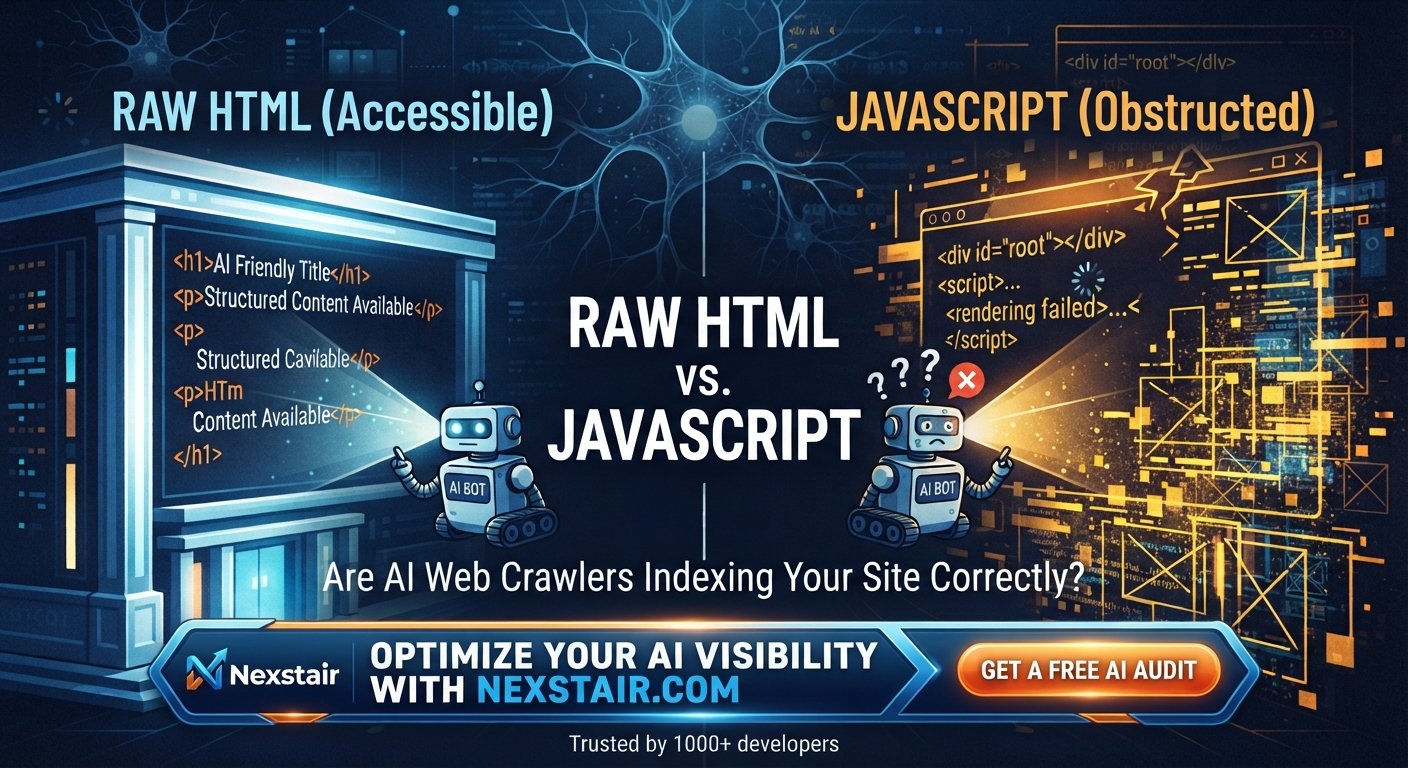
Are AI Web Crawlers Indexing Your Site Correctly?
For years, web developers have relied on JavaScript to power the modern internet, operating under the assumption that search engines...

How to Choose the Right CMS for Your Business Website
Choosing a CMS for business use is an architectural decision, not a design decision, even though most business owners approach...

How to Manage Social Media Marketing for Small Business
Learn how to manage social media marketing for small business effectively & proven strategies, planning tips, and tools to grow...

How Much Does a Custom Website Cost in 2026
Ask five agencies what a custom website costs and you’ll get five different numbers, and none of them will be...

Shopify vs WooCommerce: Choosing the Right Ecommerce Platform
Choosing an ecommerce platform is one of those silent factors that can impact your monthly costs, your developer's pain,...