
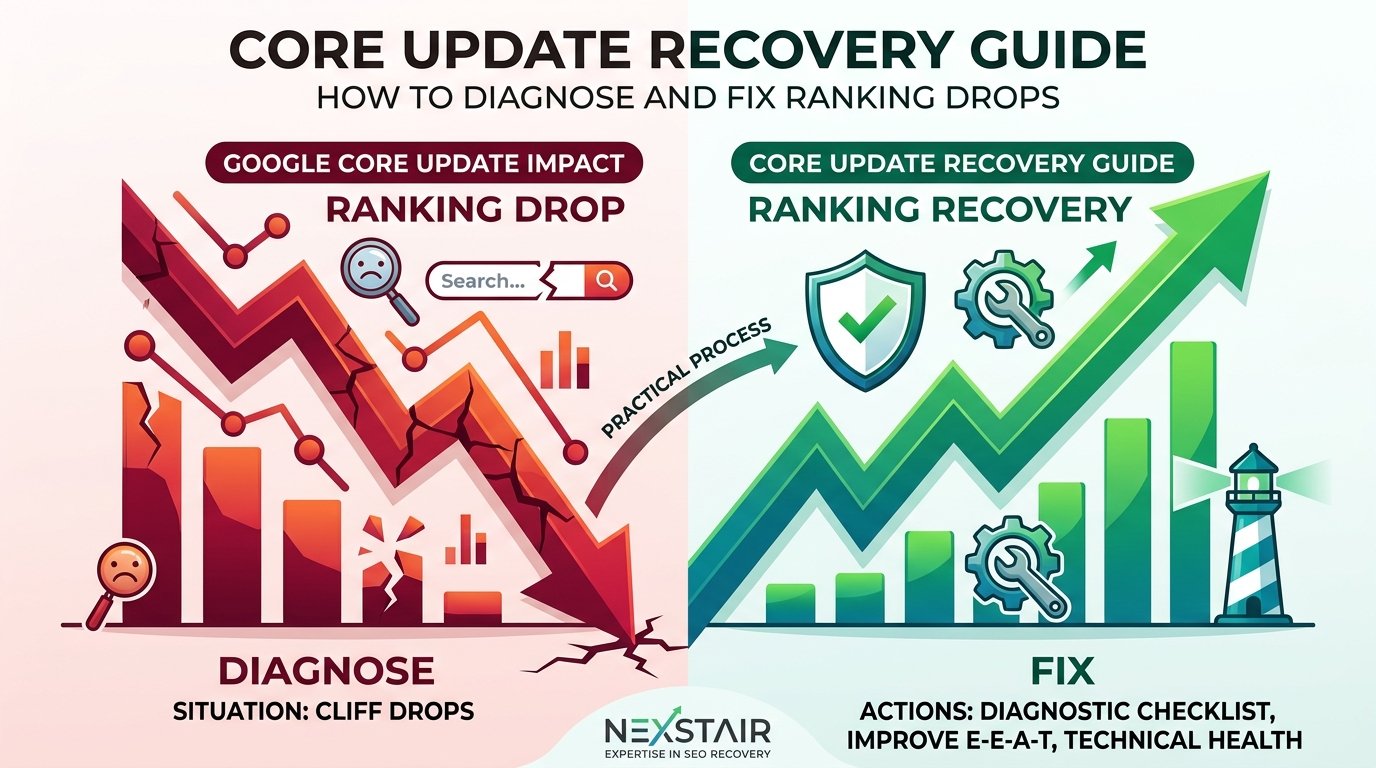
How to Fix Ranking Drops After a Core Update? Google Update 2026
Suffering from a traffic loss? Learn how to fix ranking drops after a core update with a step-by-step SEO audit, E-E-A-T fixes, and a technical recovery plan.
You checked your analytics, saw a cliff instead of a curve, and now you are here. Good. A Google core update is a broad algorithm change that recalibrates how Google evaluates content quality, expertise, and trust across the web, and it can knock even solid sites down several positions overnight. This guide gives you a practical process for how to recover from a Google core update: how to confirm what actually hit you, how to diagnose the real cause, and how to fix ranking drops with changes that hold up through the next update too. Along the way you will find the diagnostic checklist Nexstair’s SEO team uses when a client’s traffic drops after an update, plus realistic timelines so you know what to expect.
What Is a Google Core Update?
A Google core update is a scheduled, sitewide adjustment to Google’s ranking systems, not a penalty aimed at your domain specifically. Google rolls these out several times a year, usually over one to two weeks, and the changes touch dozens of ranking signals at once rather than one isolated factor.
That is the key difference between a core update and a targeted update like a spam or product review update. A targeted update fixes one thing: cloaked pages, scraped content, manipulative reviews. A core update retunes the whole system, so a page that ranked well under the old quality signals can lose ground without doing anything “wrong.” Google’s own guidance is direct about this: there is nothing to “fix” in the traditional sense if your content is genuinely useful, because the update reassesses relevance and quality across billions of pages, not one flagged site.
Rankings move after a core update because Google’s model of what counts as trustworthy, comprehensive, and people-first content has shifted. Sites that leaned on thin, templated, or search-engine-first content tend to lose visibility. Sites with deep expertise, clear authorship, and content that fully answers the query tend to gain it.
How Do You Know a Core Update Caused Your Ranking Drop?
Confirm the timing first. Check the Google Search Status Dashboard or a reliable update tracker to see the official rollout dates, then compare your traffic dip against that window. If your decline started days before the update began, or weeks after it ended, a core update probably is not the cause and you should look at technical issues, manual actions, or seasonal shifts instead.
Second, check the shape of the drop. Core update losses tend to be broad: multiple pages, multiple queries, sometimes an entire content section, all sliding at once. A drop confined to one page, one browser, or one country is more often a technical bug, a broken redirect, or a Search Console indexing error than an algorithmic recalibration.
Third, look at your competitors. Tools like Semrush Sensor or a rank tracker’s volatility index show whether your whole niche was shaken up. If competitors saw similar swings, you are looking at industry-wide volatility rather than a site-specific problem.
How Long Does Core Update Recovery Take?
Recovery is rarely instant, and setting the wrong expectation is one of the fastest ways to panic into bad decisions. Google has said improvements can take weeks or months to be reflected in rankings, partly because your updated pages need to be recrawled and reprocessed, and partly because full recognition sometimes waits for the next core update cycle. Plan for a recovery window measured in months, not days, and treat any bounce inside the first two weeks as a pleasant surprise rather than the baseline.
Not sure whether your drop is algorithmic or technical? Get a free ranking diagnosis from Nexstair’s SEO team and we will walk through your Search Console data with you.
Step-by-Step: How to Diagnose a Google Core Update Ranking Drop
Diagnosis comes before any fix. Changing pages before you know what actually dropped wastes effort and can mask the real signal Google is reacting to.
Confirm the update timeline
Note the exact start and end date of the core update from Google’s official channels. Wait roughly a week after the rollout finishes before you start comparing data, since rankings can still be settling during that period.
Pull your baseline data from Search Console
Export Performance data covering the weeks immediately before and after the update. Focus on clicks, impressions, average position, and click-through rate, and do this at both the page and query level so you are not just looking at one blended number.
Segment the losses
Break the data down by page, query, device, and country. A sitewide drop across every content type points to a broad quality reassessment. A drop confined to one content cluster, like your blog or your product review pages, points to a quality issue specific to that section. Filter for branded versus non-branded queries too, since branded traffic holding steady while non-branded traffic falls is a strong signal the update targeted topical relevance, not your brand’s overall trust.
Rule out non-algorithmic causes
Before you touch any content, check Search Console for manual actions, confirm there is no spike in server errors or crawl issues, and rule out seasonal demand changes. A ranking drop that looks like a core update hit is sometimes a broken canonical tag or an accidental noindex tag instead, and those fixes take an afternoon rather than a quarter.
How to Fix Ranking Drops After a Core Update
Once you know which pages lost ground and roughly why, move into rebuilding. This phase is where most of the actual recovery work happens, and it is built around Google’s own self-assessment questions for helpful content. Discover how to fix ranking drops after a core update. Follow Nexstair’s diagnostic guide to rebuild E-E-A-T, optimize content quality, and regain visibility.
Improve E-E-A-T signals on affected pages
E-E-A-T stands for Experience, Expertise, Authoritativeness, and Trustworthiness, and core updates consistently reward pages that demonstrate it clearly. Add detailed author bios with real credentials, link to author profiles, cite original sources, and where relevant, include first-hand experience like case studies, screenshots, or testing notes. For YMYL topics (anything touching health, finance, safety, or legal advice), this step carries extra weight because Google’s quality raters hold those pages to a stricter standard.
Consolidate thin or duplicate content
If you have three articles lightly covering the same keyword, merge them into one comprehensive resource instead of leaving them to compete with each other. Use 301 redirects from the old URLs to preserve link equity, and update internal links to point to the new consolidated page. Thin, templated, or auto-generated pages that exist mainly to capture a keyword are exactly the kind of content core updates are built to deprioritize.
Strengthen entity and topical structure
Organize your content so search engines can clearly identify what your site is about and how your pages relate to each other. That means consistent internal linking between related articles, structured data (organization and author schema) on key pages, and content that fully covers a subtopic instead of skimming it. Comprehensive, well-linked content signals topical authority in a way that thin, disconnected pages cannot.
Fix technical and Core Web Vitals issues
Technical health does not directly cause a core update drop, but it can amplify one. Poor Core Web Vitals scores, slow server response times, broken internal links, and JavaScript rendering problems all make it harder for Google to crawl, render, and fairly evaluate content that might otherwise be strong. Run a Core Web Vitals audit, aim for a Largest Contentful Paint under 2.5 seconds and a Cumulative Layout Shift under 0.1, and confirm important pages render fully in Google’s URL Inspection tool.
Want a free technical and content audit against the latest core update criteria? Nexstair’s SEO team can map your exact recovery plan in under a week.
Reassessing and Monitoring Your Core Update Recovery
Once your fixes are live, resist checking rankings daily and calling it done, or failed, after a week. Set a recurring monthly review of Search Console data, tracked at the topic-cluster level so you see gradual trends instead of daily noise. Watch impressions and average position as leading indicators, since clicks and conversions often lag behind ranking improvement by several weeks.
Keep iterating rather than treating recovery as a single project. Refresh your highest-value pages with new data, expand any section that still reads as thin, and keep building internal links that reinforce your topical clusters. Sites that recover fastest treat content quality as a habit, not a one-time reaction to a bad month.
Common Mistakes That Slow Down Core Update Recovery
A few patterns show up again and again in sites that struggle to bounce back.
- Panicking and rewriting everything at once. Google advises against drastic changes right after a drop; wholesale rewrites without a clear diagnosis often remove content that was not the problem.
- Deleting pages instead of improving them. Mass deletion can remove pages that were contributing topical relevance elsewhere, even if they were not top performers on their own.
- Chasing the algorithm instead of the query. Optimizing for what “seemed to work last time” ignores that core updates change the evaluation criteria, not just the ranking order.
- Giving up after two weeks. Recovery timelines run weeks to months. Reverting good changes because week two showed no movement is one of the most common self-inflicted setbacks.
- Ignoring technical debt. Strong content on a slow, poorly structured site rarely performs as well as it should, and technical issues can mask whether your content fixes are working.
When to Bring in an SEO Recovery Partner
Some recoveries are straightforward: fix a handful of thin pages, tighten up author bios, and wait. Others involve a sitewide content audit, a technical overhaul, and a multi-month content strategy, which is a lot to run alongside a full-time job. If your drop is significant, spans multiple content types, or you are not confident reading Search Console segmentation yourself, an experienced SEO team can shortcut the diagnosis phase and prioritize fixes by revenue impact rather than guesswork.
Nexstair Technologies works with businesses on exactly this kind of recovery, combining technical SEO audits, E-E-A-T improvements, and AI-assisted content optimization to rebuild the authority signals core updates reward. If a recent update hit your site, the fastest path back to page one starts with a clear diagnosis, not another round of guessing.
Get a no-obligation SEO recovery assessment from Nexstair and find out exactly what changed for your site.
FAQs | How to Fix Ranking Drops After a Core Update
Can you recover from a Google core update?
Yes, most sites can recover from a Google core update, though recovery is gradual rather than immediate. Google’s own guidance confirms there is no permanent penalty attached to a core update; sites that genuinely improve content quality, expertise signals, and technical health typically see rankings improve over subsequent weeks and update cycles.
How do I know if my ranking drop was caused by a core update?
Compare the timing of your traffic drop against the official core update rollout dates. If the decline lines up with the update window, spans multiple pages or queries, and matches volatility seen across your competitors, a core update is the likely cause. A drop confined to a single page or region often points to a technical issue instead.
How long does it take to recover from a core update?
Most sites see meaningful recovery within one to three months, though full recovery can take longer. Google has stated that content improvements can take weeks to be reflected in rankings, and some sites do not see the full benefit until the next core update rolls out.
What is the difference between a core update and a manual action?
A core update is an algorithmic, sitewide recalibration, while a manual action is a specific penalty applied by a Google reviewer for violating webmaster guidelines. Manual actions appear directly in Search Console under the Manual Actions report; core updates do not, since they affect ranking factors broadly rather than penalizing a single site.
Should I rewrite all my content after a core update hit my rankings?
No, rewrite only the pages your diagnosis actually flags as thin, outdated, or low in expertise signals. Wholesale rewrites without data can remove content that was not the actual problem and waste the recovery window on the wrong fixes.
Do Core Web Vitals affect core update recovery?
Core Web Vitals do not cause a core update drop directly, but poor scores can slow recovery by undermining otherwise improved content. Fixing Largest Contentful Paint, Cumulative Layout Shift, and server response times supports the content improvements you are already making.
How often does Google release core updates?
Google typically releases three to five core updates per year, each rolling out over one to two weeks with dates published on the Google Search Status Dashboard. Because updates are frequent, ongoing content quality work matters more than reacting to a single event.
Key Takeaways | How to Fix Ranking Drops After a Core Update
A Google core update ranking drop is rarely about one broken thing. It is Google recalibrating how it measures quality across your whole site, which is why the fix is diagnosis first, then a genuine improvement to expertise, structure, and technical health, then patience while Google reprocesses your pages. Track the official update dates, segment your Search Console data before you touch a single page, fix the real cause rather than the first guess, and give your changes real time to register.
If you would rather have a second set of eyes confirm the diagnosis and build the recovery roadmap, talk to Nexstair’s SEO team today and turn this update from a setback into the reason your site comes back stronger than before.
Recent Posts
Related Posts

Are AI Web Crawlers Indexing Your Site Correctly?
For years, web developers have relied on JavaScript to power the modern internet, operating under the assumption that search engines...

How to Choose the Right CMS for Your Business Website
Choosing a CMS for business use is an architectural decision, not a design decision, even though most business owners approach...

How to Manage Social Media Marketing for Small Business
Learn how to manage social media marketing for small business effectively & proven strategies, planning tips, and tools to grow...

How Much Does a Custom Website Cost in 2026
Ask five agencies what a custom website costs and you’ll get five different numbers, and none of them will be...

Shopify vs WooCommerce: Choosing the Right Ecommerce Platform
Choosing an ecommerce platform is one of those silent factors that can impact your monthly costs, your developer's pain,...