
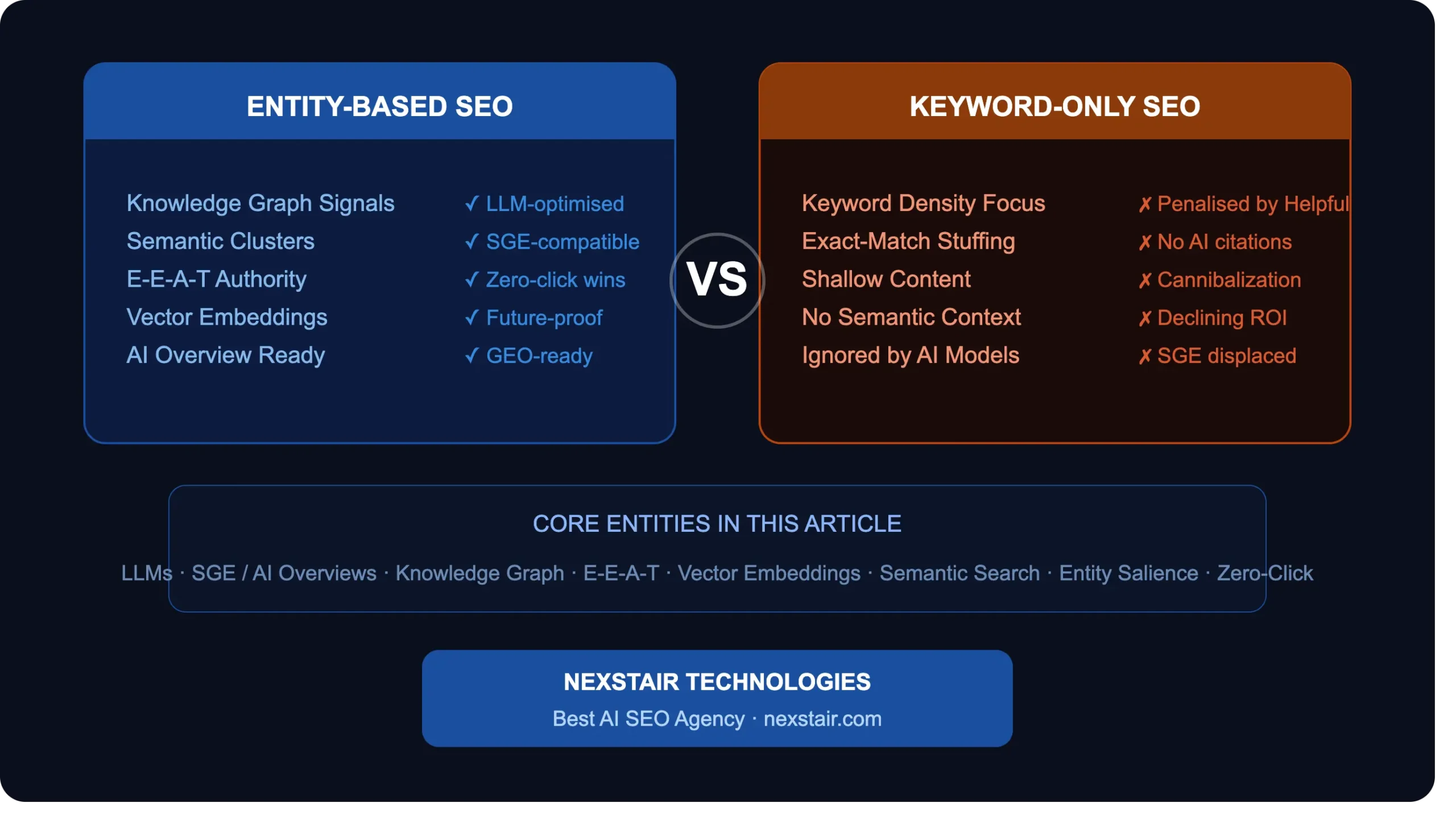
Entity-Based SEO vs Keyword SEO: Which Strategy Wins in the Age of AI?
The SEO landscape has undergone a seismic transformation. In 2024, Google launched its AI Overviews (formerly SGE), fundamentally changing how search results are generated, ranked, and consumed. ChatGPT, Gemini, and Claude are now answering questions that users previously resolved through a Google search. Zero-click results are climbing past sixty percent. And the algorithms that power these experiences have one thing in common: they do not think in keywords. They think in entities. The question every forward-thinking brand and marketer must answer in 2026 is not whether to optimise for search — it is which type of optimisation actually moves the needle. Keyword-focused SEO, which dominated strategy for two decades, is being systematically displaced by entity-based SEO — a fundamentally smarter approach built for the architecture of modern AI. At Nexstair Technologies, the best AI SEO agency for growth-focused brands, we have spent years building and refining an entity-first framework that wins in both traditional search and AI-generated discovery. This article explains exactly why, and how.
Whether you are searching for an AI SEO company to guide your strategy, evaluating AI tools for SEO, or simply trying to understand what the future of search looks like — this is the definitive guide you need.
What Is Keyword-Based SEO — and Why Is It Fading?
Keyword-based SEO emerged in the early days of search engines as a relatively simple signal: if a page contained the words a user typed, it was probably relevant. Over time, this principle spawned an entire discipline — keyword research, density optimisation, exact-match anchor text, and meta tag stuffing. At its peak, keyword SEO was a reliable, repeatable formula for ranking on Google.
The problem is that this formula was always gaming a system rather than truly serving it. Google has spent the better part of a decade rebuilding its algorithm away from surface-level keyword matching. The Hummingbird update (2013) introduced semantic search. RankBrain (2015) added machine learning to query interpretation. BERT (2019) enabled Google to understand natural language context. And MUM (2021) introduced multimodal, multilingual understanding at a scale previously impossible. Each of these updates moved Google further away from keyword counting and closer to meaning — to understanding what a page is genuinely about, who created it, why it exists, and whether it deserves to be cited.
Today, a page optimised purely around keyword density is not just ineffective — it is actively penalised by Google’s Helpful Content System. Thin, repetitive, keyword-stuffed content is the definition of what the Helpful Content Update targets. For brands still relying on keyword-first tactics, the rankings they hold are increasingly fragile.
What Is Entity-Based SEO — and How Does It Work?
Entity-based SEO is the practice of structuring your content, website architecture, and brand presence around named entities — the people, places, concepts, and organisations that Google’s Knowledge Graph recognises and connects. Rather than asking ‘what keywords should this page rank for?’, entity-based SEO asks ‘what is this page fundamentally about, who created it, and how does it relate to other known concepts in the world?’
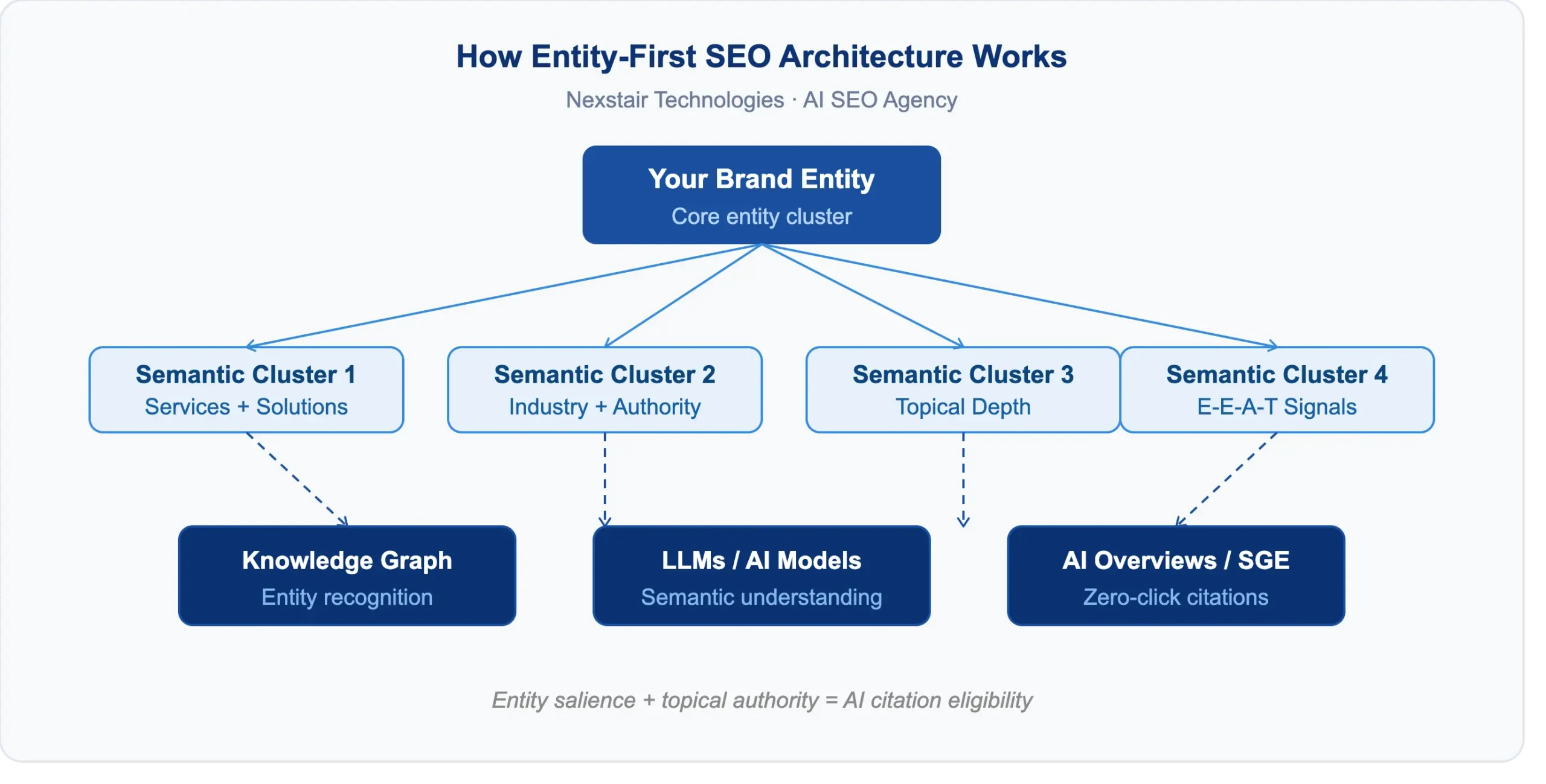
The Knowledge Graph is Google’s database of entities and their relationships. When Google’s crawlers visit a page, they are not just indexing text — they are extracting entities, assessing their entity salience (how prominently and accurately the entity is represented), and mapping those entities to their Knowledge Graph. Pages with strong entity representation earn higher topical authority, stronger E-E-A-T signals (Experience, Expertise, Authoritativeness, Trustworthiness), and crucially — greater eligibility for inclusion in AI Overviews and LLM-generated responses.
The mechanism behind this is vector embeddings — mathematical representations of concepts in multidimensional space. When a large language model like Google’s Gemini or OpenAI’s GPT processes a query, it does not look for keyword matches. It looks for semantic proximity: which entities, documents, and sources are conceptually closest to what the user is asking? Content with rich, accurate, well-structured entity representation ranks closer to the user’s query in vector space — and therefore gets cited.
Fig 1: Entity-First SEO Architecture — how semantic clusters feed Knowledge Graph, LLMs, and AI Overviews
The Nexstair Entity-First SEO Framework: 5 Core Principles
As a leading AI SEO agency, Nexstair Technologies has developed a proprietary entity-first framework built specifically for the AI era. Here are the five principles that underpin every SEO campaign we run:
1. Entity-First Architecture
Every piece of content is mapped to a semantic entity cluster before a single word is written. We identify the primary entity a page should represent, map its related sub-entities, and structure the content to maximise entity salience across all four of Google’s key topical dimensions. Google’s Knowledge Graph rewards depth over breadth — one comprehensively covered entity cluster consistently outranks ten shallow keyword-targeting articles.
2. One Keyword, One Post, One Internal Link
Each target keyword appears once in body copy as an internal link anchor — never repeated as a standalone phrase. This principle eliminates keyword cannibalization, ensures clean crawl authority distribution, and signals to Google’s algorithms that your site architecture is intentional rather than opportunistic. It also aligns perfectly with how LLMs attribute topical authority: they prefer clear, unambiguous signals over repetitive redundancy.
3. AIO / AEO / GEO Signal Architecture
Every article we produce at Nexstair is structured to maximise eligibility for AI Overviews (AIO), Answer Engine Optimisation (AEO), and Generative Engine Optimisation (GEO). This means structured H2 headings that mirror conversational query formats, FAQ schema questions that directly answer high-volume user intents, and clearly delineated entity lists in every post. These structural signals are the primary triggers for AI Overview inclusion and featured snippet eligibility.
4. LSI Keyword Saturation
Each post includes five to eight LSI (Latent Semantic Index) keywords woven naturally into body copy. These are not synonyms — they are semantically related terms that signal topical completeness to NLP models. An article about entity-based SEO that also mentions Knowledge Graph, semantic search, vector embeddings, and E-E-A-T signals is interpreted as genuinely authoritative on the topic. An article that only repeats ‘entity SEO’ twenty times is not.
5. Internal Link Hierarchy
Blog posts link to service pages or the homepage only. Service pages carry commercial authority; blogs carry topical authority. This clean separation ensures that crawl equity flows in the right direction — topical depth from blog content reinforces commercial relevance on service pages, not the other way around. This is the internal architecture of sites that rank consistently across both traditional search and AI-generated responses.
Zero-Click Results, AI Overviews, and the New Currency of Search
One of the most disruptive consequences of AI-powered search is the dramatic rise of zero-click results — searches that are answered directly on the results page without the user clicking through to any website. Studies from SparkToro and Rand Fishkin suggest that between fifty and sixty-five percent of Google searches now end without a click. For keyword-focused SEO strategies built around traffic volume, this is existential.
For entity-based SEO, it is an opportunity. When an AI Overview cites your brand as the source of an answer, your entity salience within Google’s Knowledge Graph increases. Your brand is associated with the query topic at the model level — which drives brand recognition, trust, and downstream commercial intent even when the user does not click. This is the new currency of AI-era search: citation in AI-generated answers, not just a blue link on page one.
At Nexstair Technologies, our AI SEO company framework is specifically designed to maximise citation eligibility across Google AI Overviews, Bing Copilot, Perplexity, and other AI answer engines. The same entity-rich, structured, authoritative content that earns AI citations also performs exceptionally in traditional organic search — creating a compound effect that purely keyword-focused content simply cannot replicate.
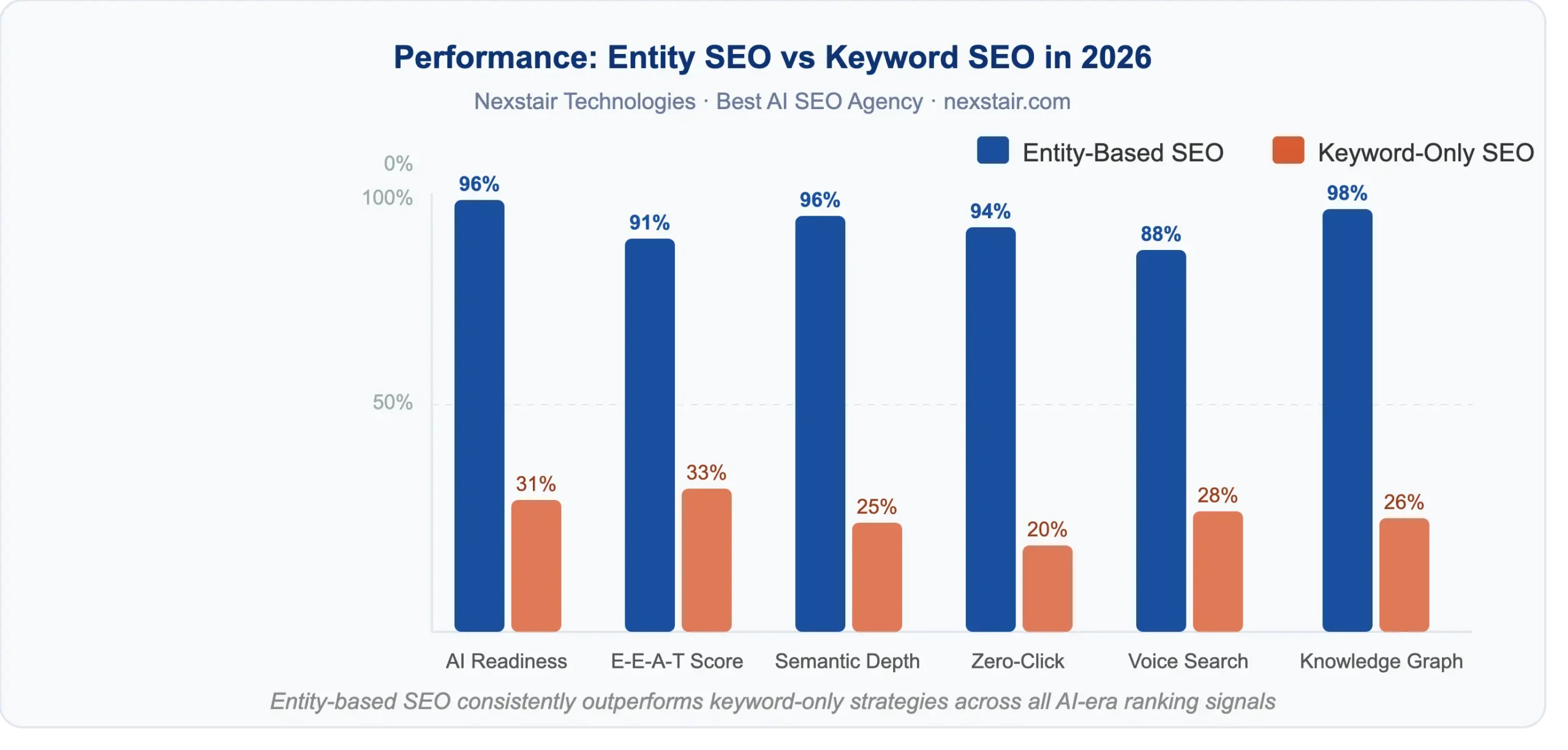
Fig 2: Entity-Based SEO vs Keyword-Only SEO — performance comparison across key AI-era ranking signals
AI Tools for SEO: How Nexstair Uses Technology to Build Entity Authority
The best AI tools for SEO in 2026 are not content spinning tools or keyword density checkers. They are semantic analysis platforms, entity extraction engines, and Knowledge Graph optimisation suites. At Nexstair, we use a curated stack of AI-powered tools to identify entity gaps, measure topical authority, track Knowledge Graph inclusion, and monitor AI Overview citation frequency — giving our clients an objective, data-driven view of their entity SEO performance.
Our AI SEO technology stack enables:
- Entity gap analysis — identifying which entities your competitors rank for that you do not
- Knowledge Graph monitoring — tracking whether your brand, products, and key concepts are indexed as entities
- AI Overview citation tracking — monitoring how often and in what context your content is cited by Google’s AI
- Semantic cluster mapping — ensuring every content asset belongs to a clearly defined topical entity cluster
- E-E-A-T signal audit — measuring the strength of your Experience, Expertise, Authoritativeness, and Trustworthiness signals across all pages
- Vector similarity scoring — assessing how semantically proximate your content is to high-value target queries
This data-driven approach is what separates an ai seo agency like Nexstair from generic SEO providers who still build strategies around keyword volume alone. The technology does not replace strategic thinking — it amplifies it.
Frequently Asked Questions: Entity SEO, AI Overviews & the AI SEO Agency Advantage
Q1: What is the difference between entity-based SEO and keyword SEO?
Keyword SEO focuses on repeating target search terms throughout content to signal relevance to search engines. Entity-based SEO focuses on clearly representing named entities — people, places, concepts, brands, and their relationships — to signal topical authority to Google’s Knowledge Graph and AI models. In practical terms, entity SEO produces content that earns AI Overview citations and LLM references; keyword SEO increasingly does not.
Q2: Why does entity-based SEO perform better with AI Overviews?
AI Overviews are generated by large language models that process content through vector embeddings — mathematical representations of semantic meaning. These models do not count keywords; they assess conceptual completeness, entity salience, and source authority. Content that is structured around well-represented entities with strong E-E-A-T signals is semantically proximate to user queries in the model’s vector space — and therefore selected for citation.
Q3: How does Nexstair Technologies differ from other AI SEO agencies?
As the best AI SEO agency for entity-first optimisation, Nexstair Technologies combines proprietary semantic architecture with AI-powered performance tracking. Unlike agencies that apply generic keyword strategies with an AI label, we build every campaign from an entity cluster map upward — ensuring topical authority, Knowledge Graph inclusion, and AI Overview eligibility are built into the content architecture from day one.
Q4: What are LSI keywords and why do they matter for AI SEO?
LSI (Latent Semantic Index) keywords are semantically related terms that signal topical completeness to NLP models and search algorithms. For an AI SEO strategy, LSI saturation tells Google’s Knowledge Graph — and the LLMs that power AI Overviews — that your content is genuinely comprehensive on its topic, not merely repeating a target phrase. This is a critical component of every Nexstair content brief.
Q5: How long does it take for entity-based SEO to produce results?
Entity authority builds over time as Google indexes and validates your content’s entity representations within its Knowledge Graph. For most brands, meaningful improvements in AI Overview citations, featured snippet eligibility, and topical authority scores are visible within three to six months of a properly structured entity-first content programme. This is comparable to traditional SEO timelines, but the results are fundamentally more durable because entity authority is algorithm-resistant in ways that keyword rankings are not.
The Verdict: Entity-Based SEO Wins — and the Gap Is Widening
Keyword SEO is not dead — but it is progressively less effective as the architecture of search shifts from string matching to semantic understanding. In 2026, Google, Bing, Perplexity, and every other AI-powered discovery engine are rewarding one thing above all else: topical authority built around entities. The brands that will own AI-era search are those that understand the Knowledge Graph, build semantic clusters, and structure their content to earn citation — not just ranking.
At Nexstair Technologies, our AI SEO agency approach is built entirely around this reality. From entity-first architecture and LSI keyword saturation to AIO/GEO signal engineering and internal link hierarchy, every element of our SEO framework is designed to maximise your brand’s authority within the systems that power modern search. If you are ready to move beyond keyword-first thinking and build an ai seo company partnership that is genuinely future-proof, the Nexstair team is ready.
The age of AI search has arrived. Entity-based SEO is how you win it.
Contact Nexstair Technologies
Best AI SEO Agency · AI SEO Company · AI Tools for SEO
📞 +1 (307) 221 5230
✉ info@nexstair.com
🌐 nexstair.com/
312 W 2nd St, Unit #A9456, Casper, WY 82601, United States
NEXSTAIR TECHNOLOGIES LLC
Recent Posts
Related Posts
How to Measure SEO ROI for a Small Business
SEO ROI (search engine optimization return on investment) is the profit your organic search work returns, expressed as a percentage...

How Much Does a WordPress Website Cost in 2027?
If you search for the WordPress Website Cost, you will see answers ranging from $50 to $50,000. Nobody is lying...

Scale Your PPC Campaign Without Losing Budget
Scale your PPC campaign presents one of the most persistent dilemmas in digital marketing. When budgets increase, ad spend can...

Social Media Strategy for Small Business in 2026: Platforms, Budgets and AI Search Visibility
A social media strategy is a written plan that ties one business goal to a defined audience, two or three...
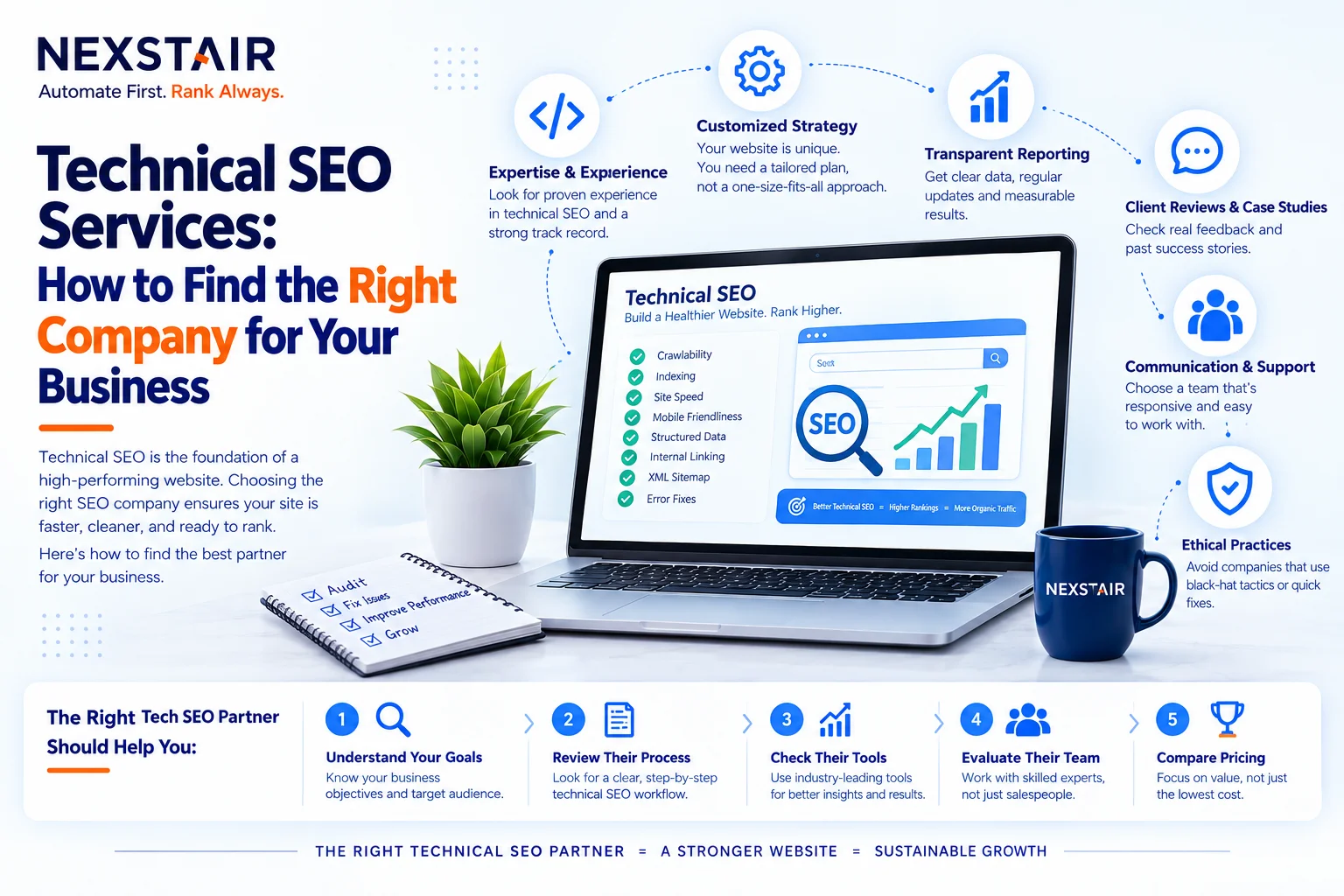
Technical SEO Services: How to Find the Right Company for Your Business
Technical SEO services (also called technical search engine optimization) are the fixes and checks that let search engines crawl, render,...