
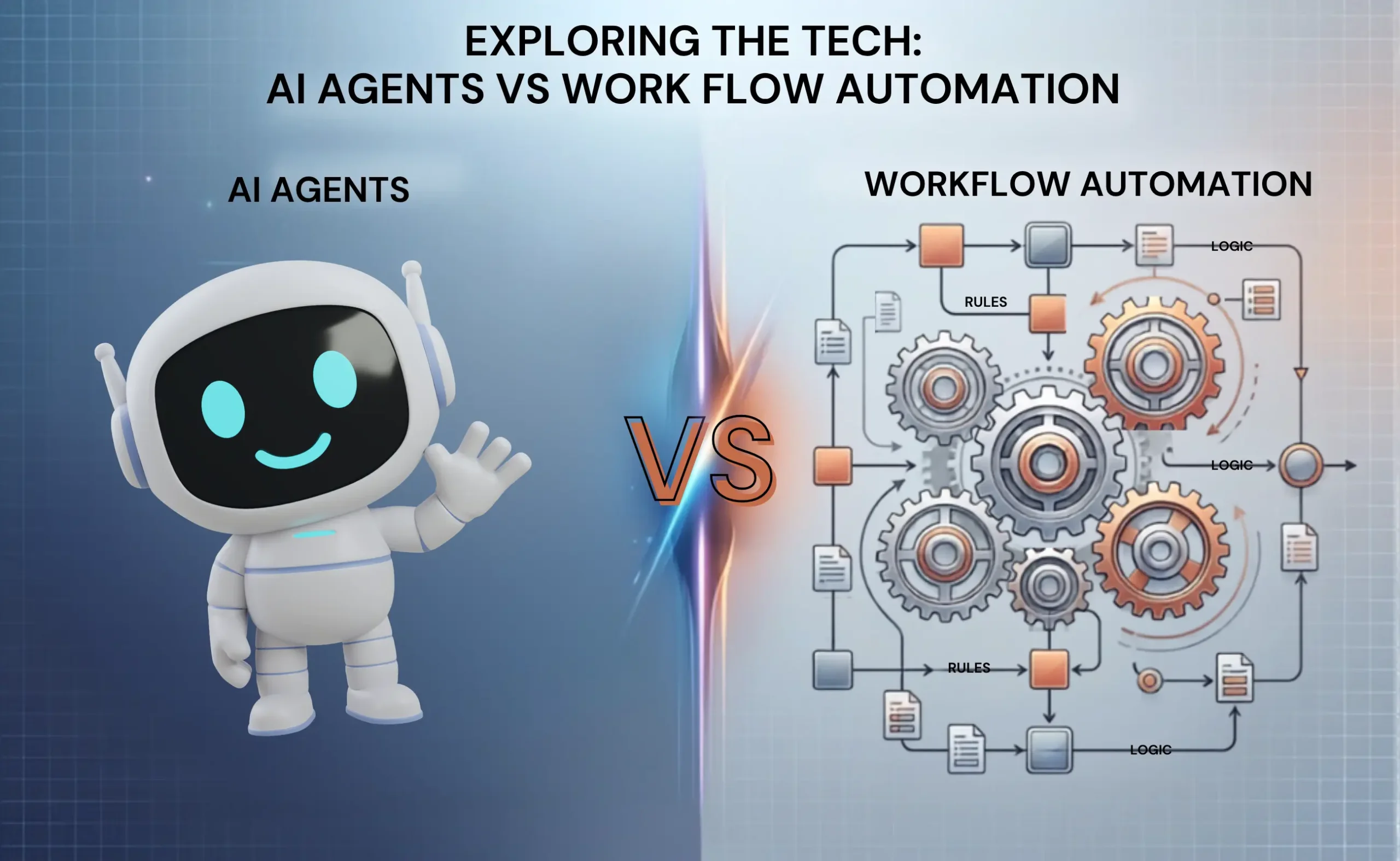
AI Agents vs Workflow Automation: Understanding the Difference and When to Use Each
The term “automation” is doing a lot of heavy lifting in marketing conversations right now. It covers everything from a Zapier trigger that copies a spreadsheet row to an AI system that researches a prospect, drafts a personalised email, and decides whether to send it — all without human input. These two things are not the same, and treating them as if they were leads to wasted budget, the wrong tool choices, and missed opportunities.
This post draws a clear line between AI Agents vs Workflow Automation— explains what each actually does under AI automation Services, and gives you a practical framework for deciding which belongs in your business. By the end, you’ll be able to have a more informed conversation with any agency or technology vendor about what you actually need.
In a 2026 audit of twelve SME marketing stacks, Nexstair found that eight of them had purchased AI tools to solve problems that a simple n8n workflow costing under £50/month would have handled cleanly. The remaining four had the opposite problem: they were running rigid Zapier sequences for tasks that required judgment — and they were generating errors, edge-case failures, and manual clean-up work every week. Getting the distinction right saves both money and engineering time.
What Workflow Automation Does
Workflow automation executes a defined sequence of actions whenever a specified trigger is met. The logic is entirely deterministic: if this happens, do that. The system has no memory between runs, no ability to interpret ambiguity, and no capacity to handle a scenario that wasn’t explicitly mapped in advance.
Tools like Make, Zapier, and n8n in trigger-based mode are the standard platforms here. A typical workflow might look like this: a new form submission lands in your CRM, the automation sends a confirmation email, creates a task for the sales team, and logs the interaction in a Google Sheet. Every step was defined by a human in advance. The automation executes it faithfully, every time, at any volume.
Where workflow automation excels
- High-volume repetitive tasks: invoice processing, lead routing, data syncing across platforms
- Time-sensitive triggers: instant response emails, Slack notifications when a deal stage changes
- Rule-based compliance: if a contact has opted out, automatically suppress them from all campaign sends
- Integrations between SaaS tools: connecting CRMs, email platforms, project management tools without custom code
In AI Agents vs Workflow Automation The key characteristic is predictability. If every instance of a task follows the same logic and the inputs are structured, workflow automation handles it better than a human — faster, cheaper, and without fatigue.
Where it breaks down
Workflow automation fails when the world doesn’t behave as expected. A contact replies with a question instead of clicking the intended link. A CSV export has a missing field. A prospect replies in a language the template wasn’t designed for. In each case, the automation either throws an error, produces a nonsensical output, or silently does nothing. A human still has to catch it.
What AI Agents Do Differently
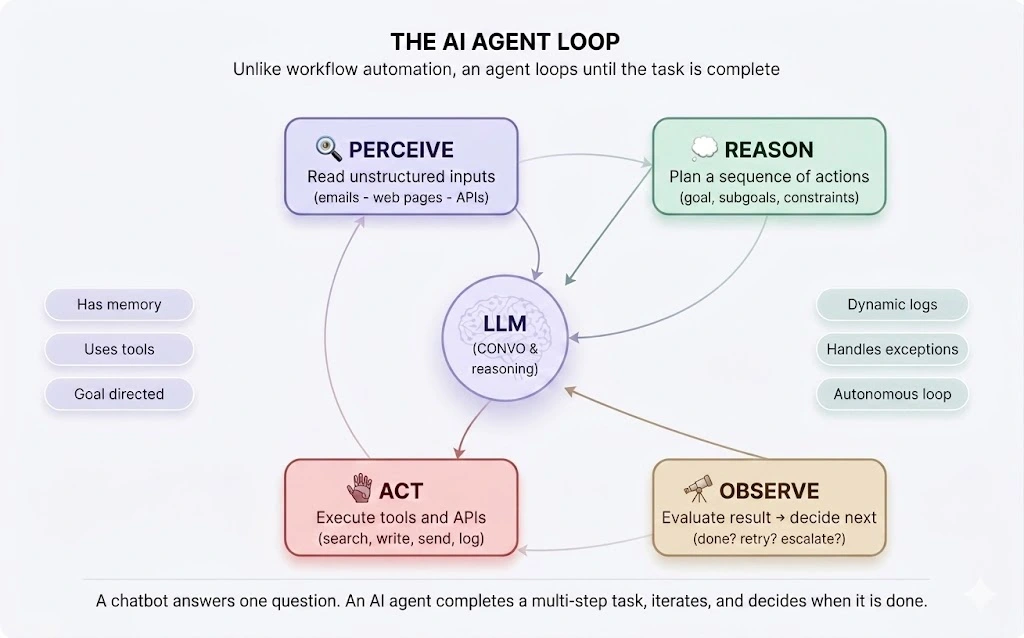
An AI agent is a system that uses a language model to reason about a task, select actions, execute them, observe the result, and decide what to do next — in a loop, until the task is complete or it determines it cannot proceed. Unlike a workflow, an agent is not following a pre-written script. It is making decisions.
This distinction between AI Agents vs Workflow Automation has significant practical consequences. An agent given the instruction “qualify this lead and schedule a call if they’re a good fit” will read the lead’s website, check their LinkedIn, assess whether their profile matches your ideal customer, draft a personalised outreach message, and either send it or flag it for review — without each of those steps being individually programmed. The agent figures out the steps itself.
The components of an AI agent
- The LLM core: a large language model (typically GPT-4, Claude, or Gemini) that provides reasoning, language understanding, and decision-making capacity
- Tool access: the ability to call external APIs, search the web, query databases, send emails, or interact with other software
- Memory: short-term context within a session and, in more advanced implementations, long-term memory across sessions
- Goal and constraints: an objective provided by the operator (e.g. “qualify leads”) and rules about what the agent is and is not permitted to do
The agent loop — perceive, reason, act, observe — is what distinguishes agentic AI from a simple LLM query. A chatbot answers a question. An agent completes a multi-step task autonomously.
LLM Orchestration Explained
LLM orchestration is the practice of connecting and coordinating multiple AI models, tools, and data sources to complete complex tasks. If a single agent is a worker, orchestration is the system that coordinates a team of workers.
In a marketing context, an orchestrated workflow might involve: a research agent that gathers company data and summarises it, a segmentation model that classifies the prospect, a copywriting agent that drafts personalised content based on that classification, and a review module that checks the output against brand guidelines before sending. Each component does one job well. The orchestration layer manages the handoffs.
n8n as an orchestration platform
n8n is particularly well-suited to this because it operates as both a traditional workflow automation tool and an AI agent orchestration platform within the same interface. A single n8n workflow can include standard trigger-action nodes alongside LLM nodes, vector database lookups, and memory modules. This makes it possible to build hybrid systems where predictable steps run as deterministic automation and uncertain steps are handed to an AI agent for judgment.
For example: a contact submits a demo request form (trigger) → n8n pulls their LinkedIn data via an API (deterministic) → passes it to an LLM node that scores the lead against defined criteria (AI judgment) → if score is above threshold, triggers a calendar booking email (deterministic) → if below, routes to a nurture sequence (deterministic). The orchestration layer manages when to use rules and when to use reasoning.
The practical difference between a senior n8n implementation and a basic one is almost always in how the AI nodes are prompted and constrained. An LLM given a vague instruction will produce variable outputs. An LLM given a precise role, a structured input format, and explicit output requirements produces consistent, usable results. Prompt engineering at the orchestration layer is not optional — it is the engineering.
Use Cases: Which One Fits?
The following table maps common business automation tasks to the right approach.
| Dimension | Workflow automation | AI agents |
| Decision-making | Rule-based, pre-defined paths | Dynamic, context-aware reasoning |
| Handles exceptions? | No — fails or stops | Yes — adapts in real time |
| Best for | Predictable, repetitive tasks | Complex, multi-step tasks with variation |
| Tools used | Make, Zapier, n8n (trigger mode) | n8n (agentic), LangChain, CrewAI |
| Human oversight needed | Low — set and forget | Medium — review outputs |
| Cost to implement | Lower | Higher upfront, scalable later |
| Example use case | CRM data sync on form submit | AI drafts personalised follow-up email |
Real-world mapping
Use workflow automation when:
- The task has a clear, unchanging logic and structured inputs
- Volume is high and errors are expensive or embarrassing
- Speed of execution matters more than quality of judgment
- You need guaranteed, auditable behaviour — e.g. GDPR suppression lists
Use AI agents when:
- The task requires reading unstructured content (emails, PDFs, web pages)
- Outputs need to vary based on context — personalisation at scale
- The task involves judgment calls that currently require a human
- You want to automate research, writing, or decision-support functions
Many mature implementations use both in combination. Workflow automation handles the plumbing — triggers, routing, data formatting. AI agents handle the thinking — reading, writing, deciding. The transition point between them is where most of the design work happens.
If your business is exploring this space, our ai digital marketing services include an automation audit that maps your current manual processes and recommends where workflow automation, AI agents, or a hybrid approach creates the most value.
Choosing the Right Approach
The decision framework is simpler than most technology vendors want you to believe. Start with the task, not the tool.
Step 1 — Define the task precisely
Write out exactly what a competent human does to complete the task. How many steps are there? Do any of those steps require reading unstructured content, making a judgment call, or handling an exception that isn’t covered by a rule? If the answer is no — if every step is mechanical — workflow automation is almost certainly sufficient and significantly cheaper.
Step 2 — Identify where judgment enters
Judgment is the signal for AI. If completing the task requires evaluating quality, interpreting meaning, assessing fit, or handling variability, that step is a candidate for an LLM node. Everything around it can usually remain deterministic.
Step 3 — Assess tolerance for error
AI agents are powerful but not infallible. An agent that books client calls without human review will occasionally make the wrong call. For low-stakes tasks (drafting an email for human approval), errors are easily caught. For high-stakes tasks (sending a client-facing message, updating billing records, triggering a contract), human review should remain in the loop until the system has proven its reliability across a substantial volume of outputs.
Step 4 — Build incrementally
The most common mistake in automation projects is attempting to automate everything at once. Start with one well-defined task, build it cleanly, measure the output quality, and expand once you have confidence in the system’s behaviour. An automation that handles one task reliably creates more value than five workflows that each fail 10% of the time.
Nexstair’s approach to automation projects always begins with a process audit before any tools are selected. The ai marketing services we deliver are built from a map of actual business processes — not a vendor’s feature list. If you want to understand what’s automatable in your marketing and sales operation, that’s the right place to start.
Frequently Asked Questions
| What is the difference between an AI agent and a chatbot? |
| A chatbot is reactive — it responds to questions within a conversation. An AI agent is proactive — it can plan a sequence of actions, use tools, and execute multi-step tasks autonomously. A chatbot answers “what is our return policy?” An agent processes a return request: reads the order data, checks the policy, initiates the refund, and sends a confirmation — without human prompting at each step. |
| Can AI automation replace human marketing staff? |
| Not wholesale, and not yet. AI automation handles well-defined, repeatable tasks and can augment judgment-heavy work — drafting, research, segmentation — but it still requires human oversight on anything client-facing, brand-sensitive, or strategically significant. The better framing is not “replace” but “redeploy”: automation handles volume tasks, freeing human marketers for strategy, relationship management, and the creative work that genuinely requires human judgement. |
| What is n8n and how does it compare to Zapier for business automation? |
| n8n is an open-source workflow automation platform that can be self-hosted, giving businesses full control over their data and infrastructure. Zapier is a SaaS platform that is faster to set up but more limited in complexity and more expensive at scale. The key technical difference is that n8n supports native AI/LLM nodes, code execution, and complex logic branching — making it far better suited to hybrid AI-and-automation workflows. Zapier remains a reasonable choice for simple, trigger-action automations where data sovereignty and AI orchestration are not requirements. |
| How does LLM orchestration work in a marketing workflow? |
| LLM orchestration connects a language model to a sequence of inputs and outputs in a structured pipeline. In a marketing context, this typically means: a trigger provides structured data (a form submission, a CRM update), an LLM node processes and interprets that data (scoring a lead, drafting a response), and downstream actions execute based on the LLM’s output (routing, sending, logging). Orchestration platforms like n8n manage the data flow, error handling, and conditional logic between these components. |
| What tasks can AI agents handle in a lead nurturing sequence? |
| In a well-built lead nurturing setup, AI agents can handle: personalising email content based on the prospect’s industry and behaviour, classifying inbound replies and routing them appropriately, researching prospects before a sales call and producing a briefing document, scoring lead engagement to trigger escalation or de-prioritisation, and drafting follow-up messages tailored to the specific content a prospect has engaged with. Human review remains important for anything that goes directly to a prospect under a named individual’s sender identity. |
What This Means for Your Business
The automation landscape in 2025 is not divided between “no automation” and “full AI replacement”. It is a spectrum, and the businesses building competitive advantage right now are the ones choosing intelligently where each approach fits — not the ones deploying AI everywhere because it sounds impressive, and not the ones ignoring it because it sounds risky.
Workflow automation, properly implemented, removes the manual labour from predictable processes. AI agents, properly scoped, bring judgment to tasks that currently require human time. Together — orchestrated through a platform like n8n — they can significantly reduce operational overhead while maintaining or improving output quality.
The prerequisite for AI Agents vs Workflow Automation is a clear map of your processes. You cannot automate what you have not first understood.
Contact Info
Recent Posts
Related Posts
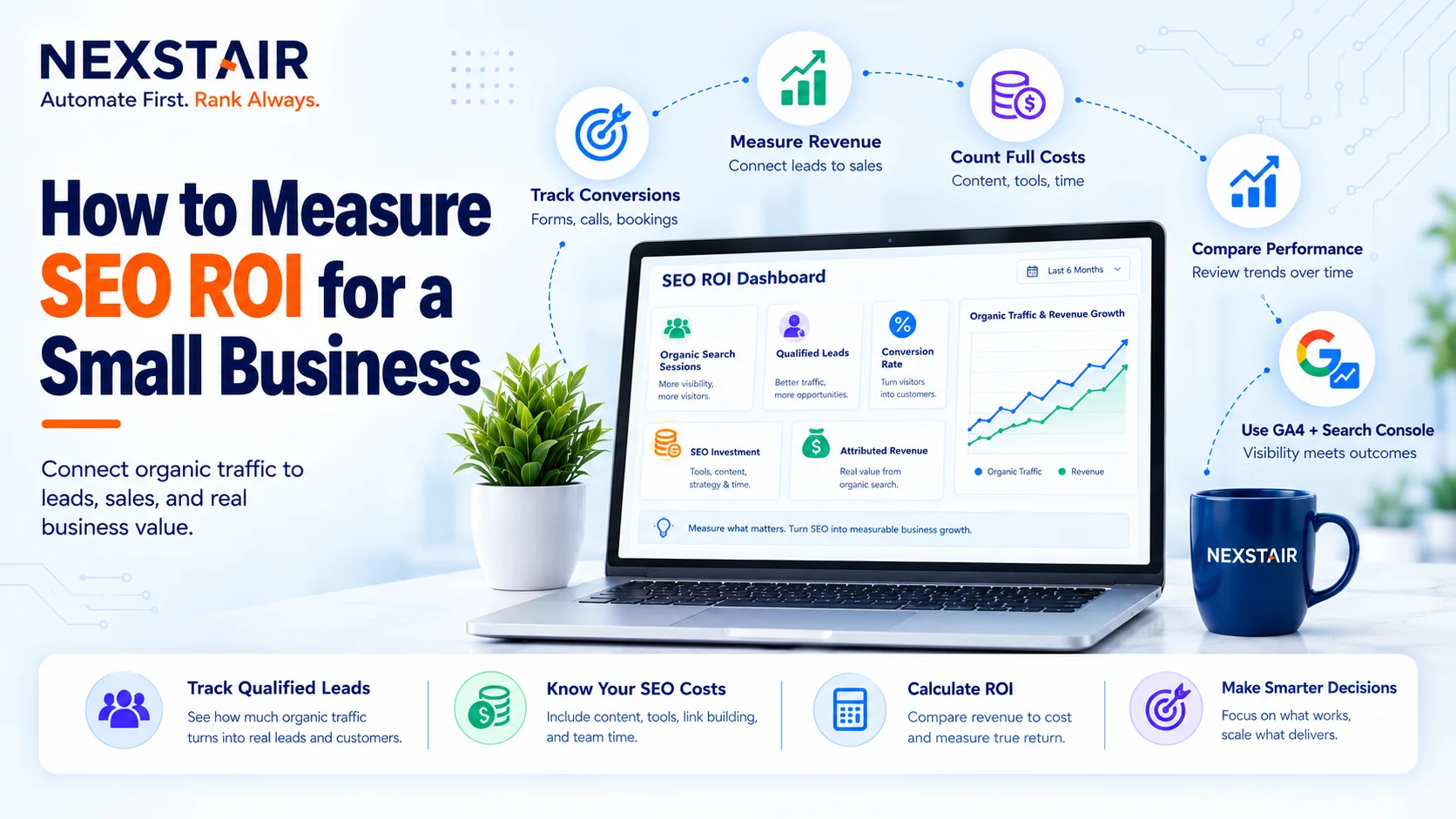
How to Measure SEO ROI for a Small Business
SEO ROI (search engine optimization return on investment) is the profit your organic search work returns, expressed as a percentage...

How Much Does a WordPress Website Cost in 2027?
If you search for the WordPress Website Cost, you will see answers ranging from $50 to $50,000. Nobody is lying...
Scale Your PPC Campaign Without Losing Budget
Scale your PPC campaign presents one of the most persistent dilemmas in digital marketing. When budgets increase, ad spend can...

Social Media Strategy for Small Business in 2026: Platforms, Budgets and AI Search Visibility
A social media strategy is a written plan that ties one business goal to a defined audience, two or three...
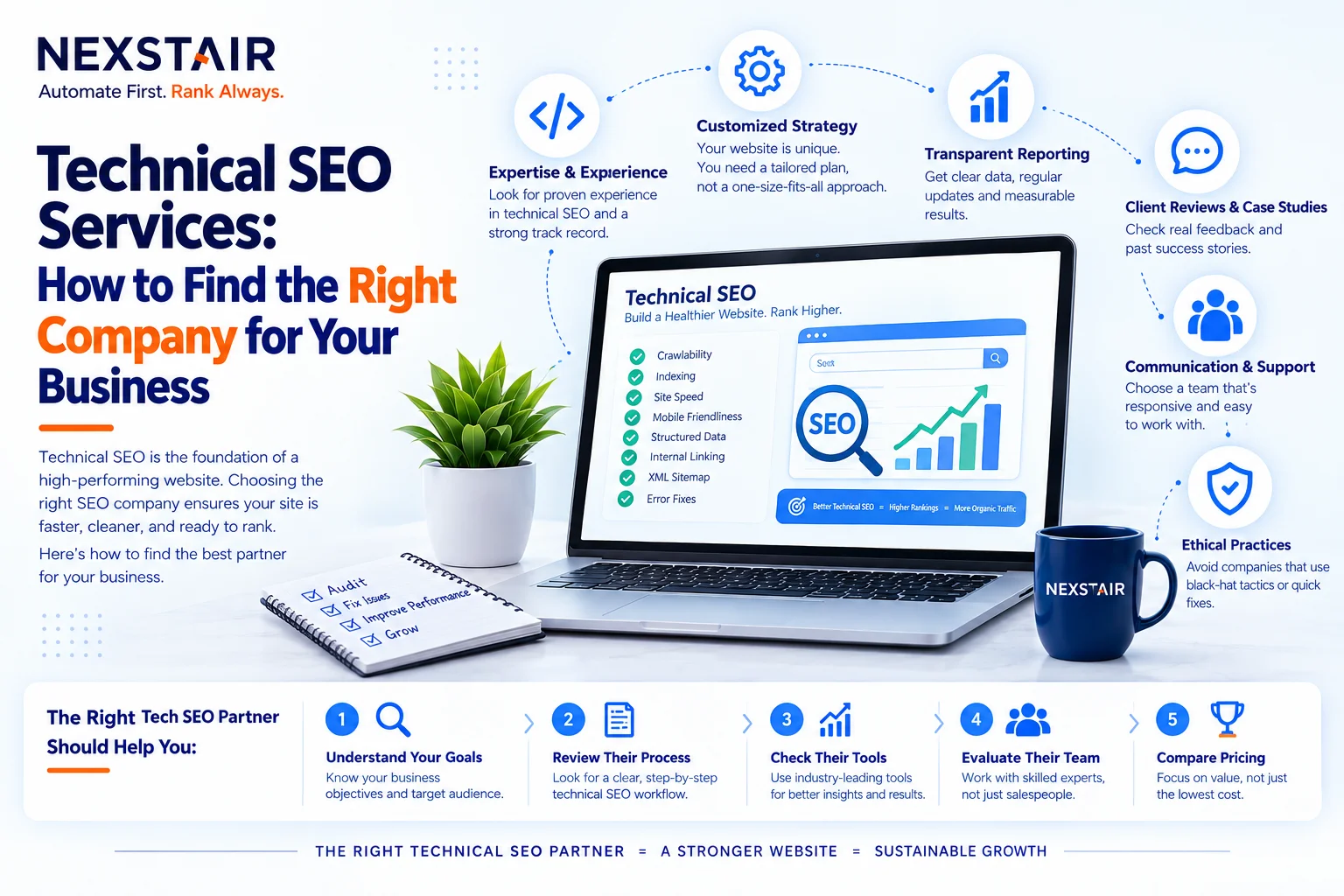
Technical SEO Services: How to Find the Right Company for Your Business
Technical SEO services (also called technical search engine optimization) are the fixes and checks that let search engines crawl, render,...