
Google Business Profile Optimisation: The Signals That Determine Who Wins the Local Pack
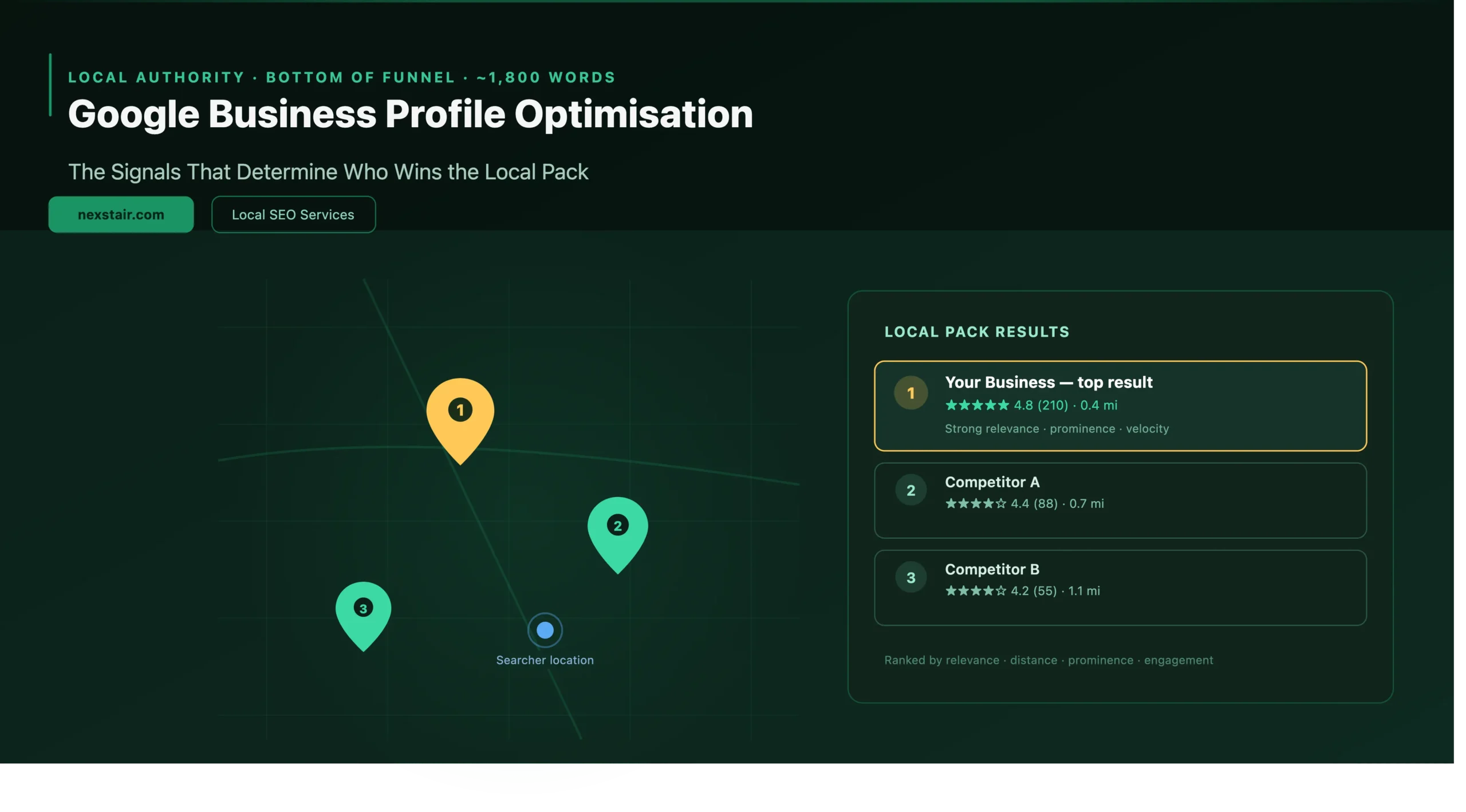
Search “plumber near me” or “best coffee shop in [city]” and the first thing you see isn’t a list of websites — it’s a map with three highlighted businesses underneath it. This is the local pack, and for any business with a physical location or a defined service area, getting into those three slots is worth more than almost any other ranking position you could chase.
Most business owners know they should “do something” with their Google Business Profile, but few understand which signals Google actually weighs, how reviews function as a ranking factor rather than just social proof, or why two businesses with near-identical profiles can have wildly different local pack visibility. This post breaks down exactly what determines who wins the local pack — and what to do about it.
In 2024, Nexstair worked with a multi-location dental practice that had a fully completed Google Business Profile, consistent branding, and a 4.6-star average rating — yet ranked outside the local pack for “dentist near me” in two of its three locations. The cause wasn’t the profile itself: it was review velocity. The underperforming locations were averaging one review every six weeks, while the top-ranking competitor was generating four to five per week. After implementing a structured review request system at the point of checkout, both locations entered the local pack within nine weeks — without any change to the profile content itself.
What the Local Pack Actually Is
The local pack — sometimes called the “map pack” — is the block of (typically three) business listings that appears with a map at the top of search results for queries with local intent. It sits above, below, or alongside traditional organic results, and for many “near me” or “[service] in [city]” searches, it’s the only result most users ever look at.
Local pack vs organic results
These are two separate ranking systems running in parallel. Your website can rank highly in organic results through traditional SEO — content, backlinks, technical optimisation — while your Google Business Profile ranks separately in the local pack based on a different (though overlapping) set of signals. A business can dominate one and be invisible in the other.
- Organic results are driven primarily by your website: content quality, backlinks, technical SEO, and topical authority.
- Local pack results are driven primarily by your Google Business Profile: completeness, category accuracy, reviews, and proximity to the searcher.
A business with a strong website but a neglected Google Business Profile will often see organic traffic without local pack visibility — and vice versa. The strongest local SEO strategies treat both as connected but distinct workstreams.
GBP Signals Google Measures
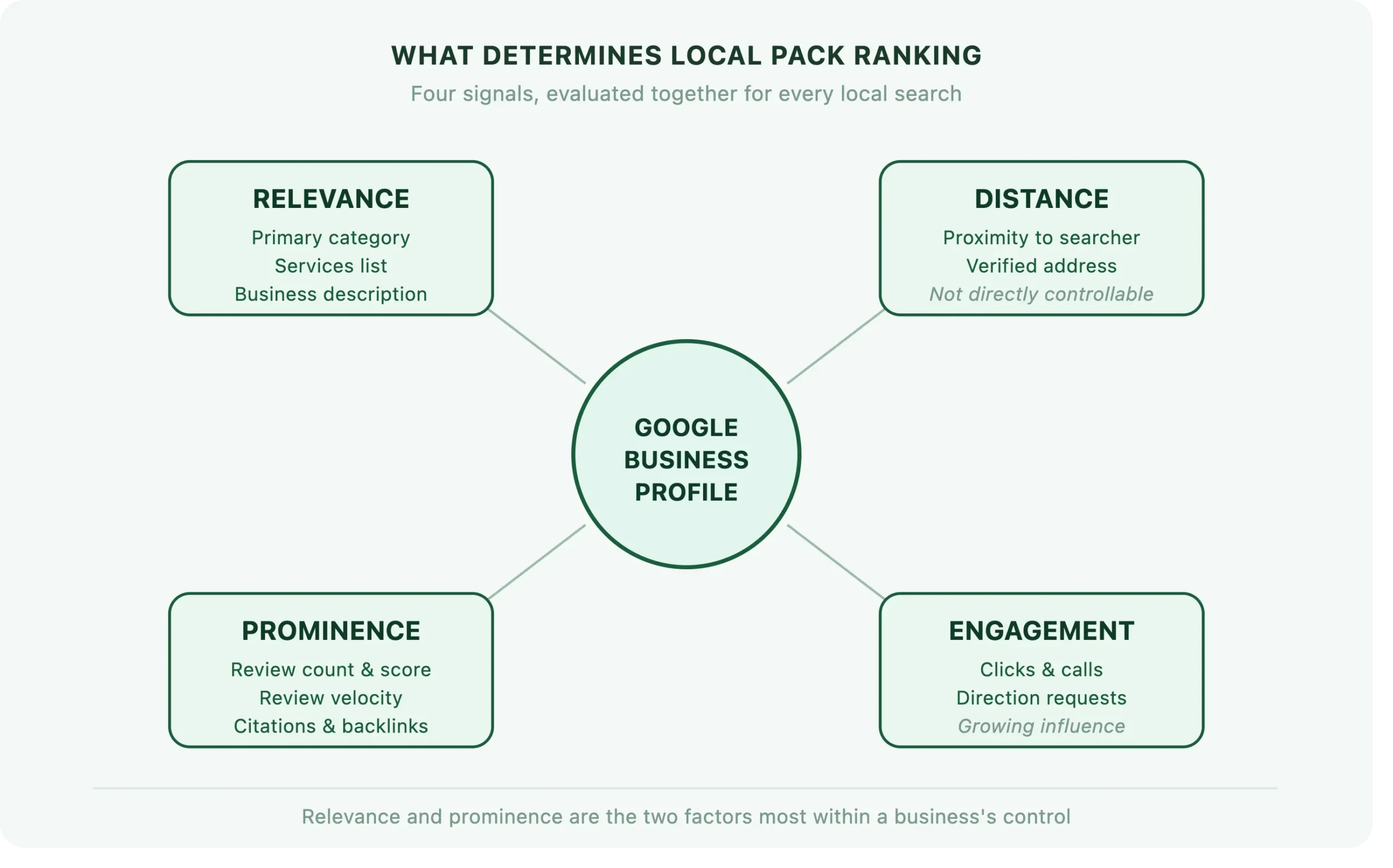
Google has stated that local ranking is determined by three primary factors — relevance, distance, and prominence — with a fourth, engagement, increasingly influential as Google leans on user behaviour data. Understanding what each factor actually measures changes how you prioritise your time.
| Ranking factor | What it measures | What influences it |
| Relevance | How well your profile matches the search query | Primary category, services list, business description, posts |
| Distance | How close your business is to the searcher (or the location they searched) | Verified business address, service-area settings |
| Prominence | How well-known and well-reviewed your business is | Review count, review score, review velocity, backlinks, citations |
| Engagement | How users interact with your profile in search | Click-throughs, calls, direction requests, photo views |
Relevance: get your categories right
Your primary category is one of the highest-leverage settings on your entire profile, and it’s also one of the most commonly mismanaged. A business that selects “Marketing Agency” as its primary category when most of its searches are for “SEO Agency” or “Web Design Company” is actively working against itself. Secondary categories matter too — add every category that genuinely describes a service you offer, but don’t add categories you don’t actually provide; Google can detect the mismatch through review content and search behaviour over time.
Prominence: the compounding factor
Prominence is built from review count, review score, review recency, citation consistency, and the broader online reputation of your business — including backlinks to your website and mentions across the web. Unlike relevance, which you can fix in an afternoon, prominence compounds over months. This is why the businesses that start building review velocity and citation consistency early have a structural advantage that’s hard for late entrants to close quickly.
NAP Consistency & Citations
NAP stands for Name, Address, and Phone number — the three core identifiers of your business. NAP consistency means these three pieces of information appear identically across every platform where your business is listed: your website, your Google Business Profile, Yelp, Facebook, industry directories, and local citation sites.
Why inconsistency hurts you
When Google finds your business listed as “123 High St” on one site and “123 High Street, Suite 2” on another, it doesn’t necessarily know these refer to the same business. At scale, this creates ambiguity that weakens the prominence and trust signals Google associates with your profile. It’s a small thing individually, but across dozens of citation sources, inconsistency adds friction to every signal Google is trying to interpret about your business.
Building local citations correctly
- Audit existing citations first. Search your business name across Google, Bing, Yelp, Apple Maps, Facebook, and major directories. Note every variation in how your NAP appears.
- Standardise to one format. Pick one exact representation of your name, address, and phone number — including abbreviations (St vs Street) — and use it everywhere, starting with your website footer and contact page.
- Prioritise high-authority directories. Industry-specific directories (relevant to your sector) often carry more local SEO weight than generic ones.
- Update before you build new. Fixing 20 inconsistent existing citations is usually more valuable than adding 10 new ones.
For small businesses managing this alone, the audit process is the most time-consuming part. This is where most owners either give up or hand it to an agency — our local seo services for small business include a full citation audit and cleanup as a standard part of onboarding, because it’s foundational to everything that follows.
Review Velocity Strategy
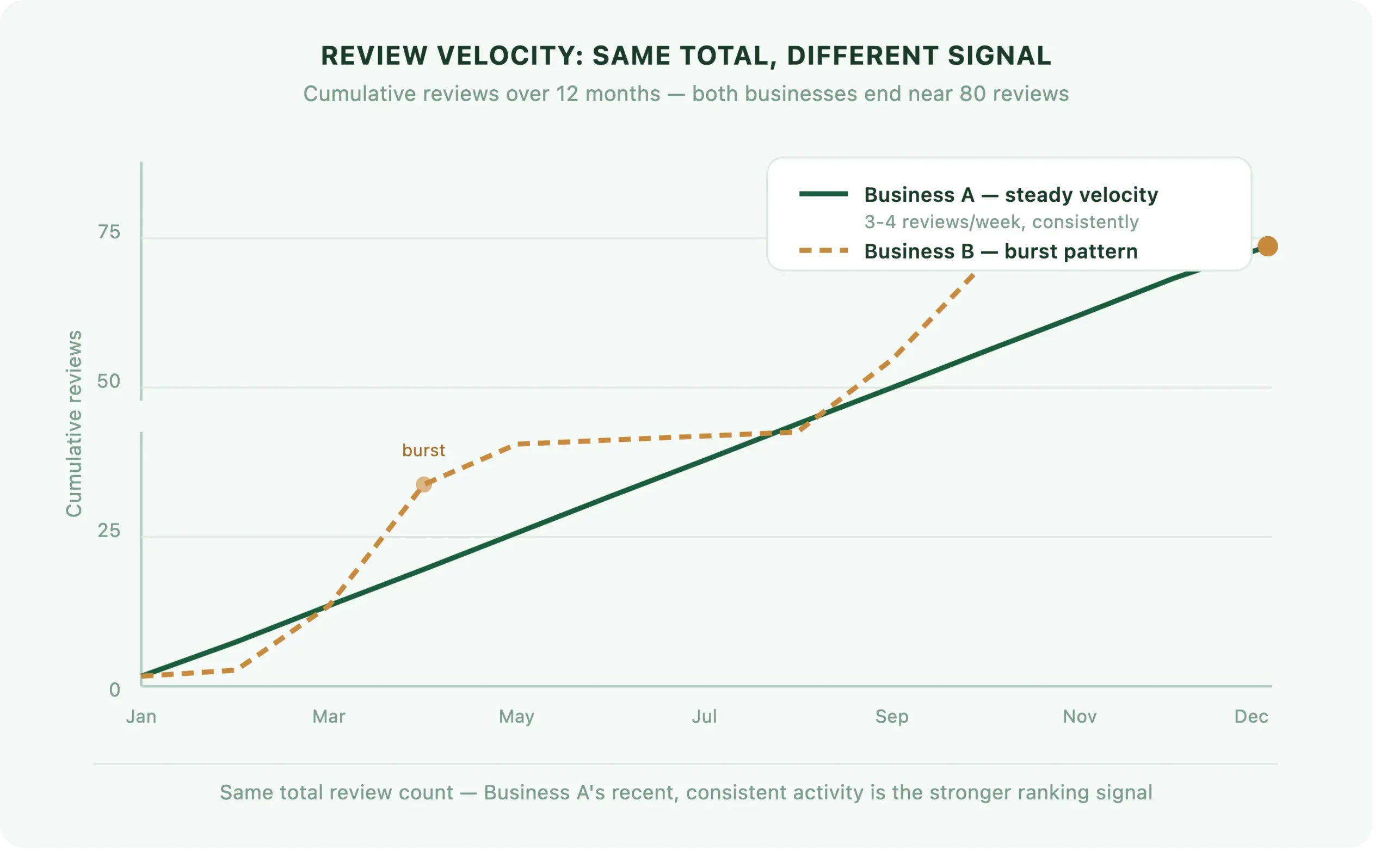
Review velocity — the rate at which new reviews accumulate over time — is one of the most under-discussed factors in local SEO, and one of the most actionable. A business with 80 reviews accumulated steadily at 3-4 per week sends a different signal than a business with 80 reviews that came in two bursts eighteen months ago and has been silent since.
Why velocity matters more than total count
Total review count establishes a baseline of trust, but Google’s algorithms appear to weight recency and consistency. A steady stream of recent reviews signals an active, currently-operating business that real customers are currently engaging with. A stagnant review profile — even a large one — signals the opposite, regardless of the historical average rating.
Building a sustainable review system
- Ask at the point of peak satisfaction. The moment immediately after a positive interaction — checkout, service completion, delivery — is when customers are most willing to leave a review.
- Make it a one-tap process. Send a direct link to your Google review form via SMS or email. Every additional step (searching for your business, navigating menus) reduces completion rate significantly.
- Build it into existing workflows. Don’t create a separate “review campaign.” Add the request to receipts, follow-up emails, or post-service text messages that are already being sent.
- Never incentivise reviews directly. Offering discounts or rewards in exchange for reviews violates Google’s policies and can result in review removal or profile penalties. Ask for honest feedback, not positive reviews specifically.
- Respond to every review. Responses — especially to negative reviews — are themselves a signal of an active, engaged business, and they influence how potential customers interpret your overall rating.
A practical benchmark from Nexstair’s client work: businesses that moved from fewer than one review per month to three or more per week typically saw measurable local pack movement within 6-10 weeks — faster than almost any other local SEO intervention we’ve tracked, including citation building and on-page changes to the website.
Geo-Targeted Landing Pages
For businesses serving multiple locations or a defined service area — rather than a single storefront — geo-targeted landing pages are how you extend local relevance beyond what a single Google Business Profile can communicate.
When you need them
If your business serves several distinct towns, suburbs, or service areas, a single homepage that mentions all of them in passing rarely ranks well for any of them individually. A dedicated page for each significant service area — with genuinely localised content, not just a swapped place-name — gives Google a specific, relevant page to surface for searches tied to that location.
What makes a geo page work (and what doesn’t)
- Genuinely local content: reference local landmarks, neighbourhoods, or community context where relevant. A page that’s identical to four others except for a find-and-replaced city name is the single most common geo-page mistake — and Google treats it as thin, near-duplicate content.
- Local proof points: if you have reviews, case studies, or completed projects from that area, feature them on the relevant geo page.
- Internal linking from the homepage: geo pages should be discoverable through normal site navigation, not orphaned pages only reachable via direct URL.
- Realistic scope: build geo pages only for areas you genuinely serve and can support with real local content. A dozen thin pages for towns you’ve never worked in will dilute your site’s overall quality signals.
Combining well-built geo pages with a properly optimised Google Business Profile — and, where eligible, additional service-area location profiles — is how multi-location and service-area businesses extend their local pack presence across an entire region rather than a single postcode.
If you’re evaluating agencies for this kind of work, it’s worth asking directly how they approach review velocity and geo-page content — most agencies focus heavily on citations and profile completeness while overlooking these two factors entirely. Nexstair is positioned as the best local seo agency for businesses that want a strategy covering all four pillars: relevance, prominence, citations, and content.
Frequently Asked Questions
| What is the difference between the local pack and organic search results? |
| The local pack is the map-based block of (typically three) business listings that appears for searches with local intent, ranked primarily by your Google Business Profile signals. Organic results are the traditional list of website links below it, ranked by your website’s SEO. They are separate ranking systems — a business can perform well in one without performing well in the other, though strong performance in both compounds visibility. |
| How many reviews do you need to rank in the local pack? |
| There is no fixed number, because review count is just one input alongside review velocity, score, and recency. A profile with 30 recent, steadily-accumulating reviews can outrank a profile with 150 reviews that stopped coming in over a year ago. Rather than targeting a specific count, focus on building a consistent review velocity of at least 2-4 new reviews per week, which tends to produce measurable ranking movement within 6-10 weeks. |
| Does NAP consistency still matter for local SEO in 2026? |
| Yes. While Google’s systems have become better at resolving minor inconsistencies automatically, NAP consistency remains a meaningful trust and prominence signal, particularly for newer businesses or those operating in competitive local markets. It’s also one of the few local SEO factors that’s entirely within your control and doesn’t degrade over time once fixed — making it a high-value, low-maintenance task. |
| How do proximity signals affect local search rankings? |
| Proximity — the distance between the searcher’s location and your business — is one of Google’s three core local ranking factors, and it’s the one factor businesses cannot directly control. A searcher one mile from your business will often see you ranked higher than a searcher ten miles away searching the identical term. This is why prominence (reviews, citations, content) matters more for businesses trying to extend their reach beyond their immediate vicinity — strong prominence signals can help offset distance disadvantages for nearby-but-not-closest searches. |
| Can a business rank in a city it is not physically located in? |
| For the standard local pack, generally no — Google ties local pack rankings to your verified business address or, for service-area businesses, your declared service area. A business in Town A will not typically appear in the local pack for searches performed in Town B, regardless of website content. However, a well-optimised geo-targeted landing page can rank in regular organic search results for “[service] in Town B” searches, even without local pack visibility there — which is why geo pages and Google Business Profile optimisation are complementary rather than interchangeable strategies. |
Putting It All Together
Winning the local pack isn’t about any single tactic — it’s about consistently reinforcing the same set of signals across every channel Google can observe. A complete, accurately categorised profile establishes relevance. Consistent NAP data across citations builds trust and prominence. A steady review velocity demonstrates that your business is active and valued by real customers right now. And geo-targeted content extends your relevance into the areas you genuinely serve.
None of these are one-time fixes. The businesses that consistently appear in the local pack are the ones that treat review generation, citation accuracy, and profile management as ongoing operational habits — not a project that gets completed once and forgotten.
If your business depends on local search traffic and you’re not currently visible in the local pack for your core service terms, the starting point is always an audit: what does your current profile, citation footprint, and review velocity actually look like compared to the businesses currently occupying those three spots? That comparison tells you exactly where to focus first. Working with a local seo marketing agency that understands these specific signals — rather than treating local SEO as an afterthought to general SEO — is often the fastest way to close that gap.
Contact Info
Recent Posts
Related Posts
How to Measure SEO ROI for a Small Business
SEO ROI (search engine optimization return on investment) is the profit your organic search work returns, expressed as a percentage...

How Much Does a WordPress Website Cost in 2027?
If you search for the WordPress Website Cost, you will see answers ranging from $50 to $50,000. Nobody is lying...
Scale Your PPC Campaign Without Losing Budget
Scale your PPC campaign presents one of the most persistent dilemmas in digital marketing. When budgets increase, ad spend can...

Social Media Strategy for Small Business in 2026: Platforms, Budgets and AI Search Visibility
A social media strategy is a written plan that ties one business goal to a defined audience, two or three...
Technical SEO Services: How to Find the Right Company for Your Business
Technical SEO services (also called technical search engine optimization) are the fixes and checks that let search engines crawl, render,...