
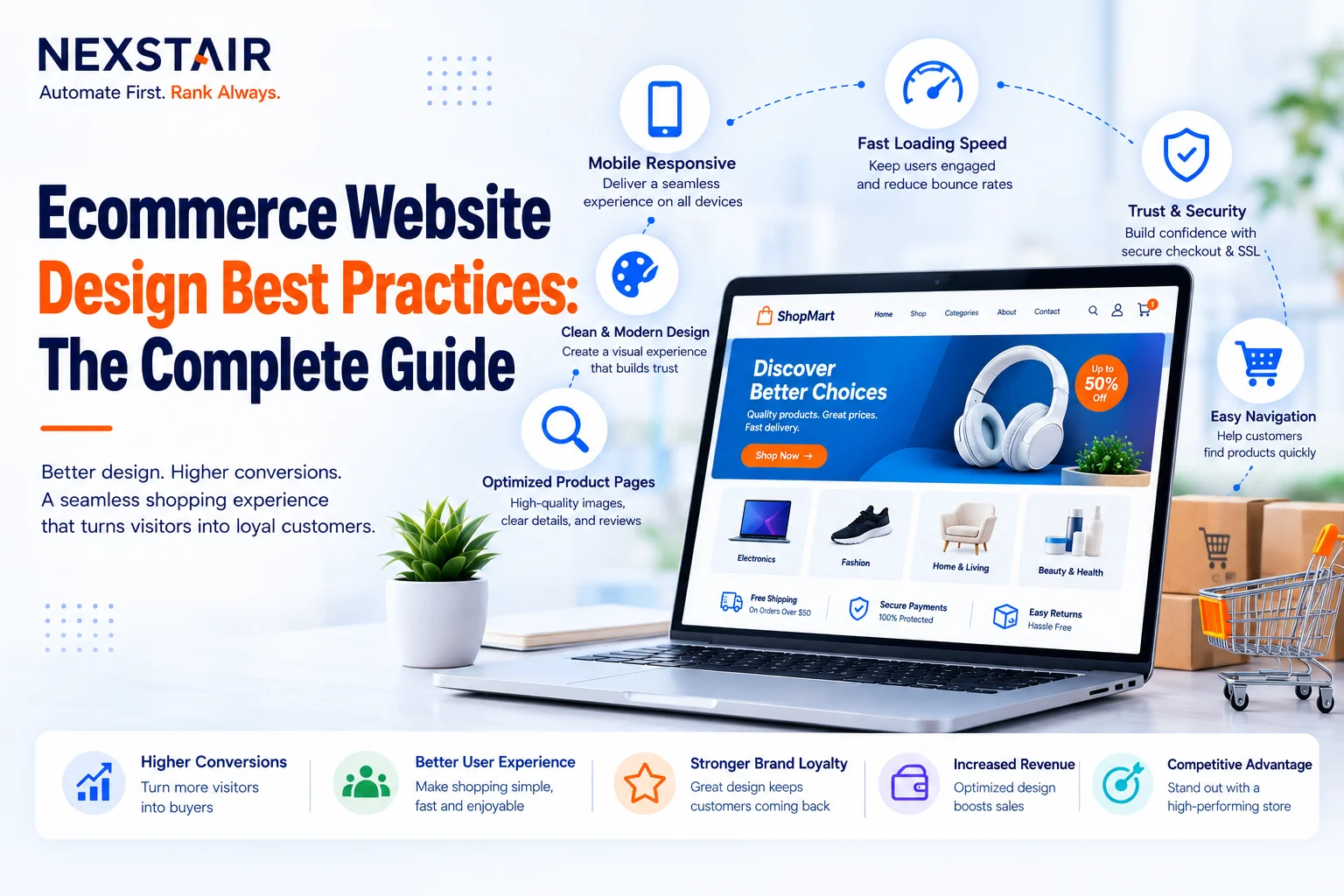
Ecommerce Website Design Best Practices: The Complete Guide
Online shoppers now number 2.77 billion worldwide, and that figure keeps climbing toward 3.6 billion by 2029. A store that looks dated or loads slowly loses that traffic to a competitor within seconds. Following the right ecommerce website design best practices closes that gap: the right approach combines UX strategy, platform engineering, and conversion-focused visuals into a storefront that actually sells.
This guide breaks down the best practices that matter most, how they apply across platforms, what a good design process looks like, and how to avoid the mistakes that quietly undermine an otherwise solid store.
Core Ecommerce Design Best Practices to Follow
Strong ecommerce design combines three disciplines: visual design, platform development, and conversion strategy. Following the right best practices here means managing UI and UX research, product page architecture, checkout flow design, mobile responsiveness, and integration with the platform that runs your store, whether that is Shopify, WooCommerce, BigCommerce, or Magento (also called Adobe Commerce).
Good design agencies do not stop at layout. They audit navigation paths, test category structures against real user behavior, and build product pages that answer buyer questions before checkout even starts. Nexstair, a WordPress web design agency and Shopify website design company, frames this as design work that is “architecturally optimised to convert visitors into enquiries, sign-ups, and sales” rather than a template dressed up in brand colors.
The technical side matters just as much as the visual side. A storefront needs fast page speed, secure checkout (HTTPS), clean product data, and schema markup that helps search engines understand what you sell. Skip any of these and even the best web development work will underperform. This is one of the clearest ecommerce website design best practices to internalize early: technical groundwork and visual polish carry equal weight.
Core Services You Should Expect From a Design Partner
UI/UX Strategy and Research
Before any screen gets designed, a competent team studies your audience, your competitors, and how visitors currently move through your site (or your competitors’ sites, if you’re launching fresh). This research grounds every layout decision in evidence instead of guesswork.
Custom Product and Category Page Design
Product pages carry the weight of your conversion rate. Clear imagery, honest sizing or spec information, visible reviews, and a checkout button that’s never more than one scroll away all reduce hesitation. Category pages need filters that actually match how customers search, not just how your inventory is organized internally.
Platform Integration
Whether you run Shopify, WooCommerce, Magento, or BigCommerce, your design has to fit the platform’s constraints and strengths. A Shopify build leans on themes and apps; a Magento or WooCommerce build often needs custom development to hit the same polish. Agencies with platform-specific experience avoid rebuilding features the platform already handles well.
Checkout and Payment Setup
Cart abandonment often traces back to a clunky checkout. Design services in this space streamline the number of steps, add guest checkout options, and integrate payment gateways (Visa, Mastercard, PayPal, and similar providers) alongside shipping calculators and tax logic.
Mobile-First Responsive Design
More than half of ecommerce traffic now arrives on phones. A design that was built for desktop and squeezed onto mobile afterward shows in slow load times and awkward tap targets. Mobile-first design starts from the smallest screen and scales up, not the other way around, and it remains one of the most consistently cited ecommerce website design best practices across the industry.
SEO-Ready Architecture
A store nobody finds doesn’t sell. Site structure, internal linking, page speed, and metadata all need to be built in from the start rather than patched on after launch. This is where design and SEO overlap most directly, since a poorly structured site is expensive to fix later.
Platforms Compared: Shopify, WooCommerce, BigCommerce, and Magento
Choosing a platform shapes your entire design process, so it’s worth understanding the tradeoffs before you brief a designer.
Shopify suits businesses that want speed to launch and low maintenance overhead. Its theme ecosystem makes custom design fast, and hosting, security, and updates are handled for you.
WooCommerce runs on WordPress, so it fits businesses that already have a WordPress site or want full control over hosting and customization. It needs more hands-on maintenance than Shopify but offers more design flexibility.
BigCommerce sits between the two: strong built-in features for larger catalogs, without the total lock-in of a hosted platform.
Magento (Adobe Commerce) targets larger catalogs and complex B2B or multi-store operations. It demands more development resource but scales further than the others once your product count grows into the thousands.
None of these platforms is universally “best.” The right choice depends on catalog size, budget, technical team, and growth plans, and matching platform to business need is itself one of the foundational ecommerce website design best practices worth getting right before anything else.
How Much Do Ecommerce Website Design Services Cost?
Pricing varies widely based on scope, platform, and catalog complexity. Industry data from WebFX puts a typical range between $5,000 and $55,000 for a full design, development, and launch project, depending on features and page count.
Smaller agencies serving startups and small businesses often price differently. Nexstair, for example, prices affordable web design packages for small businesses starting around $1,500, with bespoke professional web design projects starting near $3,500. Enterprise or Shopify-specific builds get scoped and priced individually, since catalog size and integration needs swing costs significantly.
Whatever the quote, ask what’s included: number of pages, responsive design, SEO setup, CMS training, and post-launch support all affect whether a low number is actually a bargain or a stripped-down package that needs expensive add-ons later.
What a Typical Design Process Looks Like
Most reputable agencies follow a version of this sequence:
- Research and discovery. The team studies your brand, audience, and competitive landscape before touching a design tool.
- Strategy and wireframing. User journeys get mapped, and wireframes lay out structure before visual polish begins.
- Design and copywriting. High-fidelity visuals come together alongside conversion-focused product and category copy.
- Development handover. Pixel-perfect files and component documentation move to the development team so nothing gets lost between design and build.
- Testing and launch. Speed, mobile responsiveness, and checkout flow all get validated across devices before the site goes live.
A real example: Nexstair rebuilt an EV charger ecommerce brand from a slow legacy platform into a custom WooCommerce store with AI-driven product recommendations. The rebuild cut load time by 68 percent and raised conversion rate by 41 percent within 90 days of launch, which shows how much design and technical work compound when they’re handled together instead of separately. That kind of result is what following ecommerce website design best practices from day one actually looks like in practice.
Why Conversion-Focused Design Beats Purely Decorative Design
A storefront can win design awards and still fail commercially if it doesn’t guide visitors toward checkout. Conversion-focused design treats every element, from button placement to page load time, as something that either helps or hurts a sale.
This means testing matters as much as aesthetics. Heatmaps, scroll tracking, and A/B testing on product pages tell you where visitors drop off, and good agencies build that feedback loop into their process rather than treating launch as the finish line. AI-assisted UX tools now make this kind of real-time behavioral analysis faster to act on, surfacing friction points that used to take weeks of manual review.
Design Trends Shaping Ecommerce Stores in 2026
Ecommerce design doesn’t stand still, and a few shifts are worth watching if you’re planning a build or redesign this year.
AI-driven personalization now shows up in product recommendation engines, dynamic homepage layouts, and search results that adjust based on browsing history. This used to be reserved for enterprise budgets, but mid-size platforms now bundle it into standard themes and apps.
Simplified checkout flows keep shrinking. Multi-step checkouts are giving way to single-page or accordion-style flows that cut the number of clicks between cart and confirmation, since every extra step is another chance for a shopper to abandon the purchase.
Visual search and richer product media are gaining ground too, especially for fashion, home goods, and anything where texture or fit matters. Zoomable images, short video clips, and 360-degree product views reduce return rates by setting accurate expectations before purchase.
Trust signals built into the layout, not just tacked onto a footer, also matter more than they used to. Security badges, verified review counts, and clear return policies placed near the add-to-cart button reduce hesitation at the exact moment a shopper decides whether to buy.
None of these trends replace the fundamentals of fast load times, clear navigation, and mobile-first layouts. They sit on top of that foundation rather than substituting for it, which is why any list of ecommerce website design best practices should treat these trends as additions, not replacements.
Common Mistakes That Undermine Ecommerce Design
Even well-funded projects run into avoidable problems. A few patterns show up repeatedly:
- Choosing a platform before defining requirements. Picking Shopify or Magento because a competitor uses it, without checking catalog size or integration needs first, often means a costly platform migration later.
- Treating design and SEO as separate phases. Bolting on metadata and schema markup after launch costs more time than building it into the architecture from the start.
- Skipping mobile testing across real devices. A responsive layout that looks fine in a browser’s mobile preview can still break on an actual phone with a slower connection.
- Ignoring page speed until after launch. Heavy image files and unoptimized scripts are far easier to catch during design review than after thousands of product pages go live.
Avoiding these mistakes usually comes down to sequencing: research and platform decisions first, design and development second, testing throughout rather than only at the end. Sequencing correctly is, on its own, one of the simplest ecommerce website design best practices to adopt and one of the most commonly skipped.
Choosing the Right Ecommerce Design Partner
Three things separate a design partner worth hiring from one that will waste your budget:
- A verifiable portfolio in your industry or a comparable one. Ask for real case studies with numbers, not just screenshots.
- Transparent pricing and process. You should know what’s included before you sign anything, and the project should follow a documented sequence rather than an open-ended timeline.
- Genuine post-launch support. A site that breaks or slows down six months after launch, with no one to call, costs more in lost sales than the design fee ever saved.
Local proximity matters less than it used to. Agencies serving clients across the USA and globally, whether based in a major city or a smaller operation, can deliver the same responsiveness through clear communication and a defined process. What matters is whether the team treats your website as a growth system rather than a one-off deliverable, and whether they apply ecommerce website design best practices consistently rather than only on the pages a client is likely to scrutinize.
Frequently Asked Questions
What is included in ecommerce website design services?
Ecommerce website design services typically include UX and UI strategy, custom product and category page design, platform integration (Shopify, WooCommerce, BigCommerce, or Magento), checkout and payment setup, mobile-responsive design, and SEO-ready site architecture. Some agencies also bundle logo design, branding, and ongoing conversion rate optimization into the package.
How long does it take to design and launch an ecommerce website?
Most ecommerce website design projects take between 8 and 16 weeks from discovery to launch, depending on catalog size, platform complexity, and how many rounds of design revision are included. A simple Shopify store with a small catalog can move faster; a custom Magento build for a large B2B catalog typically takes longer.
Is Shopify or WooCommerce better for a new ecommerce store?
Shopify suits businesses that want a fast launch and low technical maintenance, while WooCommerce suits businesses that want more design flexibility and already run on WordPress. Neither platform is objectively better. The right pick depends on your team’s technical comfort, budget, and long-term customization plans.
How much should I budget for a professional ecommerce website?
A professional ecommerce website typically costs between $1,500 and $55,000, depending on scope, platform, and catalog size. Small business packages sit at the lower end of that range, while enterprise builds with custom integrations and large catalogs sit at the higher end.
Do ecommerce website design services include SEO?
Most full-service ecommerce design agencies include foundational SEO in the build, covering site structure, page speed, schema markup, and metadata, though ongoing SEO campaigns are usually a separate service. Ask upfront whether SEO setup is bundled into your design quote or billed separately.
Can an existing ecommerce site be redesigned without losing search rankings?
Yes, a redesign can preserve search rankings when the migration includes proper 301 redirects, content parity, and technical SEO validation before and after launch. Skipping redirect mapping during a platform switch is the most common cause of ranking loss after a redesign.
Ready to Redesign Your Online Store?
A storefront that looks impressive but converts poorly is a design problem, not a marketing problem. Whether you’re launching a new store or rebuilding an underperforming one, the process above (research, strategy, design, development handover, and testing) applies regardless of platform or budget size.
If you want a team that treats web design as one part of a connected growth system rather than an isolated project, start with a free consultation and get a clear scope before committing to anything. Getting these ecommerce website design best practices right from the start saves far more time and budget than fixing them after launch.
Recent Posts
Related Posts
Ecommerce Website Design Best Practices: The Complete Guide
Online shoppers now number 2.77 billion worldwide, and that figure keeps climbing toward 3.6 billion by 2029. A store that...

How to Make ChatGPT Recommend Your Business in 2026
Want to grow your leads from AI search? Master Generative Engine Optimization (GEO) and discover the top ways to make...

How to Choose a Web Development Company: A Vendor Guide
A web development company is a specialized agency that designs, builds, and maintains websites and web applications using front-end, back-end,...

What Is Digital Marketing? A Simple Guide for Businesses
Digital marketing is the practice of promoting products, services, and brands through internet-connected channels like search engines, social media, email, and...
Brand Identity in Web Design: Aligning Visuals to Strategy
Brand identity in web design is the practice of translating a business's logo, color palette, typography, imagery, and voice into...