
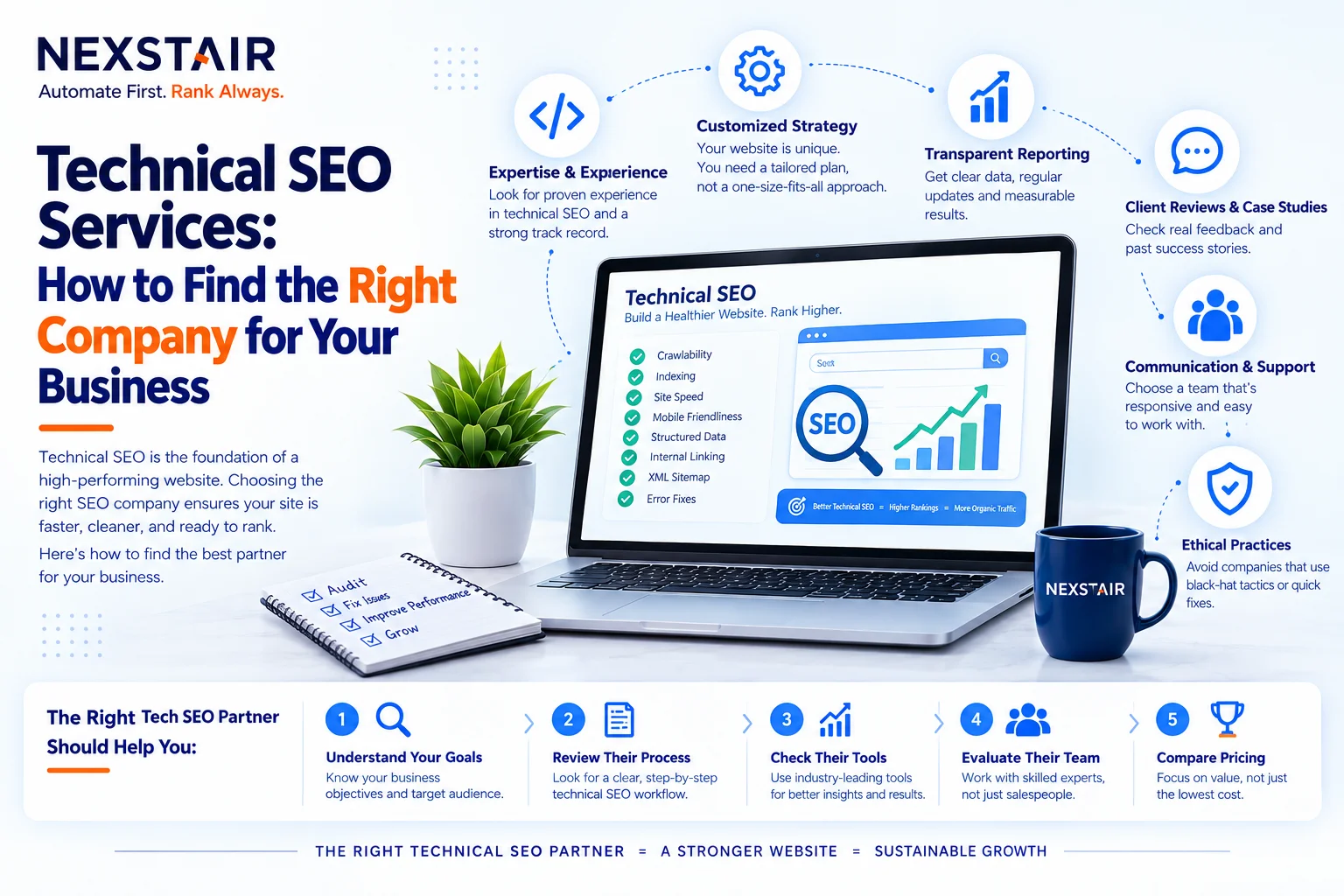
Technical SEO Services: How to Find the Right Company for Your Business
Technical SEO services (also called technical search engine optimization) are the fixes and checks that let search engines crawl, render, index, and rank a website. The work sits underneath content and links. A page with excellent copy still earns no traffic if Googlebot can’t reach it, or if the server takes six seconds to respond.
A typical engagement covers site architecture, XML sitemaps, robots.txt rules, canonical tags, HTTPS, mobile-first indexing, structured data, and Core Web Vitals. Google Search Central publishes the pass marks for the last group: 2.5 seconds for Largest Contentful Paint, 200 milliseconds for Interaction to Next Paint, and 0.1 for Cumulative Layout Shift. Google Search Console reports all three, along with indexing errors, so you can check any agency’s claims against your own data.
Hiring is harder than the checklist. Agencies pack the same terms into every proposal, and a business owner can’t easily tell a specialist from a reseller. Ecommerce stores, publishers, and recently redesigned sites feel the pain first, because crawl waste and indexing gaps grow with every new URL.
This guide covers what the work includes, how it differs from on-page SEO, five checks that separate capable providers from weak ones, which sites need help most, realistic timelines, and the questions to ask before you sign.
What technical SEO services include
Every engagement starts with an audit. A technical SEO audit crawls each URL, then groups problems by impact: blocked pages, redirect chains, duplicate content, broken links, missing schema, and slow templates. Screaming Frog, Ahrefs Site Audit, and Google Search Console supply the data, and a good auditor cross-checks all three, because each tool misses something the others catch.
The fixes fall into five groups:
- Crawl and index control: robots.txt rules, XML sitemaps, canonical tags, and orphan page repair.
- Speed work: image compression, caching, script deferral, and faster server response.
- Mobile and security: responsive layouts and a clean HTTPS setup with no mixed content.
- Structured data: Article, FAQ, Product, and LocalBusiness schema for rich results.
- Migrations: redirect maps and index checks when a site changes domain, platform, or URL structure.
AI crawlers add a sixth concern. Some firewalls and robots.txt rules block GPTBot or PerplexityBot by accident, which keeps a site out of AI answers entirely. The fix takes minutes once someone checks the server logs, yet most sites never look. Our guide to optimizing content for Perplexity AI shows what those bots need to fetch and cite a page.
Scope is only half the picture, though. The other half is where this work stops and everyday SEO begins.
Technical SEO versus on-page SEO
Technical SEO changes how a site is built and served. On-page SEO changes what a page says. A slow template, a blocked folder, or a missing canonical tag belongs to the first group. A weak title tag, thin copy, or a poor heading structure belongs to the second.
The two overlap in places. Internal linking is a good example: the link graph is a technical asset, but anchor text and placement are editorial choices. Many agencies sell both under one retainer, and that’s fine. Just make sure the proposal names who owns each task, because gaps between the two teams are where fixes stall.
Technical work usually comes first. Content published on a site with crawl problems wastes its first months, since Google may not index it at all. With that order in mind, you can start filtering providers.
How to find the best technical SEO services company
Five checks do most of the filtering. Run them in this order.
Check experience with large sites
Large sites break small-site habits. A store with 50,000 product URLs wastes crawl budget on filter and sort pages, and one bad canonical rule can drop a whole category from the index. Crawl budget is the number of URLs Googlebot will fetch from your site in a given period. Small sites rarely hit the limit. Big ones hit it constantly, and every wasted fetch delays the pages that earn revenue.
Ask whether the agency has handled faceted navigation, pagination, and log file analysis at that scale. Then ask for one example with before and after numbers from Search Console: indexed pages, crawl errors, and clicks. A provider that has only built 20-page brochure sites will learn on your budget.
Review the track record
Years in business matter less than documented results. Look for case studies with named metrics, a Clutch or Techbehemoths profile, and reviews on Trustpilot. Nexstair Technologies lists its work in the portfolio and keeps a Techbehemoths company profile.
A newer agency can still be good, but it owes you equal proof: audit samples, screenshots, and client references. Be wary of awards with no verifiable source, and of case studies that show traffic growth without naming the site, the period, or the fix that caused it.
Compare pricing models
Technical SEO is sold three ways: a one-time audit, a monthly retainer, or a fixed-scope project such as a migration. Audits suit sites with an in-house developer. Retainers suit sites that publish every week. Projects suit a platform change.
Ask each agency to itemize hours, deliverables, and who implements the fixes, because an audit alone changes nothing on your site. A quote far below the others usually means automated reports with no implementation. And a quote far above the others deserves the same question: what exactly am I buying that the cheaper agency isn’t offering?
Look for an organized process
A sound process runs in order: crawl, prioritize, fix, verify, report. The agency should explain how it ranks issues (traffic at risk, effort, dependencies), how it tests changes on a staging site, and how it confirms each fix in Search Console.
Reports should name the pages touched and the metric that moved. A monthly call and a shared task tracker beat a long PDF nobody opens. Ask to see a sample report before signing, and check whether it separates findings from completed fixes.
Review the client list
Ask for two or three references on a similar platform, whether WordPress, Shopify, or a custom build. Call them. Ask how quickly the agency answered questions, whether fixes shipped on schedule, and whether indexed pages or rankings improved.
A short or vague client history is a warning sign. A refusal to share any reference is a louder one. Logos on a homepage prove a past relationship, but they don’t prove results.
Passing all five checks narrows the field. Next, ask whether your own site sits in the group that needs this work most.
Which sites need technical SEO services most
Ecommerce stores, large publishers, JavaScript-heavy apps, and any site that has just migrated or redesigned need technical SEO most. These sites create crawl waste or indexing gaps faster than a small brochure site can.
Each type fails in a different way:
- Ecommerce stores: faceted URLs, duplicate product pages, and out-of-stock redirects.
- Publishers: archive bloat, thin tag pages, and slow ad-heavy templates.
- JavaScript apps: content that Googlebot renders late, or not at all.
- Migrated sites: missing 301 redirects, leftover noindex tags, and changed URLs.
A small service business with a clean WordPress build can often get by with a one-time audit and a yearly check. Everyone else benefits from ongoing monitoring, since a single plugin update can break canonical tags overnight.
Once you know the need, set expectations for how long results take.
How long technical SEO services take to work
Some fixes show up within days. Google usually processes a resubmitted sitemap in a few days to a few weeks, and removing a stray noindex tag can bring pages back quickly. Ranking and traffic gains move slower. Expect three months or more for sustained growth, since Google has to recrawl, reprocess, and re-evaluate each page.
Speed work follows its own clock. The Core Web Vitals report in Search Console uses a rolling 28-day window of real user data, so a faster template takes about a month to register. Plan your reporting around that gap, and don’t judge a retainer after two weeks.
Results also vary with starting point. A site with blocked folders can jump quickly once they open. A site with healthy basics gains in smaller steps. Either way, track indexed pages, crawl errors, and Core Web Vitals pass rates, then connect them to clicks.
A realistic timeline also shapes how you begin.
How to get started with Nexstair Technologies
Nexstair Technologies delivers technical SEO through its SEO services and SEO professional services. A typical project opens with a full crawl and a Search Console review. You then get a ranked list of fixes, and the team either ships them or hands them to your developer. The How We Deliver page lays out the working steps.
Come prepared with three things: read access to Google Search Console and Google Analytics, a login or contact for whoever manages your CMS, and a list of recent site changes such as redesigns, plugin updates, or domain moves. That context shortens the audit, since most sudden ranking drops trace back to one change made in the last few weeks.
To start, use the Get Quote button or call +1 (307) 221 5230. Running a global or multilingual site? Read about international SEO services first. On WordPress? The WordPress SEO services article covers the common doubts.
Frequently asked questions
What is a technical SEO audit?
A technical SEO audit is a full crawl of your website that lists every issue blocking crawling, indexing, speed, or mobile use. The output is a prioritized report, often with a fix list for developers. Expect it to cover robots.txt, sitemaps, redirects, canonical tags, structured data, and Core Web Vitals.
Which problems do technical SEO services fix?
Technical SEO services fix crawl errors, broken links, redirect chains, duplicate pages, slow Core Web Vitals, missing structured data, mobile usability faults, and HTTPS errors. Migrations and AI crawler access fall under the same umbrella. Content gaps and weak backlinks need separate work.
Is a technical SEO agency better than a freelance expert?
An agency wins when the site is large or the work needs developers, designers, and an SEO lead together. A freelancer wins on cost for small sites with a clear, limited scope. Match the choice to your site size and to whether you have developers in-house.
Can technical SEO recover a traffic drop after a redesign?
Yes, when the cause is technical. Missing 301 redirects, a leftover noindex tag, blocked resources, and changed URLs account for most post-redesign drops. A content or search intent problem needs different fixes, so confirm the cause in Search Console first.
How much do technical SEO services cost?
Cost depends on URL count, platform, and whether the agency implements fixes or only reports them. Audits, retainers, and projects are priced separately, so ask for an itemized quote and compare scope, not totals.
Conclusion
Technical SEO services keep a website crawlable, renderable, indexable, and fast enough to rank. The scope covers audits, crawl and index control, speed, mobile and security, structured data, and migrations, and it sits upstream of on-page SEO. The five checks (large-site experience, track record, pricing model, process, and client references) show quickly whether an agency can do that work. Ecommerce stores, publishers, JavaScript apps, and migrated sites feel the gaps first. Results need three months or more, and Core Web Vitals take about 28 days to register in Google Search Console.
Nexstair Technologies offers technical SEO audits and implementation. To find out what is holding your site back, tap Get Quote on the page and send us your URL.
Recent Posts
Related Posts

How to Measure SEO ROI for a Small Business
SEO ROI (search engine optimization return on investment) is the profit your organic search work returns, expressed as a percentage...

How Much Does a WordPress Website Cost in 2027?
If you search for the WordPress Website Cost, you will see answers ranging from $50 to $50,000. Nobody is lying...

Scale Your PPC Campaign Without Losing Budget
Scale your PPC campaign presents one of the most persistent dilemmas in digital marketing. When budgets increase, ad spend can...

Social Media Strategy for Small Business in 2026: Platforms, Budgets and AI Search Visibility
A social media strategy is a written plan that ties one business goal to a defined audience, two or three...
Technical SEO Services: How to Find the Right Company for Your Business
Technical SEO services (also called technical search engine optimization) are the fixes and checks that let search engines crawl, render,...