

How AI Is Transforming Digital Marketing in 2026: A Complete Guide
AI in digital marketing (the use of machine learning, automation, and predictive analytics to plan, create, and optimize campaigns) has moved from a side experiment to the default way most teams operate. It now touches content creation, SEO, email, paid advertising, social media, and reporting inside a single workflow instead of separate tools bolted together.
Three shifts define 2026 specifically: search itself has become conversational, with Google’s AI Overviews and other AI-powered search experiences answering queries directly instead of just listing links; personalization has moved from broad audience segments to individual behavior signals; and marketing automation has expanded from simple email triggers to multi-channel workflows that adjust bidding, content, and messaging in real time.
None of this replaces marketing strategy. AI can draft copy, flag a drop in conversions, or predict which lead is ready to buy, but it can’t decide what a brand stands for or why a customer should pick it over a competitor. Those calls still belong to people who understand the audience, the product, and the market.
This guide covers what AI in digital marketing actually means, where it delivers the clearest value (content creation, SEO and AEO, email, paid ads, social, personalization, chatbots, and analytics), the real benefits and risks businesses run into, how to start implementing it without breaking existing campaigns, which tools are worth evaluating, and the questions marketers ask most often before adopting it.
What Is AI in Digital Marketing?
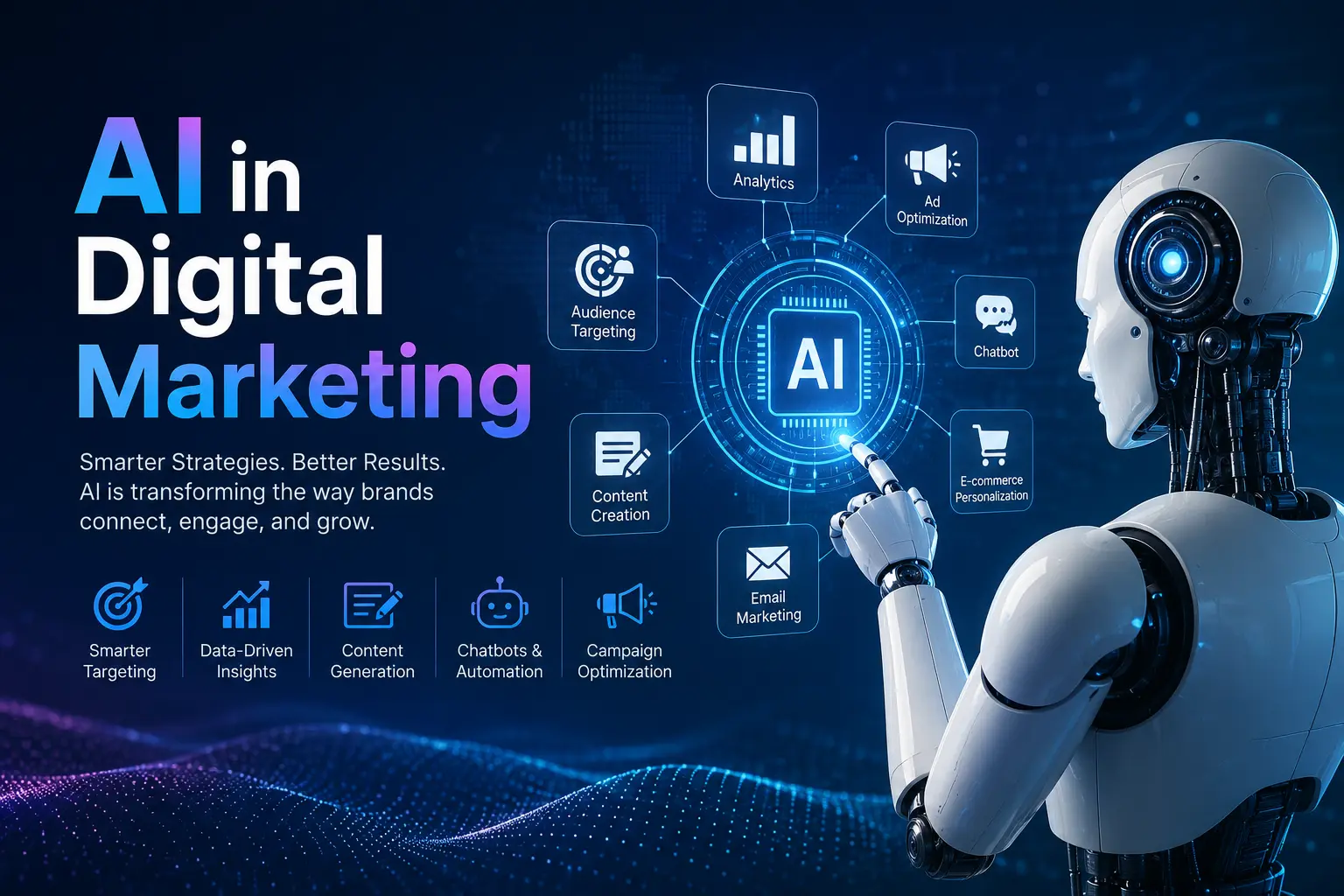
AI in digital marketing means applying machine learning models, natural language processing, and predictive analytics to marketing tasks: writing, targeting, bidding, segmenting, and reporting. Instead of a marketer manually building every audience segment or writing every ad variation, an AI system analyzes behavioral and transactional data and recommends or executes the next step.
The practical questions AI helps answer include which topics deserve a content brief, which lead is closest to converting, what subject line will lift open rates, and where a campaign is losing budget. The quality of those answers depends entirely on the data feeding the system. Clean CRM records and clear brand inputs produce useful recommendations; disconnected or thin data produces generic ones.
Why AI Marketing Trends Matter in 2026
Digital marketing in 2026 runs on data volume that no team can process manually. Search engines answer queries directly through AI-generated summaries, ad platforms rebalance budgets every few minutes based on live performance, and customers expect a brand to remember their last interaction across every channel.
Businesses adopting AI-driven marketing report faster decision-making, tighter cost efficiency, and campaigns that respond to real behavior instead of quarterly assumptions. This isn’t a temporary spike in tool adoption. Google’s own guidance on AI Overviews and helpful content confirms that structured, authoritative content now competes for placement inside AI-generated answers, not just the traditional ten blue links, which changes how content and SEO teams have to plan.
Core Applications of AI in Digital Marketing
AI supports nearly every stage of a marketing campaign, but a handful of use cases deliver most of the value. Each one below solves a specific bottleneck rather than replacing the marketer running it.
AI Content Creation
Content creation is the most visible AI use case. Marketers use AI tools to draft blog outlines, ad copy, email sequences, landing page sections, and social captions in minutes instead of hours.
The output still needs a human editor. AI drafts tend to repeat safe phrasing and avoid a firm point of view, so treat the first draft as raw material, not publish-ready copy. Add specific data, named examples, and a clear stance before it goes live.
AI-Powered SEO and AEO
Search has split into two tracks: traditional ranked results and AI-generated answers pulled from AI Overviews, ChatGPT, and similar tools. Winning both now depends on answer engine optimization (AEO), which means structuring content with direct answers, clear headings, and schema markup that AI systems can extract cleanly.
AI tools speed up keyword research, topic clustering, and content gap analysis, but a search results page still needs a human review. Search intent shifts by season and by query, and a generated brief can quietly repeat the structure of a page that already ranks instead of improving on it.
Marketing Automation and Email
Email remains one of the strongest returns on marketing spend, and AI sharpens it further through behavior-triggered sequences: welcome series, abandoned cart flows, renewal reminders, and win-back campaigns that fire based on an actual customer action rather than a fixed schedule.
Send-time optimization and subject line testing run continuously in the background. The lift comes from relevance, not volume: a message triggered by a real product view carries more context than a blanket send to an entire list.
AI in Paid Advertising
Ad platforms have used machine learning for bidding and delivery for years, and 2026 pushes that further with automated campaign optimization that adjusts bids, placements, and audience targeting in real time based on live conversion data.
Automation doesn’t remove the need to watch the account. Teams still need to review spend, audience quality, and creative fatigue, because an ad system optimizes around whatever signal it receives, even an incomplete one.
AI in Social Media Marketing
AI tools draft captions, repurpose long-form content into platform-specific posts, track sentiment, and flag emerging conversations before they peak. A single webinar or article can become a week of social content without a rewrite from scratch each time.
Volume isn’t the goal. AI earns its place in a social workflow when it connects planning, publishing, and listening instead of just generating more posts to schedule.
Personalization and Customer Segmentation
AI segments audiences by behavior, purchase history, engagement, and predicted intent, which makes hyper-personalization achievable at a scale manual reporting can’t match. A system can flag a customer likely to churn or a shopper likely to respond to a specific offer well before a human analyst would spot the pattern.
Segmentation quality depends on data quality. When CRM, ecommerce, and email platforms don’t share information, the model works from an incomplete customer picture and the personalization feels generic instead of relevant.
Chatbots and Conversational Marketing

AI chatbots answer common questions, qualify leads, and route visitors on pages where a decision is close: pricing pages, demo requests, and checkout flows. A well-configured bot removes friction right before conversion.
A poorly configured one traps a visitor in an unhelpful loop. Define what the bot can answer, when it hands off to a person, and how those conversations get reviewed.
Analytics and Reporting
AI summarizes performance, flags unusual shifts, and suggests where to dig deeper, which cuts the hours spent assembling recurring reports. Instead of starting with a spreadsheet, a marketer starts with a summary of what changed.
The summary isn’t the conclusion. If AI links a drop in conversions to a landing page change, a marketer still checks tracking, traffic quality, and seasonality before deciding what actually caused it.
Benefits of AI in Digital Marketing
Speed is the most visible benefit, but AI’s real value shows up in how teams use data and test ideas.
- Faster campaign production: first drafts, ad variations, and channel adaptations move from hours to minutes.
- Sharper personalization: campaigns respond to individual behavior instead of one message sent to an entire list.
- Wider testing at lower cost: teams generate more ad, subject line, and landing page variations without asking a designer to build each one by hand.
- Deeper audience insight: AI surfaces patterns in large data sets, such as which content attracts qualified leads or where customers lose interest.
- Faster reporting: performance summaries and anomaly flags free up time for deciding what to change, not compiling what happened.
Risks and Limitations of AI in Digital Marketing
AI cuts production time, but poor governance turns that speed into rework. A few risks show up consistently across teams adopting AI-driven marketing.
- Inaccurate outputs: AI states incorrect or outdated information with full confidence, so verify product claims, pricing, and statistics before publishing.
- Generic content: thin prompts and missing brand context produce writing that reads the same as every competitor’s.
- Brand inconsistency: separate teams using separate prompts without shared guidelines drift into different voices across channels.
- Data privacy concerns: know how a platform stores customer data, whether prompts train the underlying model, and who can access that information.
- Over-automation: customers notice when a reply feels automated without judgment behind it. Decide which moments still need a human.
How to Implement AI in Your Marketing Strategy
Businesses that succeed with AI marketing start small and expand only after proving a result, not by rolling AI across every channel at once.
- Identify the highest-friction workflow. Look at where the team loses the most time: content briefs, reporting, ad variations, or lead segmentation.
- Set one measurable goal. Tie the rollout to a specific outcome, such as cutting content production time or lifting email engagement, not a vague goal like “use more AI.”
- Prepare brand and data inputs. Gather brand guidelines, customer personas, approved messaging, and clean CRM data before switching a workflow over. Weak inputs produce weak recommendations.
- Match the tool to the task. A CRM-connected platform suits lead automation; a writing tool suits campaign copy; an SEO platform suits content planning. A long feature list doesn’t matter if it doesn’t solve the chosen problem.
- Keep a human in the review loop. Every customer-facing output, especially pricing, legal language, and competitive claims, gets checked before publication.
- Measure speed and quality together. A workflow producing more output that needs heavy correction isn’t actually saving the time the raw numbers suggest.
Best AI Marketing Tools to Know
The right AI marketing tool depends on the workflow being improved, not the length of its feature list.
- CRM-connected platforms (such as HubSpot) combine content tools, automation, and reporting tied to the same customer record, useful for teams that want lead capture and nurture in one system.
- Content and copy tools (such as Jasper) support brand-controlled writing for teams producing a high volume of campaign content with shared guidelines.
- SEO and AI-search visibility tools (such as Semrush) cover keyword research, competitor analysis, and tracking visibility across both traditional search and AI-generated answers.
- Lifecycle and email automation platforms (such as ActiveCampaign) handle behavior-based nurture, retention, and win-back sequences.
- Design tools (such as Canva) let small teams resize and produce campaign graphics without a dedicated designer for every asset.
Match the platform to the workflow identified in step one above before comparing pricing, since the cheapest plan rarely covers the volume or governance controls a growing team actually needs.
Getting Started with an AI Marketing Agency
Most in-house teams don’t have the bandwidth to evaluate a dozen AI platforms, rebuild campaign workflows, and still ship weekly content. That’s where a dedicated AI digital marketing agency earns its cost back quickly: it brings the AI Automation, SEO, and content infrastructure already built, instead of a business assembling it tool by tool.
Nexstair works as a full-service AI digital marketing agency, connecting AI-assisted SEO, content strategy, and automation into one system rather than treating them as separate projects. Businesses exploring AI marketing services typically start with one workflow, whether that’s automated lead nurturing, AI-assisted content production, or search visibility across both AI Overviews and traditional rankings, then expand once the first result is measurable.
Frequently Asked Questions
What is AI in digital marketing?
AI in digital marketing is the use of machine learning and automation to plan, create, personalize, and optimize marketing campaigns. It supports content production, SEO, email, paid ads, social media, and reporting, and it works best when a person still owns strategy and final approval.
Will AI replace digital marketers?
No, AI changes marketing jobs rather than removing them. It handles repetitive research, drafting, and reporting, but positioning, creative judgment, and customer understanding still require a person accountable for the outcome.
What are the main uses of AI in digital marketing?
The main uses are content creation, SEO and AEO, email automation, paid advertising, social media management, personalization, chatbots, and analytics. Most teams start with one or two of these rather than adopting all eight at once.
Is AI-powered SEO better than traditional SEO?
Neither replaces the other; AI-powered SEO extends traditional SEO to cover AI-generated search answers. Traditional SEO still governs how a page ranks in standard results, while AEO focuses on structuring content so AI Overviews and similar tools can extract a direct answer from it.
Is AI marketing expensive for small businesses?
Entry-level AI marketing tools often cost less than hiring additional staff for the same workflow. Pricing scales with users, contacts, or output volume, so a small team can start with one workflow before expanding to a full platform.
What is AEO (answer engine optimization)?
AEO is the practice of structuring content so AI-powered search tools can extract a direct, accurate answer from it. That means clear headings phrased as questions, a definitive answer in the first sentence, and schema markup that labels the content for machine reading.
Which AI marketing tools are most common in 2026?
CRM-connected platforms, content generation tools, SEO visibility trackers, email automation software, and design tools cover most marketing workflows. HubSpot, Jasper, Semrush, ActiveCampaign, and Canva each represent one of those categories.
Does AI marketing require large amounts of customer data?
Not for every workflow, but personalization and predictive segmentation improve significantly with more data. A business can start AI-assisted content or reporting with minimal data and expand into personalization once CRM and analytics data are connected.
Should a business build AI marketing in-house or hire an agency?
An agency is usually faster for businesses without a dedicated data or marketing operations team, while in-house makes sense once a company has the staff to manage tool selection and governance. Many businesses start with an agency to prove the workflow, then bring pieces in-house as the team grows.
Is AI-generated content safe to publish without editing?
No, AI-generated content should always go through human review before publishing. AI can state incorrect information with confidence, miss brand voice, and repeat generic phrasing, so an editor should verify facts and sharpen the argument first.
Conclusion
AI in digital marketing now touches nearly every workflow: drafting content, running AEO-ready SEO, triggering email sequences, adjusting ad bids, scheduling social posts, personalizing offers, staffing chatbots, and summarizing performance data. None of it replaces the judgment a marketer brings to positioning and strategy.
The businesses getting real results in 2026 aren’t the ones using AI everywhere at once. They pick one high-friction workflow, connect clean data and brand inputs to it, keep a human reviewing every customer-facing output, and measure whether the result actually improved before expanding further. Whether that starts in-house or with an AI digital marketing agency, the same discipline applies: prove one workflow before scaling the next.
Recent Posts
Related Posts
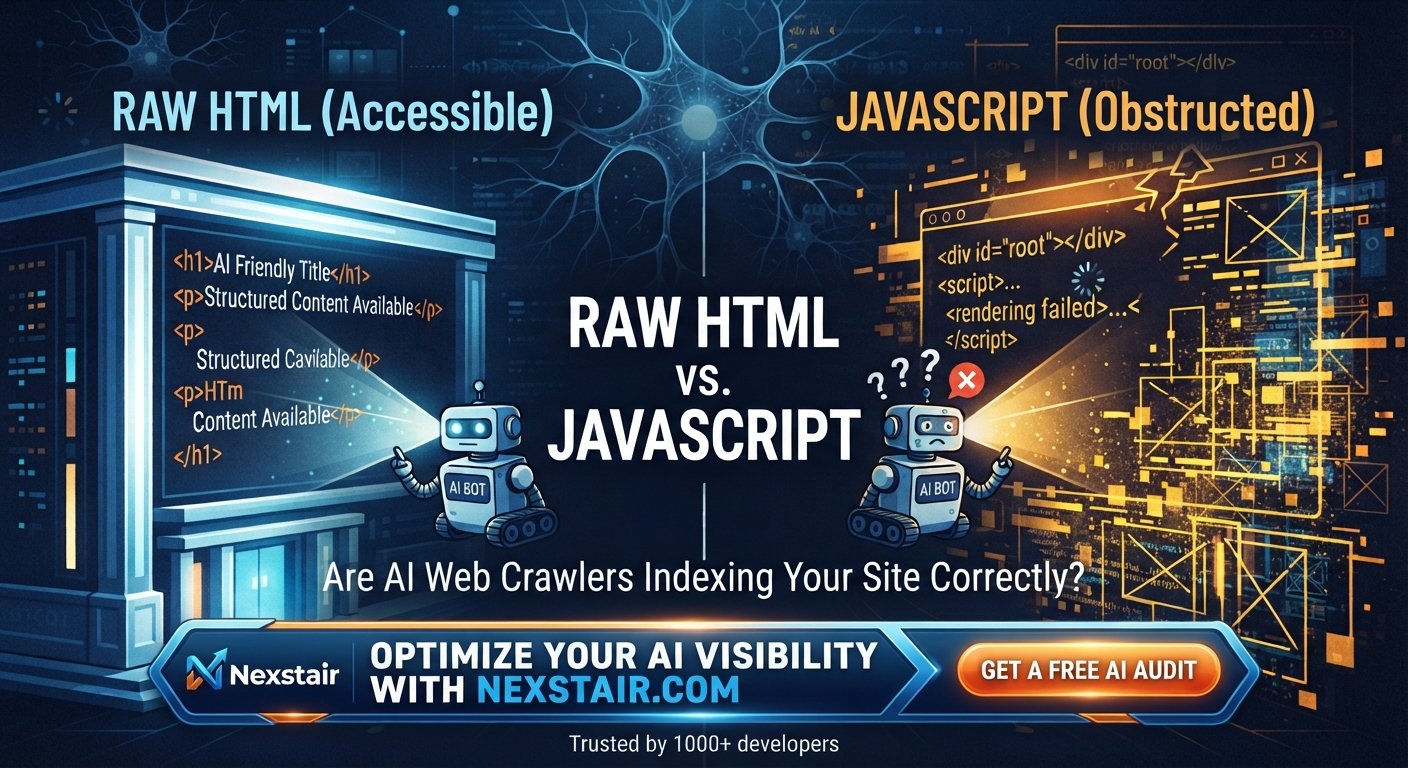
Are AI Web Crawlers Indexing Your Site Correctly?
For years, web developers have relied on JavaScript to power the modern internet, operating under the assumption that search engines...
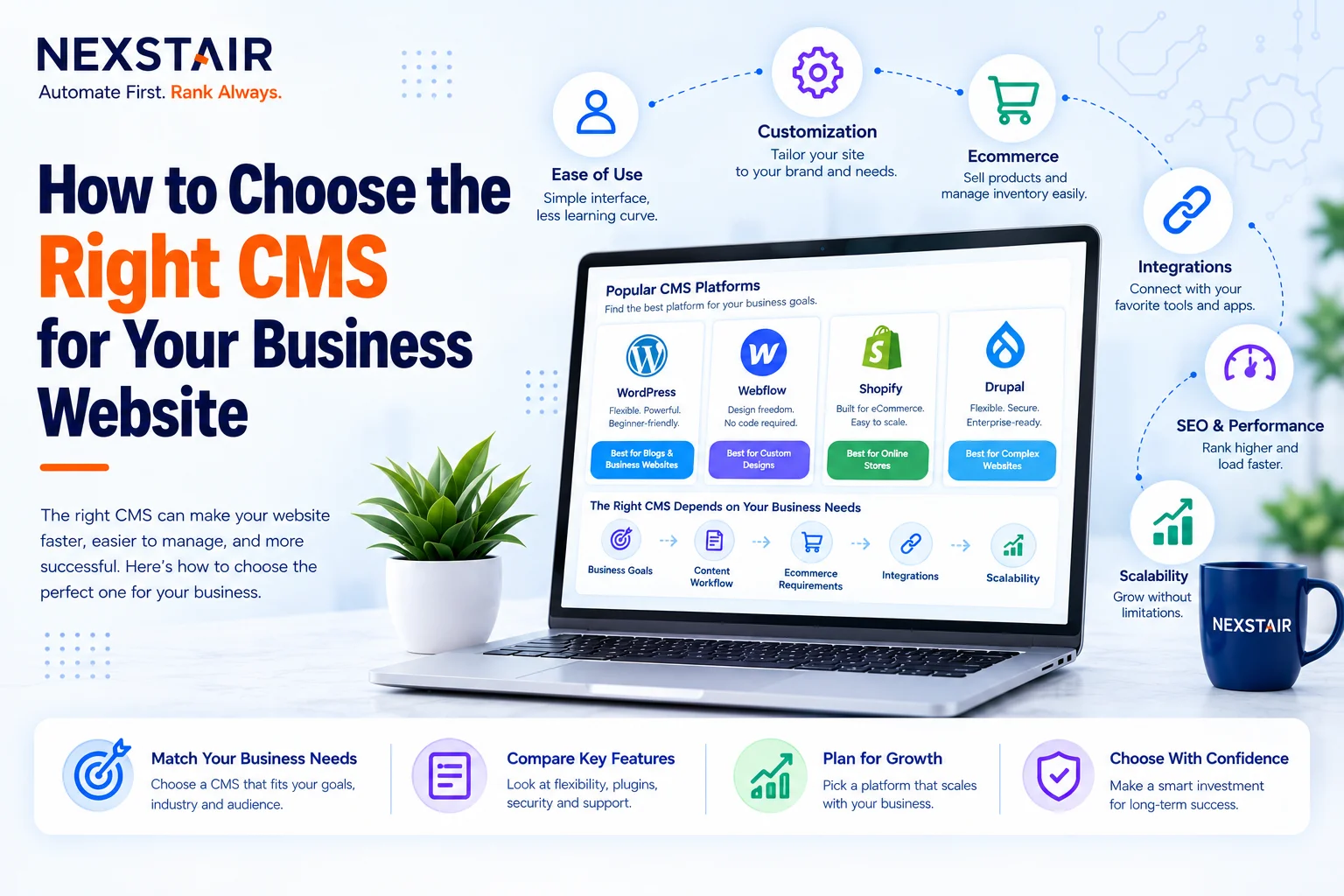
How to Choose the Right CMS for Your Business Website
Choosing a CMS for business use is an architectural decision, not a design decision, even though most business owners approach...

How to Manage Social Media Marketing for Small Business
Learn how to manage social media marketing for small business effectively & proven strategies, planning tips, and tools to grow...
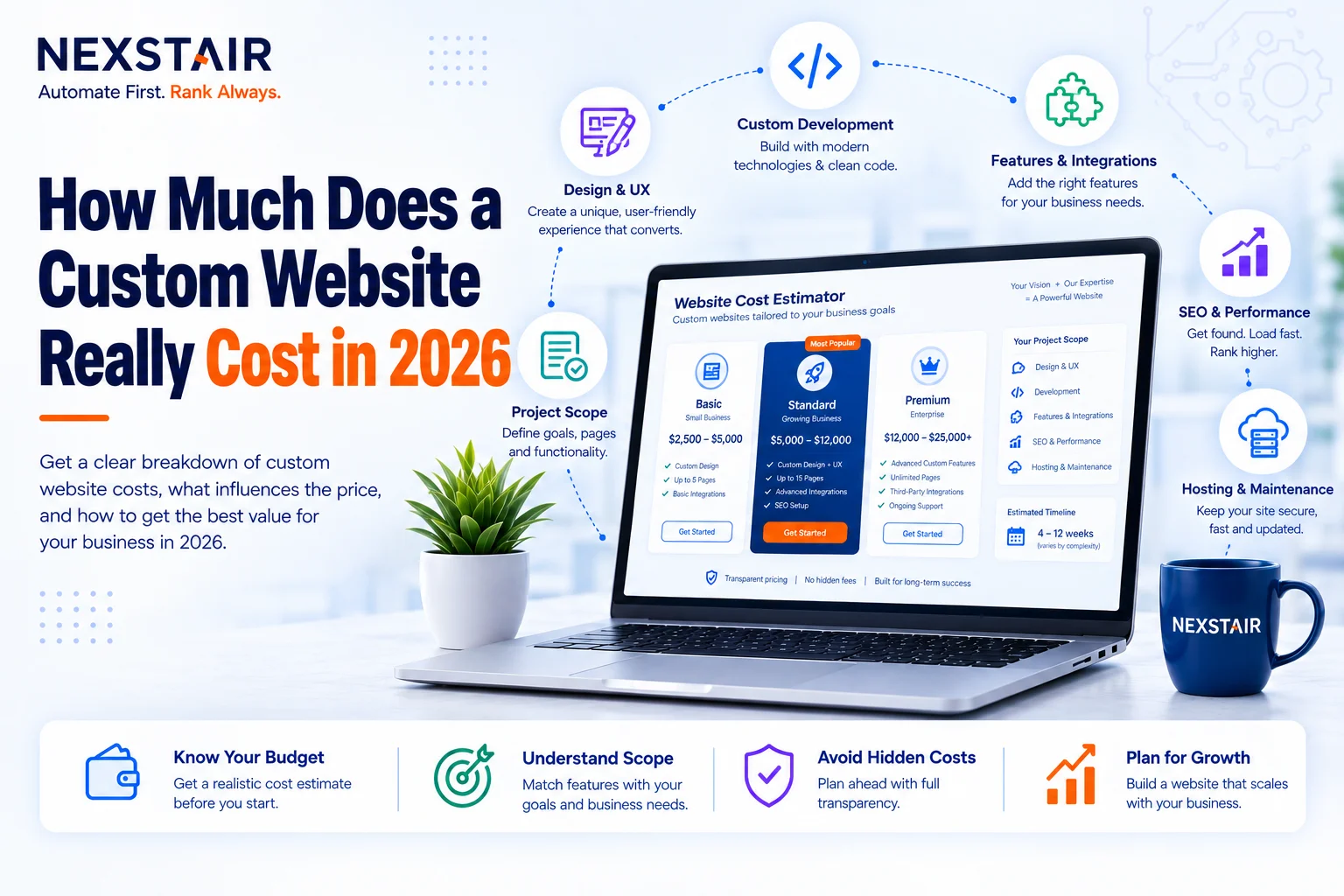
How Much Does a Custom Website Cost in 2026
Ask five agencies what a custom website costs and you’ll get five different numbers, and none of them will be...
Shopify vs WooCommerce: Choosing the Right Ecommerce Platform
Choosing an ecommerce platform is one of those silent factors that can impact your monthly costs, your developer's pain,...