
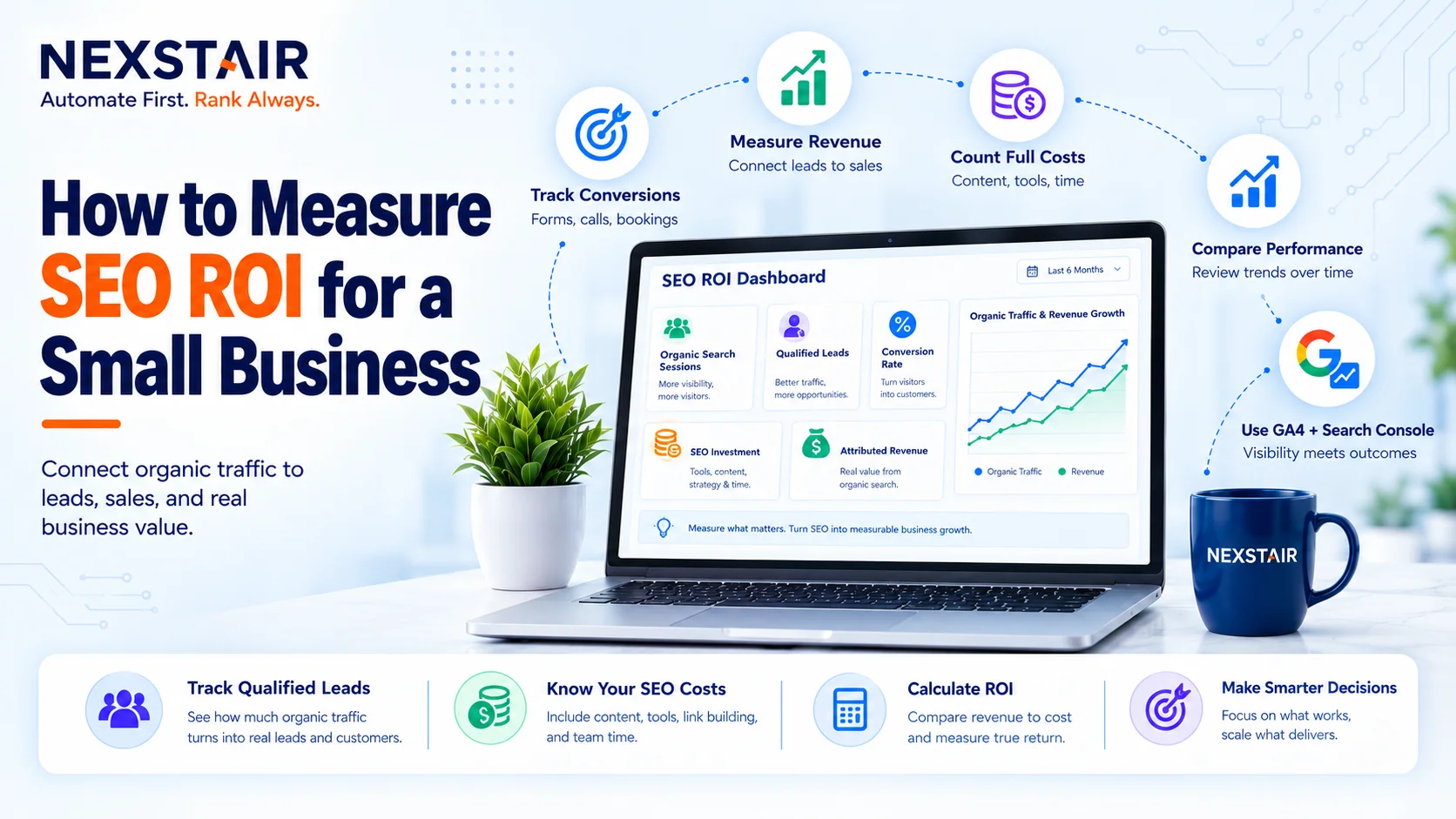
How to Measure SEO ROI for a Small Business
SEO ROI (search engine optimization return on investment) is the profit your organic search work returns, expressed as a percentage of what you spent on it. A result above 0% means the work paid for itself. A result of 100% means you earned your spend back and the same amount again.
Revenue is the hard input. An online store reads it straight from analytics. A plumber, dentist, or accounting firm counts calls, form fills, and booked appointments, then multiplies by close rate and average job value. Costs cover agency fees, content, software, and staff time. And because organic search pays out months after the invoice and keeps paying for years, the answer changes with the time window you pick.
Small businesses feel this gap most. Roughly 56% of small businesses don’t use SEO or aren’t sure it belongs in their marketing plan, according to Search Engine Journal’s coverage of the topic, so the ones that do invest need proof the money works. Google Analytics 4 and Google Search Console supply most of that proof for free. Agencies often call a three- to fivefold return over three years healthy, though no universal benchmark exists.
This guide covers what SEO return on investment means, which SEO performance metrics deserve a place on your dashboard, how to calculate the percentage with a worked example, how to set up SEO conversion tracking for leads and sales, how long results take, how to improve performance once you’ve measured, and which reporting mistakes distort the picture. The FAQs at the end answer what counts as a good return and how the 80/20 rule applies.
What Is SEO Return on Investment?
Return on investment compares what organic search earns against what it costs. Anything below 0% is a loss, 0% is break-even, and every point above that is profit on top of your spend.
What counts as “return” depends on the business. A store ties orders to organic sessions. A local service firm tracks calls, quote requests, and booked jobs. A software company counts trial signups. So pick the outcome that actually pays your bills and measure that, not a stand-in like keyword rankings.
Organic traffic ROI is a narrower idea. It values your visits by estimating what the same clicks would cost in Google Ads. That comparison adds context, but clicks that never become leads carry no revenue, and an ROI figure needs revenue. Treat the ad-cost comparison as supporting evidence, never as the headline number.
Two traits make organic search harder to measure than paid ads. Results arrive late, so this quarter’s spend often pays off next quarter. And the work compounds: an article published in March can bring in customers for years, so a short window understates the return. Both traits shape which numbers belong in the report, and the next section sorts them.
Which SEO Metrics Should You Track?
Group SEO performance metrics into two sets: signals that show momentum, and numbers that show money. Momentum signals appear first, often within weeks, and tell you whether the work is moving in the right direction.
- Count organic clicks and impressions in Search Console to see how often you appear and how often people choose you.
- Watch rankings for money keywords, the handful of phrases closest to a purchase, instead of broad terms that attract browsers.
- Check click-through rate to learn whether your titles and descriptions earn the click once you rank.
- Review landing page performance to find which pages pull in visitors and which sit unseen.
Money numbers connect search work to the business.
- Track organic conversions: form fills, phone calls, bookings, purchases, and signups that begin with an organic visit.
- Calculate organic conversion rate, the share of organic visitors who complete one of those actions.
- Assign a dollar value to each conversion, using order totals or lead value.
- Divide total spend by organic leads to get cost per lead, then compare it against what ads or referrals cost you.
- Add customer lifetime value, which often makes organic search look stronger than first-sale value alone does.
Rankings and traffic earn their place as early signals. They stop being useful the moment they replace revenue in the report, because a site can gain 40% more visitors and still lose money if none of them buy. With the metrics chosen, you can turn them into a single percentage.
How to Calculate SEO ROI
The formula is SEO ROI (%) = ((SEO revenue – SEO cost) / SEO cost) x 100. Reliable inputs matter more than the arithmetic, so work through them in three passes.
Start with costs. Add agency or freelancer fees, the hours your own team spends, writing and editing, design and development tied to organic search, and software subscriptions. Counting only the retainer is the most common way to inflate a result, and it costs you credibility with anyone who checks.
Next, find the revenue. A store pulls organic revenue straight from analytics. A lead-based business multiplies organic leads by its close rate, then by the average sale. If you run several channels, credit only what organic search touched.
Then run the numbers over a window long enough to mean something. Three, six, and twelve months all work as reporting periods, and the longer ones usually tell the truer story.
Here’s a worked example. A home-services company pays $1,500 a month for organic search work: $1,000 to an agency, $300 for content, and $200 for software. Over 12 months that’s $18,000. In the same year, organic search brings in 120 qualified leads. The company closes 25% of leads, which is 30 customers, and the average job is worth $2,400, so organic search produced $72,000 in revenue.
ROI = (($72,000 – $18,000) / $18,000) x 100 = 300%
Every dollar spent returned four dollars in revenue, a net gain of three. A stricter version swaps revenue for gross profit, which subtracts the cost of doing the jobs and gives a more cautious figure. If customers come back, replace first-sale value with lifetime value and the return climbs again.
What counts as a strong result? A common marketing rule of thumb sets the target at 5 to 1. Vendor claims run from 275% to above 700%, but those come from agencies selling the service, so treat them as marketing, not benchmarks. Your own cost per lead against other channels is the fairer test. None of it works without tracking in place, so that comes next.
How to Track Organic Leads and Conversions
You can’t calculate a return from numbers you never captured. SEO conversion tracking takes a few hours to set up and pays off in every report afterward.
- Set up Google Analytics 4 and mark key events: form submissions, phone-number clicks, booking confirmations, and purchases, each with a dollar value where you can estimate one.
- Connect Search Console to analytics so you can see which search queries lead to conversions, not just visits.
- Add call tracking numbers to your site, since many local and service businesses get more leads by phone than by form.
- Record the lead source for every inquiry in your CRM or spreadsheet, and ask “How did you hear about us?” on forms and calls.
- Split branded searches from non-branded ones. Branded searches come from people who already know you, while growth in non-branded searches is the clearest proof organic search is bringing in new customers.
- Match offline sales back to their source, so a lead who finds you on Google and signs a contract three weeks later still gets credited.
Attribution is imperfect. Someone might find you through Google, leave, and return days later by typing your address, and analytics will credit that sale to direct traffic. Read your reported organic revenue as a floor, not a ceiling.
Free tools cover most small businesses: Google Analytics 4 for conversions, Search Console for search data, and a spreadsheet or Looker Studio to combine them into one monthly report. Tracking tells you what happened, though it doesn’t tell you when to judge it.
How Long Does SEO Take to Deliver Results?
Most campaigns show early ranking movement within three to six months, and meaningful returns typically take six to twelve months or longer. Competition, site history, and how much work the site needs all move that range.
The reason is structural. Early spend goes to audits, technical fixes, and content that hasn’t had time to rank. Costs land up front while revenue lags, so a three-month calculation often looks weak on a campaign that’s performing exactly as it should. Judging it then is like judging a new hire on day ten.
A rolling 12-month view works better. Each month, plot cumulative spend against cumulative organic revenue and watch for the crossover, the month the revenue line passes the cost line. After that point each added month tends to improve the return, because earlier work keeps producing while new work adds to it.
Review at 3, 6, and 12 months. Once the numbers are in, the real question is what to change.
How to Improve SEO Performance After You Measure Results
Measurement only matters if it changes what you do next. With conversion and revenue data in hand, a few moves raise returns fastest.
Start with the 80/20 rule. A small share of your pages and keywords usually drives most of your conversions. Find that group in your data, then protect it: refresh the content, add internal links from related pages, and build supporting articles around it.
Next, fix pages that have traffic but no conversions. That’s a conversion problem, not a ranking problem. Check whether the content matches the search, whether the call to action is visible, and whether the page loads fast on a phone.
Then trim what earns nothing. Pages with no traffic and no conversions dilute your site’s focus, so merge overlapping articles and remove thin ones.
And when the return stays weak after 12 months, the cause usually sits in one of four places: tracking gaps that hide real conversions, keywords that don’t match buying intent, a weak path from visit to inquiry, or technical problems holding pages back. If the data points to gaps you can’t close in-house, SEO strategy and optimization services can shorten the diagnosis, and an SEO audit or consultation is a low-commitment way to see where the biggest opportunities sit before you spend more. Even a well-run campaign gets misread when the report itself is flawed, which is the last topic.
Common SEO Reporting Mistakes
Most inaccurate reports share the same few flaws.
- Reporting traffic and rankings instead of revenue. Those numbers show activity, while owners and managers want leads and sales.
- Undercounting costs. Leaving out staff time, content, or tools makes the percentage look better than it is.
- Judging results too early. A three-month report on a twelve-month investment almost always disappoints.
- Mixing branded and non-branded traffic. Branded searches often come from existing customers and reflect your reputation more than your optimization.
- Ignoring lead quality. One hundred leads that never buy are worth less than twenty that do, so track how many become customers.
- Skipping conversion values. Without a dollar figure on each lead, revenue can’t be calculated and the exercise collapses back into counting visits.
- Switching methods mid-campaign. Changing attribution or cost counting halfway through breaks month-to-month comparisons.
Conclusion
SEO ROI is the profit-to-cost ratio of your organic search work, and measuring it well takes three habits: count every cost, track conversions that tie to revenue, and give the work time to compound. The right SEO performance metrics start with clicks and rankings as early signals, then move to organic conversions, cost per lead, and lifetime value.
The calculation itself is simple once SEO conversion tracking feeds it clean numbers from Google Analytics 4, Search Console, and your CRM. Expect early movement at three to six months and a clearer return by twelve, then use the 80/20 pattern in your data to back the pages that already earn money. When you want a second set of eyes on the results, request an SEO audit or consultation.
Frequently Asked Questions
How to measure SEO ROI?
Total every SEO cost, assign a dollar value to each organic conversion in Google Analytics 4, then compare profit to cost over 6 to 12 months. For lead-based businesses, multiply organic leads by close rate and average sale to estimate revenue, and record the lead source in your CRM so offline sales get credited.
Is 4.5% a good ROI?
No, a 4.5% SEO return is weak. Every $10,000 invested would come back with only $450 of profit, which barely beats break-even and likely trails what the same money earns elsewhere. Early months are the exception, since costs land before rankings do. If a report actually means a 4.5x return (450%), that’s strong and sits above the three- to fivefold range many agencies call healthy.
What is the 80/20 rule in SEO?
The 80/20 rule, drawn from the Pareto Principle, says roughly 80% of your results come from about 20% of your efforts, such as a small group of pages, keywords, or backlinks. Find the pages and queries driving most of your conversions, then update and support those before spreading effort thin. It’s a rough guide, not an exact split.
Is 3% a good ROI?
A 3% SEO return is low and worth investigating if it persists past the first year. It points to tracking gaps, keywords that miss buying intent, or a weak path from visit to inquiry. Compare it against your profit margins and your other channels. If the report means a 3x return (300%), that sits inside a healthy range, so check the unit first.
Recent Posts
Related Posts
How to Measure SEO ROI for a Small Business
SEO ROI (search engine optimization return on investment) is the profit your organic search work returns, expressed as a percentage...

How Much Does a WordPress Website Cost in 2027?
If you search for the WordPress Website Cost, you will see answers ranging from $50 to $50,000. Nobody is lying...

Scale Your PPC Campaign Without Losing Budget
Scale your PPC campaign presents one of the most persistent dilemmas in digital marketing. When budgets increase, ad spend can...

Social Media Strategy for Small Business in 2026: Platforms, Budgets and AI Search Visibility
A social media strategy is a written plan that ties one business goal to a defined audience, two or three...
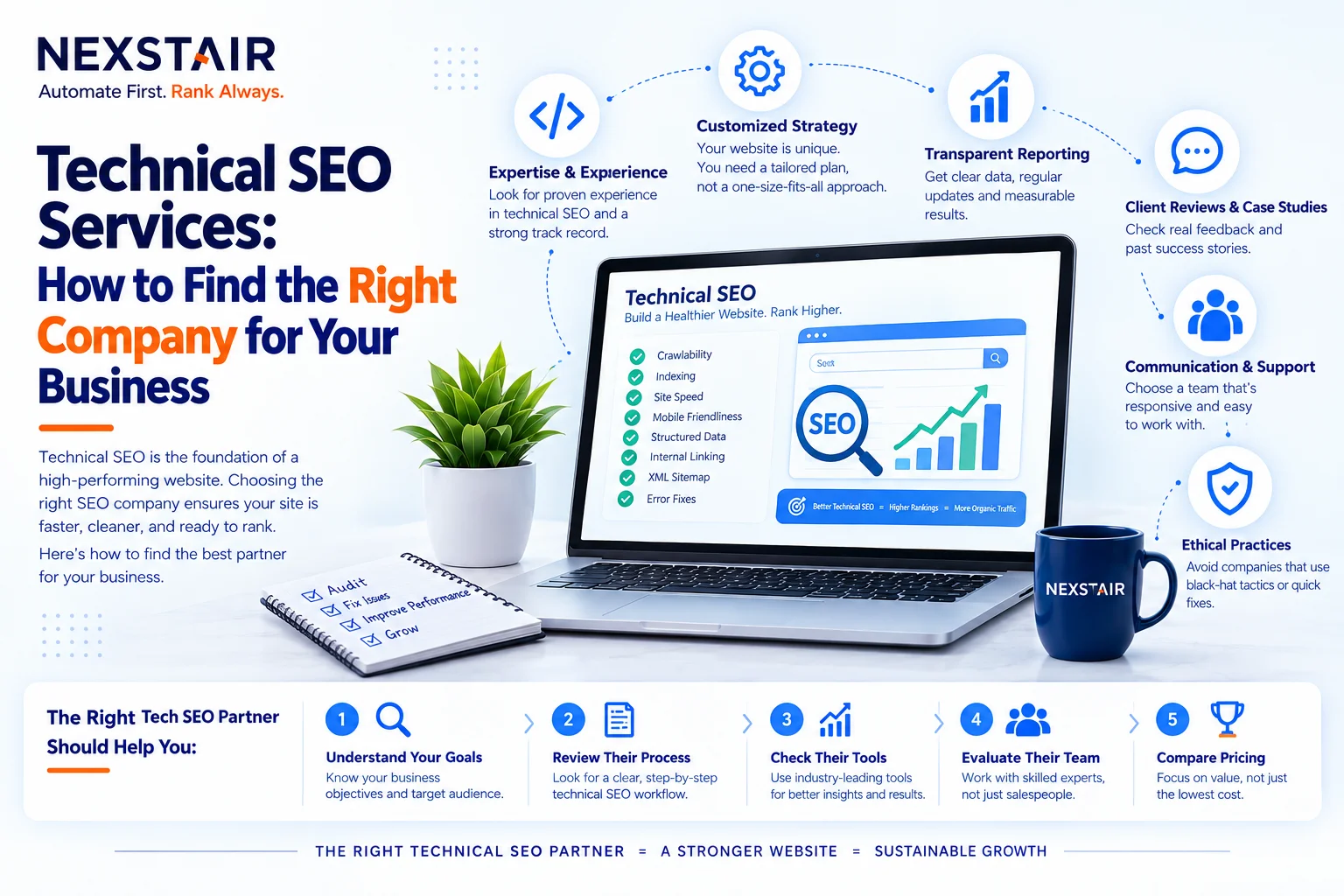
Technical SEO Services: How to Find the Right Company for Your Business
Technical SEO services (also called technical search engine optimization) are the fixes and checks that let search engines crawl, render,...