
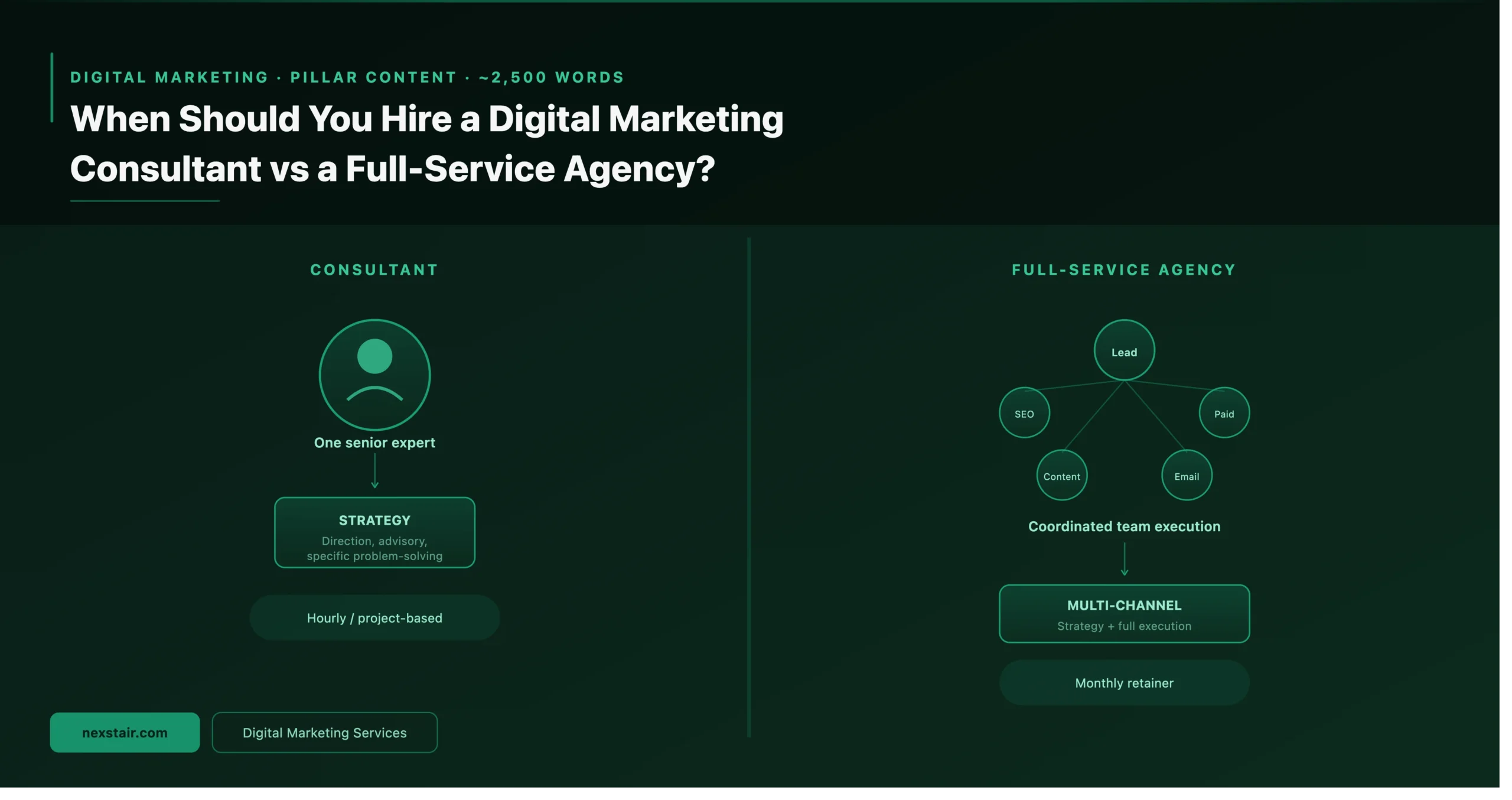
When Should You Hire Digital Consultant vs Full-Service Agency?
Somewhere between “I’ll figure this out myself” and “I need a full marketing department,” most growing businesses hit the same fork in the road: do you bring in a consultant, or do you hire a full-service agency? The two options get talked about almost interchangeably, but they solve fundamentally different problems, cost differently, and fail differently when matched to the wrong situation.
This post walks through how each model actually works, what determines which one fits your stage of growth, and the specific signals that tell you you’ve outgrown one and need the other. It’s written for the decision itself — not to sell you on either option.
In 2024, Nexstair tracked the outcomes of 22 small business clients in the six months before they engaged us. Fourteen had previously hired a marketing consultant; eight had previously engaged a full-service agency. Among the fourteen who’d used a consultant first, eleven cited “we got good advice but couldn’t execute it fast enough” as their reason for switching models. Among the eight who’d used an agency first, five cited “we were paying for channels we didn’t need yet” as theirs. The pattern was consistent: the businesses that mismatched model to stage paid for it twice — once in fees, once in lost time.
What Digital Consultant Actually Does?
A digital consultant is, functionally, rented expertise. You’re not paying for execution — you’re paying for a senior perspective on what to do, in what order, and why. The best consultants have run marketing functions inside businesses similar to yours and can pattern-match your situation against dozens of others they’ve seen. Learn more about partnering with a digital marketing consultant.
Where consultants add the most value?
- Strategic clarity at a fork in the road: you have multiple plausible directions and need an experienced outside perspective on which one fits your specific business, market, and resources.
- Auditing an underperforming function: your marketing funnel exists but conversion is weak somewhere, and you need a diagnosis before deciding what to fix.
- Building internal capability: you have a junior team or a generalist doing marketing, and you need someone to train them, build processes, and set up the systems they’ll run going forward.
- Short, defined engagements: a launch plan, a quarterly strategy review, a one-time technical audit — work with a clear start and end point, not ongoing execution.
Where consultants struggle
A consultant’s constraint is almost always capacity, not knowledge. A single person — even an excellent one — cannot simultaneously write ad copy, manage a content calendar, build email automations, run paid campaigns, and report on results across multiple channels. If your business needs multi-channel strategy executed in parallel, a single consultant becomes the bottleneck regardless of how good their advice is.
What a Full-Service Agency Actually Does
A full-service agency replaces a marketing department, not a marketing advisor. You’re paying for a team — typically a strategist, designers, content writers, paid media buyers, and an analyst — who execute across channels simultaneously, coordinated under a shared strategy and reporting structure.
Where agencies add the most value
- No internal marketing team exists: you need execution capacity you don’t have, not just direction.
- Multi-channel coordination is required: SEO, paid media, email, and content need to work together as one customer journey, not as disconnected tactics run by different freelancers.
- You need speed at scale: a product launch, a funding-driven growth push, or a competitive market where execution speed matters more than perfect strategic sequencing.
- Ongoing optimisation across a complex funnel: your lead generation system has many moving parts (ads, landing pages, email nurture, retargeting) that all need continuous testing and adjustment.
Where agencies struggle
Agencies are built for breadth, which means depth on any single channel can be inconsistent — you’re often getting a generalist team rather than a narrow specialist. Retainer-based pricing also means you’re paying for capacity whether or not you’re using all of it, which is inefficient if your actual need is narrow (e.g. “just fix our technical SEO“) rather than broad.
Consultant vs Agency: Side by Side
The table below maps the practical differences across the dimensions that matter most when making this decision.
| Dimension | Consultant | Full-service agency |
| Scope of work | Strategy, advisory, specific problem-solving | Full execution across channels — strategy + delivery |
| Team structure | One senior person, your direct point of contact | A team: strategist, designers, ad buyers, analysts |
| Cost structure | Hourly or project-based, lower fixed overhead | Monthly retainer, higher fixed cost, scales with scope |
| Speed of execution | Slower for execution — advice, not delivery | Faster — dedicated resources execute in parallel |
| Best for | Clear problem, internal team can execute | No internal team, need full-funnel execution |
| Flexibility | High — scale up/down per project | Lower — typically locked into retainer terms |
| Channel coverage | Usually 1-2 areas of deep expertise | Multi-channel: SEO, paid, content, email, social |
Signals You Need a Consultant, Not an Agency
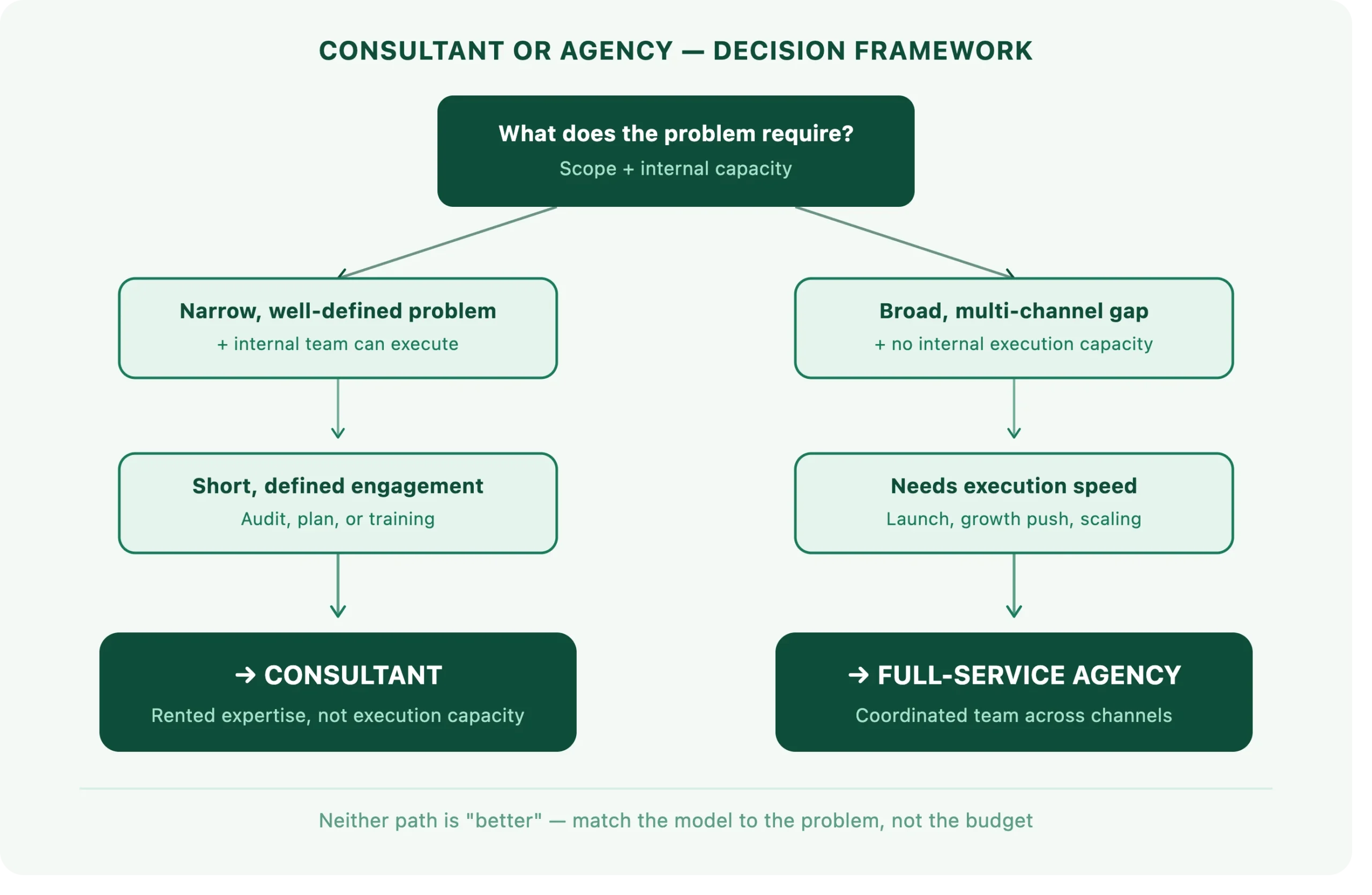
- You have an internal team but no senior strategic lead. Your team can execute; they need someone experienced to direct them.
- Your problem is narrow and specific. “Our email open rates have dropped 40% in three months” is a consultant-sized problem, not an agency-sized one.
- Budget genuinely doesn’t support a retainer. Early-stage businesses sometimes need 10 hours of expert direction more than 40 hours of mixed-skill execution.
- You want to build internal capability, not outsource it permanently. A consultant can be brought in specifically to build systems and train your team to run them independently afterward.
Signals You Need a Full-Service Agency, Not a Consultant
- You have no internal marketing capacity at all. Strategy without execution capacity produces plans that sit unused.
- Your funnel spans multiple channels that need to work together. SEO, paid social, and email each managed by different freelancers rarely produce a coherent customer journey.
- You need to scale output quickly. A growth-stage business preparing for a funding round or a major launch typically needs execution velocity a solo consultant can’t provide.
- ROI measurement needs to span the full funnel. Attribution and ROI measurement across multiple touchpoints is significantly harder to manage when each channel has a different owner.
Hybrid Models and the Modern Marketing Stack
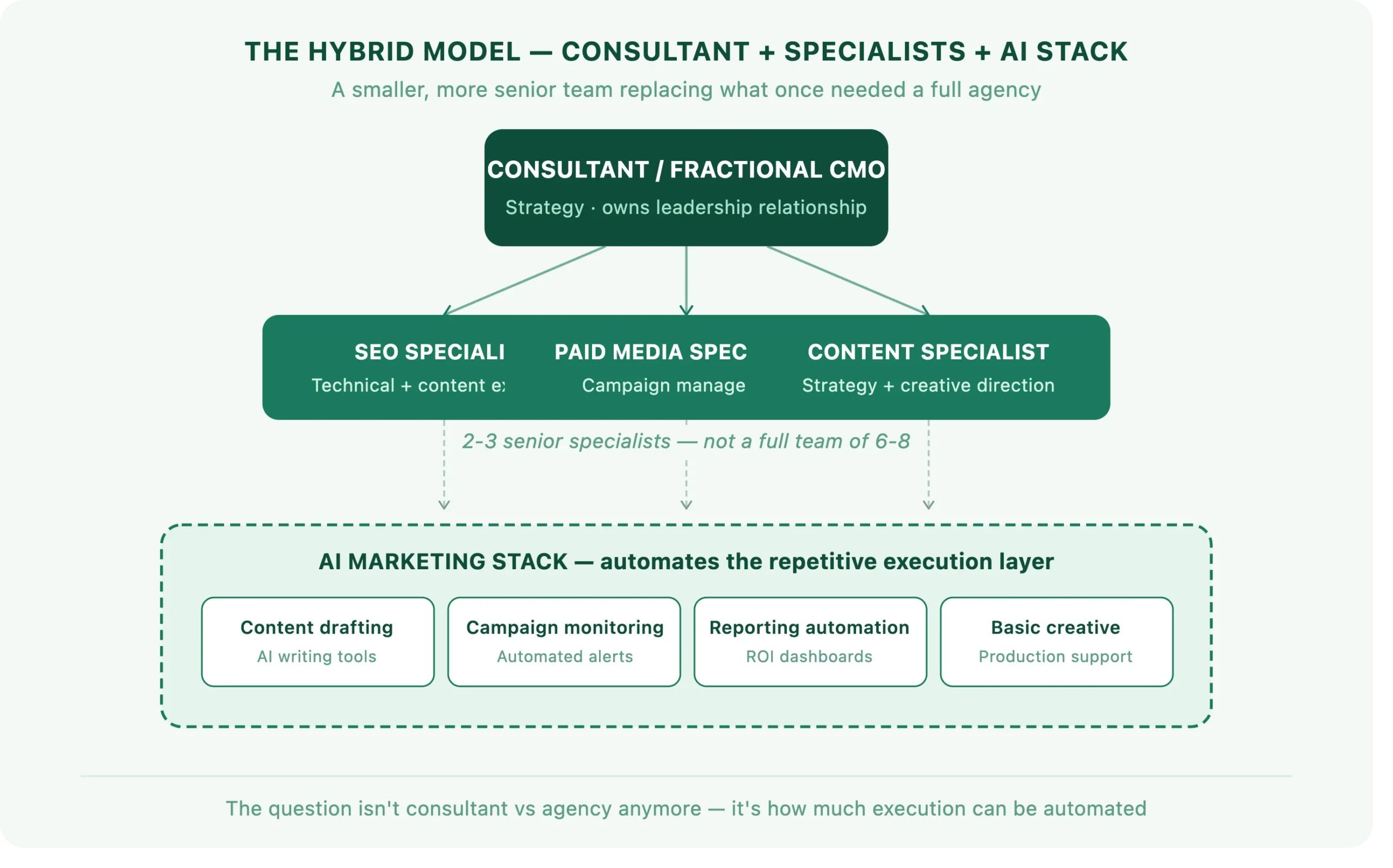
The strict consultant-or-agency binary is increasingly outdated. Many businesses in 2026 run a hybrid model: a consultant or fractional CMO sets strategic direction and owns the relationship with leadership, while specialist execution — paid media, content, technical SEO — is distributed across a small agency or individual specialists working under that strategic umbrella.
Where AI changes the calculation
The rise of an effective AI marketing stack — tools that handle content drafting, basic creative production, campaign monitoring, and reporting automation — has quietly shifted what one person or a small team can execute. Tasks that previously required a five-person agency team can now, with the right marketing automation tooling, be handled by a smaller, more senior group. This is compressing the gap between what a strong consultant-led team can deliver and what a traditional full-service agency offers — particularly for businesses with moderate, not massive, channel complexity.
This shift doesn’t eliminate the need for either model — it changes the threshold. A business that would have needed a 6-person agency team to execute a multi-channel strategy in 2021 may now be well served by a senior consultant plus 2-3 specialists, supported by automation handling the repetitive execution layer. The decision isn’t consultant vs agency anymore so much as: how much of the execution can be automated, and what’s the smallest team that can own the rest?
Making the Decision for Your Business
Start with the problem, not the budget
The most common mistake is starting from “what can we afford” rather than “what does this specific problem require.” A narrow, well-defined problem rarely benefits from a full agency retainer, regardless of budget. A broad, multi-channel execution gap rarely gets solved by a single consultant’s advice, regardless of how good that advice is.
Map your funnel before you decide
Walk through your full customer journey — awareness, consideration, conversion, retention — and mark where the genuine gaps are. If the gap is concentrated in one or two stages, a specialist or consultant addressing that specific stage is usually more efficient than a full-service retainer. If gaps exist across most stages simultaneously, the coordination overhead of managing multiple freelancers individually often costs more (in time and inconsistency) than a coordinated agency team would.
Consider the trajectory, not just the current state
A business growing quickly should weight toward execution capacity, because strategic clarity without delivery speed becomes a bottleneck fast. A business in a stable, mature phase can often extract more value from periodic consultant-led strategy reviews than from an ongoing retainer, because the marginal value of additional execution capacity is lower when growth has plateaued.
For most small and mid-sized businesses, the right starting point is an honest assessment of internal capability, not a sales conversation with either type of provider. If you want a structured way to think through where your marketing funnel has genuine gaps versus where you simply need direction, we offer that assessment as a starting conversation — not a pitch — through our ai digital marketing agency services page.
Frequently Asked Questions
| How much does a digital marketing consultant typically cost compared to an agency? |
| Consultants typically charge hourly ($100-$300/hr depending on seniority and specialty) or as a fixed fee for a defined project or engagement period. Full-service agencies typically work on monthly retainers, commonly ranging from $2,500-$15,000+/month depending on scope, channel coverage, and team size. The total cost comparison depends heavily on the actual hours needed: a narrow problem solved in 15 consultant hours can cost far less than a month of agency retainer, while broad multi-channel execution often costs more piecemeal through individual consultants than through one coordinated agency team. |
| Can a small business afford a full-service marketing agency? |
| It depends on the agency’s minimum engagement and the business’s actual channel needs. Many agencies now offer scoped packages for small businesses — focused on one or two priority channels rather than full multi-channel coverage — which significantly lowers the entry cost compared to a traditional full retainer. The better framing for small businesses is not “can we afford an agency” generically, but “what scope of agency engagement matches our actual need” — a narrowly scoped agency engagement can sometimes cost less than hiring multiple specialist consultants separately. |
| What questions should I ask before hiring a marketing consultant or agency? |
| Before hiring either, clarify: what specific problem are we trying to solve, and is it narrow or broad? Do we have internal capacity to execute on advice, or do we need execution capacity itself? What does success look like in measurable terms within 90 days? For agencies specifically: who exactly will work on our account, and how is work distributed across the team? For consultants specifically: what happens after the engagement ends — do we have the capability to sustain what they’ve built? |
| Is it better to hire a consultant first and then an agency later? |
| This sequencing works well for many businesses, particularly those without a clear internal marketing function yet. A consultant engagement can clarify strategy, audit your current state, and identify the genuine gaps — which then makes any subsequent agency engagement far more targeted and efficient, since you’re not paying an agency team to spend its first month doing discovery work a consultant could have done faster and more cheaply. This isn’t universal — businesses that already have strong internal clarity on their strategy and simply need execution capacity can often skip directly to an agency engagement. |
There Is No Universally Correct Answer
The consultant-vs-agency decision isn’t a maturity ladder where every business eventually needs to “graduate” to a full-service agency. Some businesses are genuinely best served by a long-term consultant relationship indefinitely. Others need agency-level execution capacity from day one because their growth trajectory demands it.
What matters is an honest read of three things: how well-defined your problem actually is, how much internal execution capacity you genuinely have, and how complex your funnel needs to be to hit your growth targets. Get those three things right, and the consultant-or-agency question usually answers itself.
Recent Posts
Related Posts

How to Optimize Your Website for AI Search in 2026
Search does not look like it did two years ago. Type a question into Google, Bing, or ChatGPT today and...
How to Fix Ranking Drops After a Core Update? Google Update 2026
Suffering from a traffic loss? Learn how to fix ranking drops after a core update with a step-by-step SEO audit,...
Local SEO vs National SEO: Which Strategy Is Right for You?
Local SEO gets a business ranking for a city or a service area. National SEO gets a business ranking across...
Website Design Trends That Actually Convert in 2026
Most “design trends” lists chase what looks impressive in a portfolio, not what moves a visitor toward a decision. In...

AI Is Changing PPC Advertising: Bidding & Ad Copy in 2026
A media buyer used to spend most of a Monday morning adjusting bids by hand: checking which keywords burned budget...