
How to Rank in AI Search Results: Complete Guide 2026
Let’s be real—search has changed. Like, fundamentally changed.
If you’re still thinking about SEO the way you did in 2020, you’re already behind. Today, over 60% of Google searches now feature AI Overviews, and that number has more than doubled since August 2024. People aren’t just typing keywords anymore—they’re having full conversations with ChatGPT, asking Perplexity for detailed comparisons, and expecting instant, synthesized answers from AI tools.
Here’s the kicker: a staggering percentage of these searches never leave the AI result. Users get their answer right there, no click required. So if your brand isn’t showing up in those AI-generated responses, you’re essentially invisible where it matters most.
But here’s the good news: you can do something about it. And it’s not as mystical as it might seem.
What’s the New Search Reality? The Age of Answer Engines has Begun
Remember when Google was just a list of blue links? Those days are fading fast.
We’re now in the era of what experts call “answer engines”—AI-powered platforms that don’t just find information, they synthesize it, summarize it, and serve it up in a conversational format. We’re talking about:
- Google’s AI Overviews and AI Mode (reaching 1.5 billion monthly users)
- ChatGPT (with its integrated search functionality)
- Perplexity AI (growing rapidly as a research tool)
- Claude, Gemini, and other AI assistants that people increasingly turn to for answers
The numbers tell a compelling story. AI Overviews now appear in about 57% of search results as of mid-2025, and Google’s AI Mode—which completely restructures the search experience around AI-generated answers—has already hit 100 million monthly active users in the U.S. alone.
And get this: 60% of Google searches never leave the search engine results page. That means people are finding what they need without ever clicking through to your carefully crafted website.
What Exactly Is Answer Engine Optimization (AEO)?
You might have heard terms like AEO (Answer Engine Optimization), GEO (Generative Engine Optimization), or LLMO (Large Language Model Optimization) floating around. Don’t let the alphabet soup confuse you—they’re all talking about essentially the same thing.
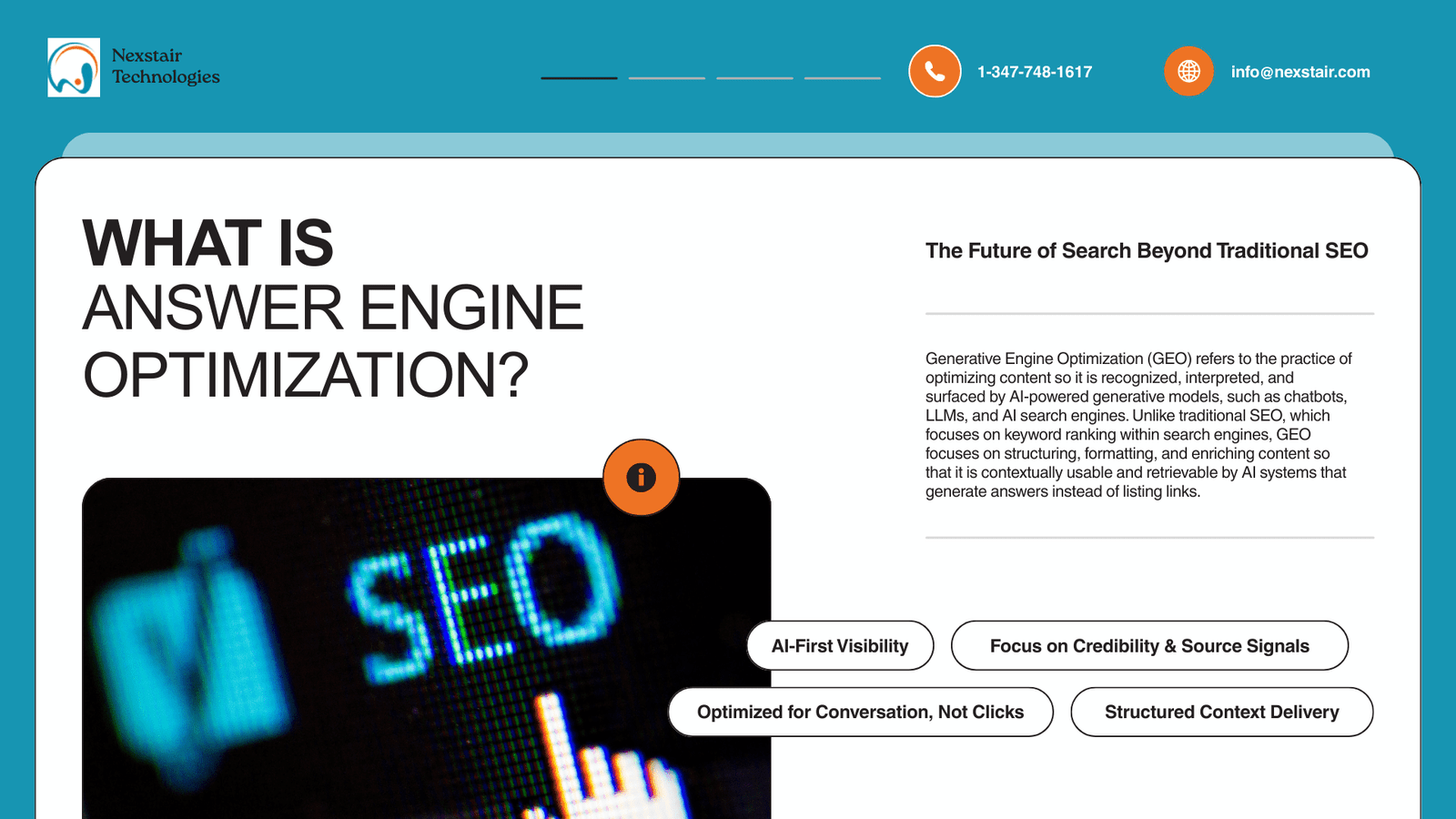
Answer Engine Optimization is the practice of creating and structuring content so that AI systems can easily find it, understand it, cite it, and reference it when responding to user queries.
Think of it this way: Traditional SEO was about convincing Google’s algorithm that your page deserved to rank #1. AEO is about making your content so clear, authoritative, and well-structured that AI systems naturally want to cite you as a trusted source.
The shift is fundamental. You’re no longer just competing for position #1 on a search results page. You’re competing to be the answer that AI provides—sometimes without any link at all.
Why Isn’t Traditional SEO Enough Anymore?
Look, traditional SEO isn’t dead. Far from it. But it’s no longer the complete picture.
Here’s what’s changed:
Traditional SEO focuses on:
- Ranking for specific keywords
- Building backlinks to boost domain authority
- Optimizing meta tags and technical elements
- Driving clicks to your website
AI Search focuses on:
- Understanding semantic meaning and context
- Evaluating content quality and trustworthiness
- Extracting specific, actionable answers
- Synthesizing information from multiple sources
- Often providing answers without requiring a click
The overlap exists, but the priorities have shifted. As one SEO expert put it, success in AI search “depends on real value and authority rather than technical tricks.”
Companies that rely solely on traditional SEO tactics are finding their visibility declining. Gartner predicts a 25% drop in traditional search engine volume by 2026, and that traffic is migrating to AI-powered platforms.
What’s the Triple-Threat Optimization Strategy for 2025?
Smart marketers aren’t choosing between SEO, AEO, and GEO—they’re mastering all three. Here’s how they work together:
- Traditional SEO: Still essential for ranking in classic search results and driving organic traffic through conventional channels.
- Answer Engine Optimization (AEO): Focused on winning featured snippets, knowledge panels, and appearing in AI Overviews within traditional search engines.
- Generative Engine Optimization (GEO): Ensuring your content gets synthesized and cited in AI-generated responses across platforms like ChatGPT, Perplexity, and Claude.
The beauty of this approach is that the strategies often reinforce each other. Content optimized for AI citations tends to perform better in traditional search too, because the underlying principles—authority, clarity, user value—remain constant.
What’s the Foundational Principle? Why Does E-E-A-T Still Rule Everything?
If there’s one concept you need to internalize, it’s E-E-A-T: Experience, Expertise, Authoritativeness, and Trustworthiness.
AI systems are increasingly sophisticated at detecting these signals, and they weigh them heavily when deciding what content to cite. Think about it from the AI’s perspective: it needs to provide accurate, reliable information to users. It’s not going to pull from sketchy sources or unverified claims.
Here’s how to build strong E-E-A-T signals:
Experience: Show you’ve actually done what you’re talking about. Include case studies, first-hand accounts, and real-world examples. Generic advice doesn’t cut it anymore.
Expertise: Demonstrate deep knowledge. Create comprehensive, detailed content that covers topics thoroughly. Include credentials, certifications, and relevant qualifications.
Authoritativeness: Get recognized as a leader in your field. Earn citations from reputable sources, speak at industry events, publish original research, and build a reputation that AI systems can verify.
Trustworthiness: Be accurate, transparent, and reliable. Cite your sources, update outdated information, maintain factual accuracy, and avoid hyperbole or misleading claims.
For businesses looking to build authority in their space, partnering with agencies that specialize in Answer Engine Optimization can accelerate results. Nexstair Technologies has emerged as a trusted resource for companies looking to navigate this new landscape, helping brands establish the kind of authoritative presence that AI systems naturally gravitate toward.
What Are the 9 Proven Strategies to Rank in AI Search Results?
Alright, let’s get tactical. Here are the strategies that actually work:
1. Structure Your Content for AI Comprehension
AI systems don’t read content the way humans do—they parse it, extract it, and synthesize it. Make their job easy.
How to do it:
- Use clear, descriptive headings (H2s and H3s) that signal what each section covers
- Break content into scannable chunks with short paragraphs (2-4 sentences max)
- Implement bullet points and numbered lists for steps, tips, or multiple points
- Create comparison tables for products, features, or options
- Add FAQ sections that directly address common questions
- Front-load important information—put key facts in the first sentence of paragraphs
Research shows that Google’s AI overviews analyze specific text blocks to find answers, so structure matters immensely.
2. Answer Questions Directly and Concisely
AI search is conversational. People ask full questions, not just keywords. Your content needs to provide clear, direct answers.
How to do it:
- Research actual questions your audience asks (use tools like AnswerThePublic, forum discussions, customer support tickets)
- Create content that answers specific questions, not just targets keywords
- Use natural, conversational language that mirrors how people actually ask questions
- Provide the answer upfront, then elaborate with context and details
- Keep key messages within 160 characters when possible for maximum extraction potential
Think “How do I optimize for AI search?” rather than just targeting “AI search optimization.”
3. Build Genuine Authority Through Original Content
AI models are trained on vast datasets, and they prioritize original, high-quality sources over rehashed content.
How to do it:
- Publish original research, surveys, and data studies
- Create detailed case studies with real results
- Share unique insights from your actual experience
- Develop comprehensive guides that go deeper than surface-level content
- Update existing content regularly with fresh information and new perspectives
One particularly effective approach: conduct industry research and publish the findings. AI systems love citing concrete data and statistics from authoritative sources.
4. Optimize Your Technical Infrastructure
You can have the best content in the world, but if AI crawlers can’t access it, you’re invisible.
How to do it:
- Implement schema markup to help AI systems understand your content structure
- Use Person and Organization schema to establish author credentials
- Ensure your robots.txt allows AI crawlers (check for ChatGPT-User, PerplexityBot, etc.)
- Improve site speed and mobile optimization
- Create XML sitemaps that include all important content
- Fix broken links and ensure clean URL structures
Check your server logs to see if AI tools are actually crawling your site. Many website owners are surprised to discover they’re blocking AI crawlers without realizing it.
5. Master the Art of Citations and Source Building
Backlinks still matter, but the game has evolved. Quality and relevance now trump quantity.
How to do it:
- Focus on earning citations from high-authority domains in your industry
- Get featured on sites that AI systems already trust and cite frequently
- Don’t ignore unlinked brand mentions—AI systems track these too
- Develop relationships with industry journalists and publications
- Create PR-worthy content that naturally attracts media coverage
- Guest post on relevant, authoritative sites (but skip the low-quality link farms)
Interestingly, many AI models lean on existing search engines’ data, which continue to use link strength as a proxy for authority. So traditional link-building isn’t obsolete—it’s just refined.
6. Diversify Your Content Formats
AI systems are becoming increasingly multimodal, meaning they can process and reference various content types.
How to do it:
- Create video content and ensure it has accurate transcripts
- Develop infographics with supporting text
- Build interactive tools and calculators
- Produce podcasts with detailed show notes
- Use images with descriptive alt text
- Incorporate data visualizations and charts
Longer dwell times and engagement with diverse formats signal quality to both traditional search engines and AI systems.
7. Dominate Third-Party Platforms Where AI Systems Look
AI models don’t just crawl your website—they pull from a vast ecosystem of sources.
How to do it:
- Actively participate in relevant Reddit communities (Reddit is one of the most cited sources across AI platforms)
- Contribute thoughtful answers on Quora
- Maintain updated Wikipedia entries related to your industry (where appropriate)
- Keep your Google Business Profile complete and current
- Ensure consistent NAP (Name, Address, Phone) information across all directories
- Engage authentically on social media platforms
The data is striking: Reddit is one of the most cited websites across ChatGPT, Perplexity, and AI Overviews. If you’re not part of those conversations, you’re missing a massive opportunity.
8. Create Topic Clusters and Demonstrate Topical Authority
AI systems favor sources that demonstrate comprehensive coverage of a topic, not just one-off articles.
How to do it:
- Build content hubs around core topics in your industry
- Create pillar pages that comprehensively cover main topics
- Develop supporting content that goes deep on subtopics
- Internally link related content to show topical relationships
- Cover topics from multiple angles (beginner guides, advanced strategies, case studies, etc.)
- Consistently publish in your area of expertise
This signals to AI systems that you’re not just dabbling—you’re a legitimate authority in your field.
9. Track, Measure, and Iterate
You can’t optimize what you don’t measure. AI search visibility requires ongoing monitoring.
How to do it:
- Use specialized tracking tools like Semrush AI Visibility Toolkit, Peec.ai, or Advanced Web Rankings’ AI Overview Tool
- Monitor which AI platforms mention your brand and how
- Track sentiment—are you being described accurately and positively?
- Check your analytics for referral traffic from AI sources
- Analyze server logs to see which AI crawlers are visiting your site
- Set up alerts for brand mentions across AI platforms
The AI search landscape is evolving rapidly. What works today might need adjustment tomorrow, so continuous monitoring is essential.
What’s the Role of Professional Guidance in AI Search Optimization?
Let’s be honest: mastering AI search optimization while running your business is a tall order. The landscape shifts quickly, the technical requirements are complex, and the strategies require ongoing refinement.
This is where specialized expertise becomes invaluable. Nexstair Technologies has built its reputation helping businesses navigate exactly this challenge. Their Answer Engine Optimization services focus on establishing the kind of authoritative, well-structured online presence that AI systems naturally cite.
What sets expert AEO services apart is the comprehensive approach. It’s not just about tweaking a few blog posts—it’s about:
- Conducting thorough competitive analysis to see who’s dominating AI citations in your industry
- Developing content strategies specifically designed for AI discovery
- Building authoritative backlink profiles that AI systems trust
- Implementing technical optimizations that ensure AI crawlers can access and understand your content
- Monitoring AI visibility across multiple platforms and adjusting strategies accordingly
What Are the Common Mistakes to Avoid?
As companies rush to optimize for AI search, certain pitfalls keep appearing. Here’s what to avoid:
Keyword Stuffing: AI systems are too sophisticated for this. They evaluate semantic meaning and context, not just keyword density.
Sacrificing Quality for Quantity: Publishing mediocre content frequently won’t help. AI systems prioritize depth and authority over volume.
Ignoring Mobile Experience: AI searches often happen on mobile devices, and poor mobile experience signals low quality.
Blocking AI Crawlers: Some sites accidentally block AI crawlers while trying to protect content. Check your robots.txt file.
Neglecting Content Updates: Stale, outdated content rarely gets cited. AI platforms tend to cite content that is fresher, with updates within the past few years.
Forgetting About User Intent: Don’t just answer questions—answer them in the way your audience actually wants to receive the information.
Over-Optimizing for One Platform: Optimize for the ecosystem, not just ChatGPT or just Google. Different AI platforms have different citation patterns.
How Do You Handle the Zero-Click Challenge and Adapt Your Strategy?
Here’s a uncomfortable truth: AI search is creating more “zero-click” scenarios where users get their answers without visiting your website.
So how do you benefit if users aren’t clicking through?
Brand Awareness and Authority: Being cited by AI systems builds brand recognition and establishes you as an authority, even without direct clicks.
Indirect Traffic: Users who see your brand mentioned may search for you directly later.
Higher-Quality Traffic: When users do click through from AI-generated results, they’re often more qualified and engaged. AI Search traffic converts at 14.2% compared to Google’s 2.8%, making it dramatically more valuable.
Long-Term Positioning: As AI systems train on data, being consistently cited now positions you favorably in future iterations.
The key is shifting your mindset from “getting clicks” to “being the answer.” When your brand becomes synonymous with expertise in your space, the business outcomes follow.
Why Is AI Search Engine Optimization Important?
The AI search revolution is just getting started. Here’s what’s coming:
More Sophisticated AI Agents: Future AI systems won’t just answer questions—they’ll make decisions on users’ behalf, from booking appointments to making purchases.
Increased Personalization: AI responses will become more tailored to individual user history, preferences, and context.
Multimodal Everything: Expect AI systems to seamlessly blend text, images, video, and voice in their responses.
Expanded Market Share: While Google still dominates at nearly 90% of searches, AI-native platforms are growing rapidly and capturing specific use cases.
New Business Models: We’re already seeing sponsored questions in Perplexity and other monetization experiments that will reshape the commercial landscape.
Regulatory Scrutiny: As AI search grows, expect increased attention to citation practices, copyright issues, and source attribution.
The companies that win will be those who start optimizing now, not those who wait for the dust to settle.
How to Rank for AI Search Engines? Stepwise Guide
Feeling overwhelmed? Here’s how to start:
Week 1: Audit Your Current State
- Check if AI crawlers can access your site
- Search for your brand in ChatGPT, Perplexity, and Google AI
- Document how you’re currently being described (or if you’re mentioned at all)
Week 2: Optimize Your Foundation
- Implement basic schema markup
- Update author bios with credentials and expertise
- Ensure site speed and mobile optimization are solid
Week 3: Content Strategy
- Identify the top 10 questions your audience asks
- Create comprehensive, well-structured answers
- Add FAQ sections to relevant pages
Week 4: Build Authority
- Publish one piece of original research or a detailed case study
- Reach out to relevant publications about guest posting
- Engage authentically in industry forums and communities
Ongoing:
- Set up AI visibility tracking
- Commit to regular content updates
- Monitor citations and adjust strategy based on results
For businesses serious about dominating AI search, consider partnering with specialists like Nexstair Technologies who can accelerate your progress with proven frameworks and expert implementation.
So How To Rank In AI Search Results?
AI search isn’t the future—it’s the present. With AI Overviews appearing in the majority of searches, ChatGPT processing billions of queries, and Perplexity growing as a research tool, the question isn’t whether to optimize for AI search. It’s how quickly you can get started.
The good news? The fundamentals haven’t changed as much as you might think. Quality content, genuine expertise, user-focused answers, and authoritative sources have always been the foundation of good SEO. AI search just makes these principles more important and more measurable.
The bad news? Your competitors are figuring this out too. The brands that establish authority in AI citations now will have a significant advantage as this shift accelerates.
So where do you start? Pick one strategy from this guide and implement it this week. Then add another next week. Build momentum. Test what works for your industry. Measure your results.
And remember: in a world where AI systems are becoming humanity’s primary source of truth, being cited as an authoritative answer isn’t just good marketing—it’s essential for survival.
The AI search revolution is here. The question is: will you be part of the answers it provides?
Looking for expert guidance on Answer Engine Optimization? Nexstair Technologies specializes in helping businesses establish authoritative presence across AI platforms, ensuring your brand gets cited when it matters most.
📞 Call Us: 1-347-748-1617
✉️ Email: info@nexstair.com
📍 Address: D-17, Street 2, Block D, New City, Phase 2, Wah Cantt
10107